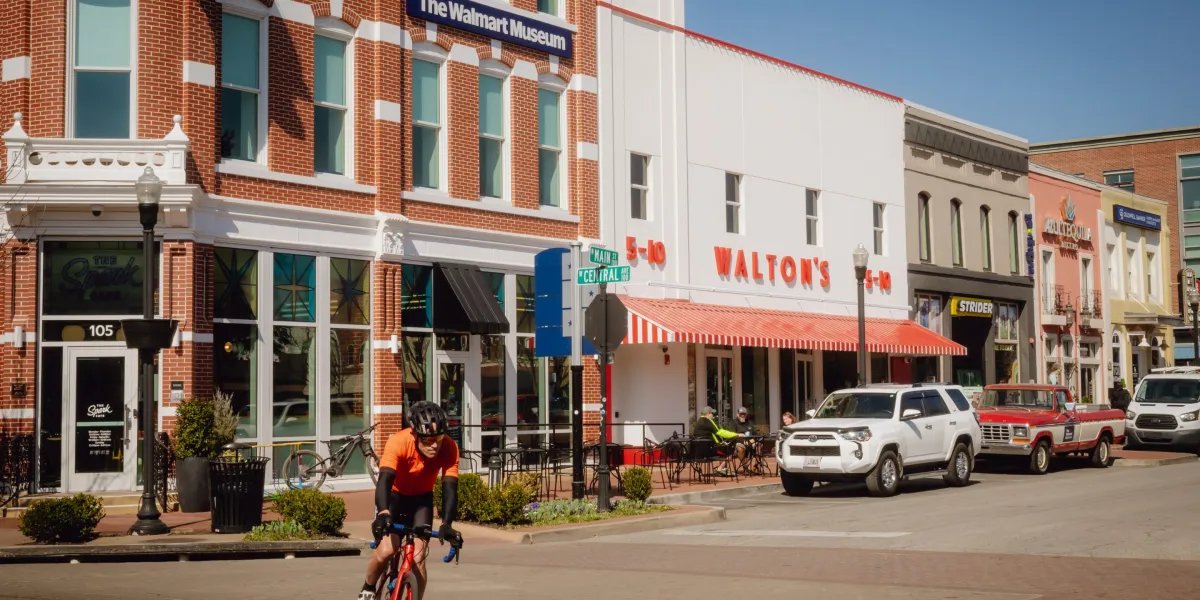
Sam Walton’s favorite ice cream, butter pecan, is always available at the Spark Café, in the quaint town square of Bentonville, Ark. Next door is Walton’s 5&10, the five-and-dime store where in 1950, “Mr. Sam,” as he was known locally, planted the seeds of Walmart, a retail empire that became the biggest company in America. That little shop is now a museum, and parked outside is a replica of Mr. Sam’s red 1979 Ford F150, the pickup truck he used to tool around town in, often with his dog Ol’ Roy.
Venture out beyond the square, and the small-town USA illusion breaks. The population of the town surrounding Walmart’s sleek new multibillion-dollar headquarters has soared from about 6,000 in the 1970s to more than 60,000 today, and it’s expected to triple in coming decades as the company attracts top tech and management talent from coastal cities.
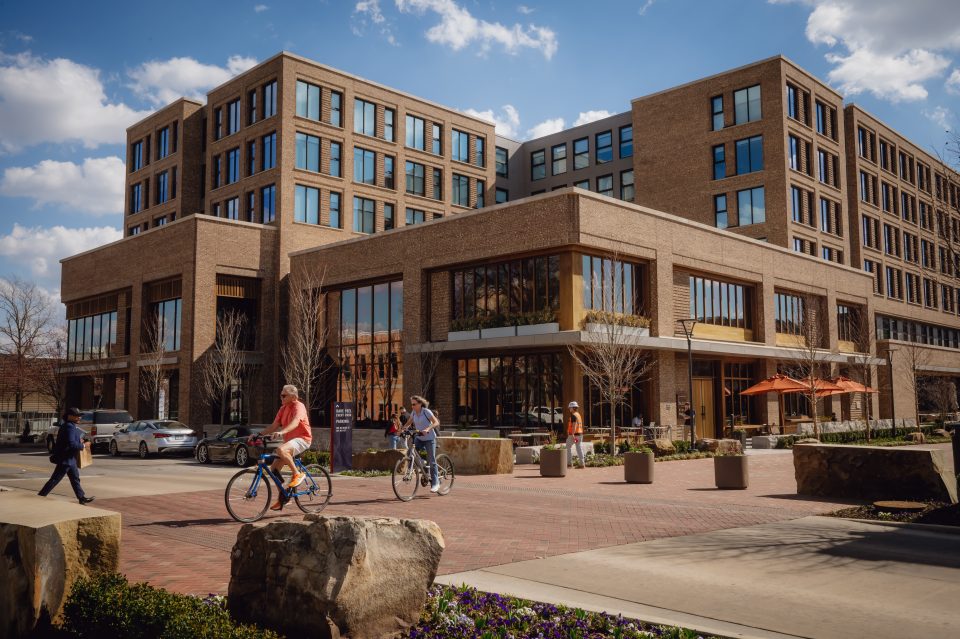
The feeling is more glossy high-design hub than Norman Rockwell painting. There’s a Soho House-like private social club and spa, boutique hotels, chef-driven restaurants, speakeasies. At the private-jet-filled municipal airport, you can drink a cappuccino and watch vintage planes take off. There are sprawling parks and playgrounds, paved walking paths, and hundreds of miles of mountain biking trails. The expanding 200,000-square-foot Crystal Bridges Museum of American Art sits on a landscaped 134-acre campus and is free to the public, as is the music and arts center The Momentary.
Much of Bentonville’s transformation has been bankrolled, directed, and shaped by the Walton family, whose approximately 44% stake in Walmart makes them one of the richest families on earth. Walmart is now worth around $1 trillion. Through their various hospitality and investment groups, and their philanthropies, Sam Walton’s children and grandchildren have helped remake the town as a kind of urban utopia in the Ozarks.
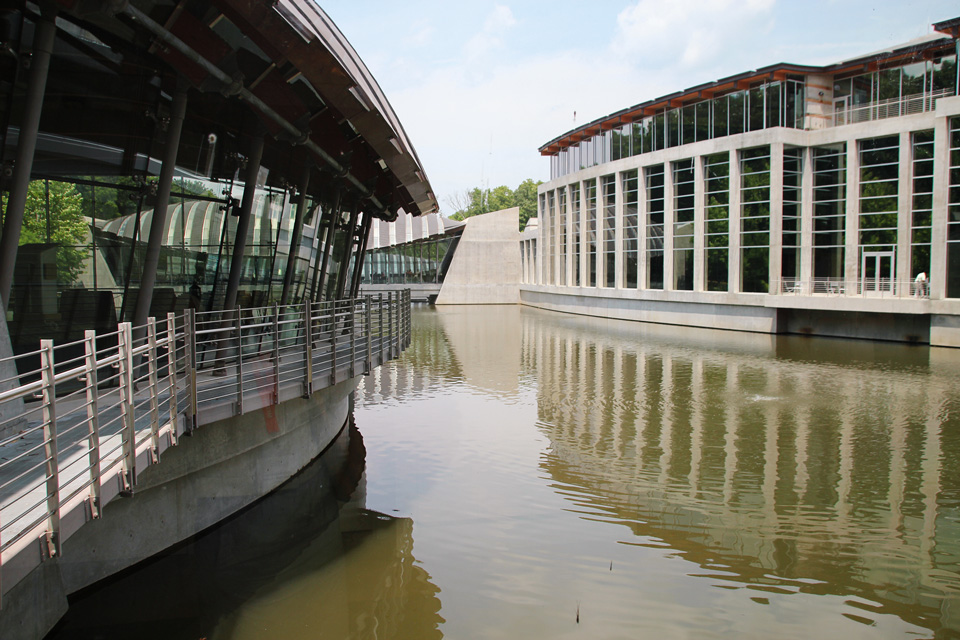
Christina Horsten—picture alliance/Getty Images
“They are like royalty in Bentonville,” said Charu Thomas, who chairs the board of Bentonville-based supply-chain tech company Ox and lived there for several years. “It’s a little bit bizarre.”
Lately, however, something has changed. As the Waltons have become more and more involved in the city’s development, some have started to express harsh skepticism about their intentions. In a region where the family seems to have a part in every aspect of life, the closing of a restaurant they own or even a generous loan to the city can cause backlash.
Simmering resentments came to a head in 2023 in the tiny nearby town of Jasper when it was revealed that two Walton grandchildren were exploring whether there would be support to pursue national park and preserve status for one of Arkansas’s most important natural icons, the Buffalo National River. Locals, fired up by rumors that such a redesignation could lead to unwelcome tourism, development, or even them being pushed off their land, packed a town hall meeting. They erupted in applause at an anti-elite country song one indignant resident had reworked: “Rich Men Not From Here.” It was very clear who the “rich men” were. A Republican state senator who spoke against the redesignation campaigned this year with flyers boasting: “Bryan King said no to the billionaires,” and won reelection in March.
Stunned by the firestorm they set off, the Waltons dropped the effort to redesignate the river. But the outcry marked a tidal shift in sentiment and exposed long-festering resentments. It underscores a split that has existed in America as long as the nation has, between rural and urban, rich and poor. That divide has grown especially raw lately, as the wealth gap widens and a populist backlash against billionaires has gathered force.
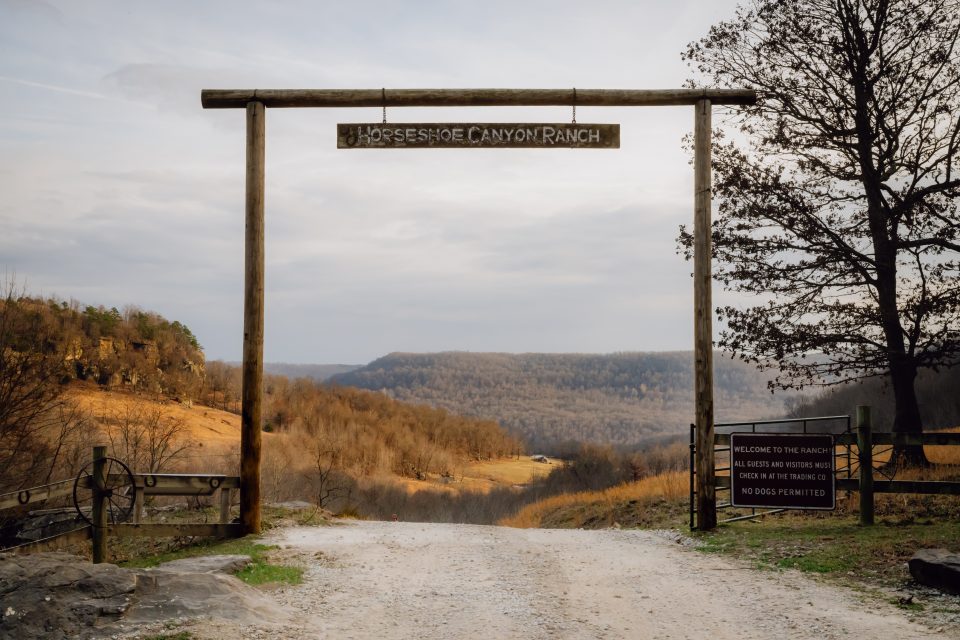
Desiree Rios for Fortune
As the ultrawealthy fund political campaigns and amass influence, the billionaire class has been under fire. In California, progressives and unions are pushing for a “wealth tax.” In New York, efforts by billionaires to defeat a democratic socialist mayoral candidate backfired spectacularly.
In Bentonville, there are no protesters marching with signs. But growing pushback against the Waltons is showing up in snarky Instagram posts and damning opinion pieces in magazines. It goes to the heart of a community that has for decades revered and identified with Sam Walton and his kin—and to some of the inherent tensions in large-scale civic philanthropy.
Few families in American history have given, invested, and loaned so much capital to a small community. And the community certainly values them: Indeed, a former governor told me he worked to reduce Arkansas’s tax rates specifically to entice some of the Waltons to move back.
$440 billion
Approximate value of the Walton family’s ownership stake in Walmart, which has a market value of about $1 trillion. The Waltons own about 44% of the Fortune 500–topping big-box retailer and e-commerce giant.
In Bentonville, the Waltons’ enormous power and influence is emerging as a kind of double-edged sword: With one check, the Waltons can—and have—transformed lives. With a change of heart or strategy, however, they can—and have—crushed dreams.
To report this story, I spoke with more than two dozen people, attended city meetings, and reviewed hundreds of email exchanges, grant agreements, and nonprofit disclosures, some obtained via Freedom of Information Act requests. While the family largely avoids the spotlight, Sam’s daughter, Alice Walton, and two of his son Jim’s children, Tom and Steuart Walton, remain active and public-facing in Arkansas. Tom and Steuart sat down with me to share their perspective. Alice Walton declined to comment.
I should note: I live here, too. I moved to Bentonville from New York in 2020, and quickly fell in love with the small-town charm; the kindness of the people; cycling on gravel roads and getting chased by local farm dogs. And much of what I like about my adopted hometown I can thank the Waltons for: I can go see Wicked at the Walton Arts Center, then listen to folk music in a dive bar. I can ride my e-bike, subsidized by a Walton-funded city grant, around town, or drive 45 minutes to hike in the wilderness.
It’s evident that, despite their generosity, at least some of the goodwill the Waltons have generated over decades has begun to erode. Some accuse the family of gentrifying the town, or treating it like a kind of feudal society. Others were reluctant to talk to a reporter about the Waltons at all. “You don’t want to bite the hand that feeds you,” one local company owner told me.
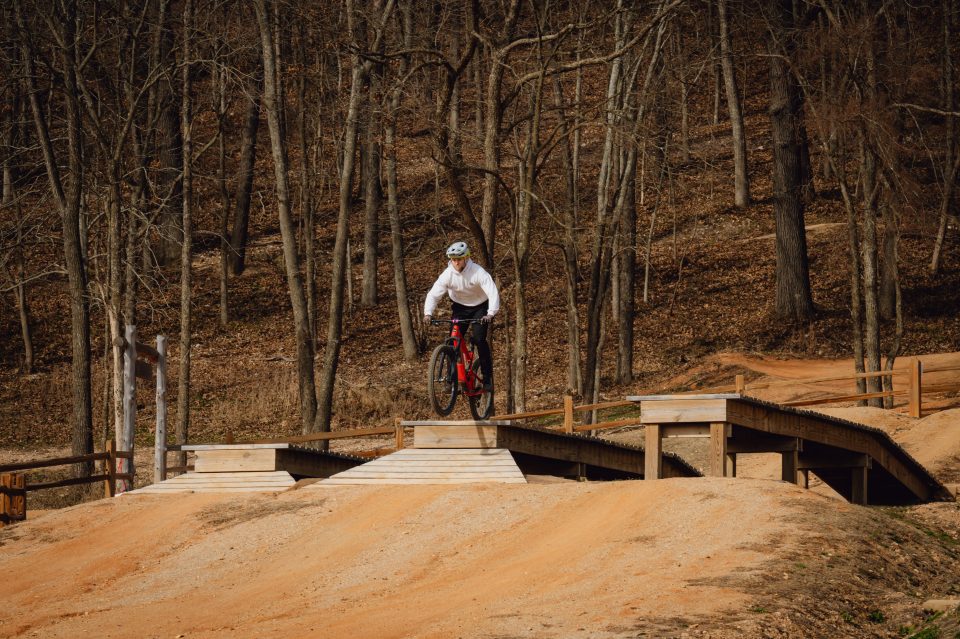
Desiree Rios for Fortune
Tom and Steuart say they are open to hearing criticism and are willing to take risks to implement their vision. Like their grandfather Sam, neither seems particularly bothered about their personal reputations. Their goal, they say, is to invest in their hometown and its practical and hardworking culture, and to make it a better place to live.
“We care,” Steuart said. “I mean, we’re trying to do the right thing. We’re not perfect, and we know that.”
As Walmart hurtles into the AI age and rebrands itself as a tech company, the legacy of the chain’s plainspoken founder is lore in this city surrounded by cattle farms and poultry houses. People still tell stories about Mr. Sam—how he was generous and kind; how even after he was a billionaire many times over, he still lived in a modest house.
This folksy caricature of the man once made big-city financiers skeptical of whether his rural Arkansas retail chain could compete with established corporations and become a global powerhouse. The way he proved them all wrong—and stayed true to his roots—has shaped how the Walton family is seen in his hometown and beyond.
Sam Walton died in 1992, and while the family no longer oversees day-to-day management of the retailer, his grandson-in-law, Greg Penner, chairs the board, and Steuart is a board member. Sam’s three surviving children and numerous grandchildren are spread out across the country, where they own the Denver Broncos, run the regional bank Arvest, and have launched investment firms.
The Waltons’ collective scale of philanthropy and investment in Bentonville puts them on par with the Carnegies, the Rockefellers, and the Vanderbilts—American dynasties who gave billions away to build the libraries, schools, museums, concert halls, universities, parks, and boulevards that have defined big-city downtowns from New York to Chicago. “The Waltons are the Medicis of this town,” said one real estate investor, who spoke on condition of anonymity because he feared that speaking about the Waltons would threaten his business.
10X
Bentonville’s population growth since the 1970s. The town had around 6,000 residents then, and has 60,000 now. It’s expected to triple in coming decades.
Unlike many high-society philanthropists, Sam’s descendants are not distant figures with their names on plaques. In Bentonville, residents spot them shopping at the farmers’ market or eating pizza at Pedaler’s Pub. Grandsons Tom and James Walton personally built some of the first mountain-biking trails in the area, and residents will spot the Waltons’ helicopter flying overhead, mountain bikes fastened to the side.
In 2004, a Fortune cover story about the Walton family observed that you would be “hard-pressed” to find any signs of their wealth in Bentonville. These days, if you throw a stone in the town, you’ll likely hit something the family had a role in creating. Sam and his wife, Helen Walton, established the Walton Family Foundation early on, and through it funded the Walton Arts Center in Fayetteville and, via another entity, the Walton College of Business at the University of Arkansas. Today, the foundation gives away half a billion dollars every year to local, educational, and environmental causes.
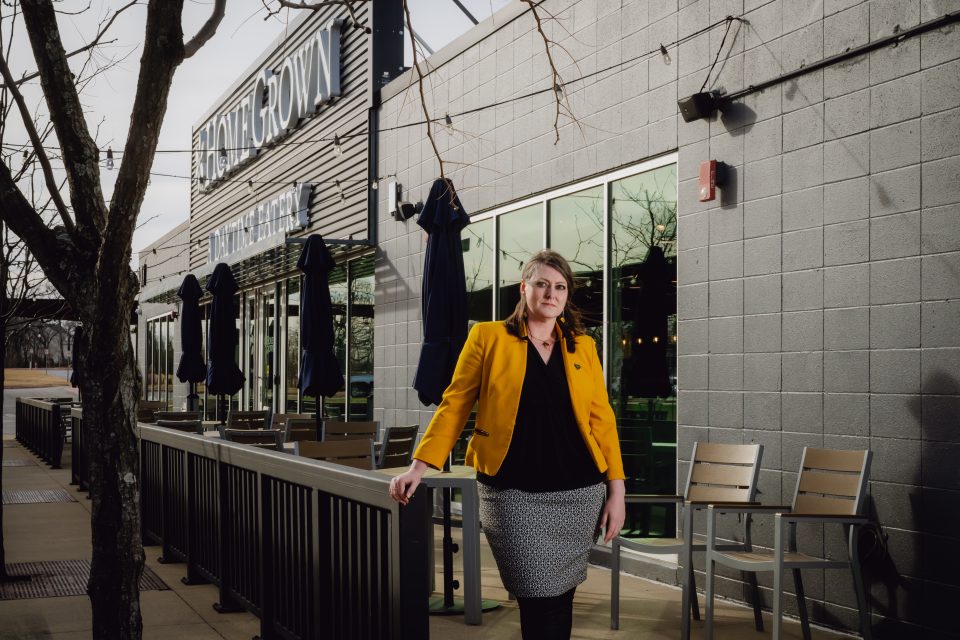
Not all the bets the Waltons have made are paying off as intended—and their high profile means that any perceived missteps or backtracking can add dents to the family’s reputation. For example: Tom and Steuart’s property management group closed a vendor-style market, paving the way for a chain brunch restaurant. Jessica Keahey, a cheesemonger who had run a beloved artisanal shop, Sweet Freedom Cheese, in that space for five years, was told she had a little over three months to leave. She ended up having to shut the store down. Customers wrote hundreds of emails and messages to express their dismay, she said: “It was heartbreaking, for sure.”
Desiree Rios for Fortune
Then there was Pressroom, a Bentonville farm-to-table restaurant owned by the Walton grandsons’ hospitality group, Ropeswing. It closed with no warning in March 2024, prompting employees to launch a GoFundMe campaign for staffers who were suddenly out of a job. “Please please do not give any Ropeswing concepts any of your money,” one of the laid-off employees, Debbie Garcia, wrote in a Facebook post. “This is absolutely horrible and not how any employee should ever be treated.”
Of course, restaurants do close. The real estate investor pointed out that such harms are sometimes unavoidable. “[The Waltons] are playing such a large game that sometimes the individuals get stepped on,” he said.
In other cases, residents have accused the Waltons of not doing enough—not giving enough. In December, it emerged that Alice Walton, via her foundation, had agreed to a $239 million loan to the city of Bentonville to update its wastewater system, as a bond to be paid back by developers. Some builders complained that the unusual bond seemed hastily approved, but the mayor’s office said it had run out of funding options to address the infrastructure needs of the growing city, and that the terms Walton’s foundation offered had been quite generous. “It was either that, or we don’t build the way that we’re building now,” said Patrick Johndrow, Bentonville’s finance director.
“[The Waltons] are like royalty in Bentonville…it’s a little bit bizarre.”
Charu Thomas, chair of the board of Ox
From early in the discussions, there were concerns about how the public would react to the loan. The executive director of Alice Walton’s foundation expressed them in an email to the mayor (released via FOIA): “[One] issue we are facing is the ‘why doesn’t Alice just pay for it’ issue that we often face with the City and the Family.”
Those fears turned out to be warranted. Shortly after the loan was announced, residents expressed misgivings on Reddit: “Given that Walmart is a huge factor in the explosive growth of this area, it would have been nice to have done this in the form of a grant,” one poster grumbled.
When I asked Tom and Steuart about recent criticism, they said they did not know specifics about market closures or Pressroom severance packages. “Do people in our organization do things we wish they wouldn’t sometimes?” Steuart asked. “Of course, probably every day. But you know, we’re doing our best, and we’re trying to find things that work and create and drive sustainable growth that, over time, leads this community and this region into a place that it wouldn’t maybe get to on its own.”
When I arrived for the interview, at the upscale Walton-owned Compton hotel, it was just the two brothers, eating breakfast sandwiches. Tom jumped up to grab me a cup of coffee. Pointing to elk heads mounted on the wall, the two jokingly bickered over who had bowhunted which.
Desiree Rios for Fortune
They described how they grew up in Bentonville: going to public school with friends who went on to be firstgeneration college students. They didn’t have TV, and went floating on the Buffalo National River many weekends. But, Tom acknowledged, “none of that is what lands…We get bucketed here or there with our identities. Our personalities get put to one side because of the extreme wealth and the association with Walmart.”
The Waltons have always had critics, but everyone I spoke with liked them, even if they disapproved of some of their organizations’ actions. “They’re good people,” said 78-yearold Max Bollinger, as he grabbed a local paper from a newsstand in nearby Kingston’s town square. He recalled how Alice Walton used to come by his father’s store, and let his daughter pet her horse. Ox’s Thomas remembered Steuart offering his personal phone number the first time they met. Garrison Gattis, who co-runs a gift shop in Jasper, said Tom seems like “a guy I would grab a beer with.”
“These guys have billions of dollars, and they can put it in their pockets and go wherever they want,” Gattis said. “But they decide to build things for the public to use.”
Jared Phillips, an associate professor at the University of Arkansas, who teaches the history of the Ozarks, said the underlying issue in Bentonville is capitalism encroaching on civic life, even if embodied by “perfectly nice people.” Corporations shouldn’t run towns, he said, because they have “very little interest in helping the people out who actually live next door.” In Bentonville, he added, “It all points back to the way that Walmart and the Walton family have decided to invest in a place,” he said. “Because it was a market decision.”
In Why Democracy Needs the Rich, author John McGinnis argues that wealth, including billionaire philanthropy, is a healthy counterbalance to government. But he has seen antagonism rise against the wealthy since the 2008 financial crisis, he said: “The rich, because of their independence, are often an obstacle to both the new right and the left. There’s a concern that the rich have just too much influence in democracy.” That sentiment, he said, has grown under the Trump administration—particularly after Elon Musk became a key advisor to Trump after donating nearly $300 million to his campaign
In deep red Arkansas—one of the most conservative states in the country—the Waltons keep a low profile with their personal politics. Family members have typically backed Republican candidates and groups in the state, though several have supported candidates and causes across the political spectrum. Alice donated to the Biden campaign in 2020, for example. And the Family Foundation has supported programs and studies focused on racial disparities.
Walton family members have wielded their influence strategically when it comes to issues that are important to them, such as charter schools and walkable cities. Tom and Steuart’s investment group, Runway, flew Bentonville Mayor Stephanie Orman on at least two trips to see traffic improvements and innovative housing development in other cities.
Like other billionaires, some of the Waltons have gravitated to states with lower taxes. Former Arkansas Gov. Asa Hutchinson, who ran against Trump in the Republican primary election in 2024, recalled Tom Walton asking him, over lunch in Austin, to consider lowering the Arkansas state income tax, to entice him and other family members to come back to their home state.
“I plotted the strategy, he provided the motivation, and over time, we did get it reduced from 7% to 4.9% while I was governor,” Hutchinson said. “And sure enough, Tom, Steuart, Alice—all of them—came back to Arkansas. That’s a good example of how lower taxes increase capital investment in the state.”
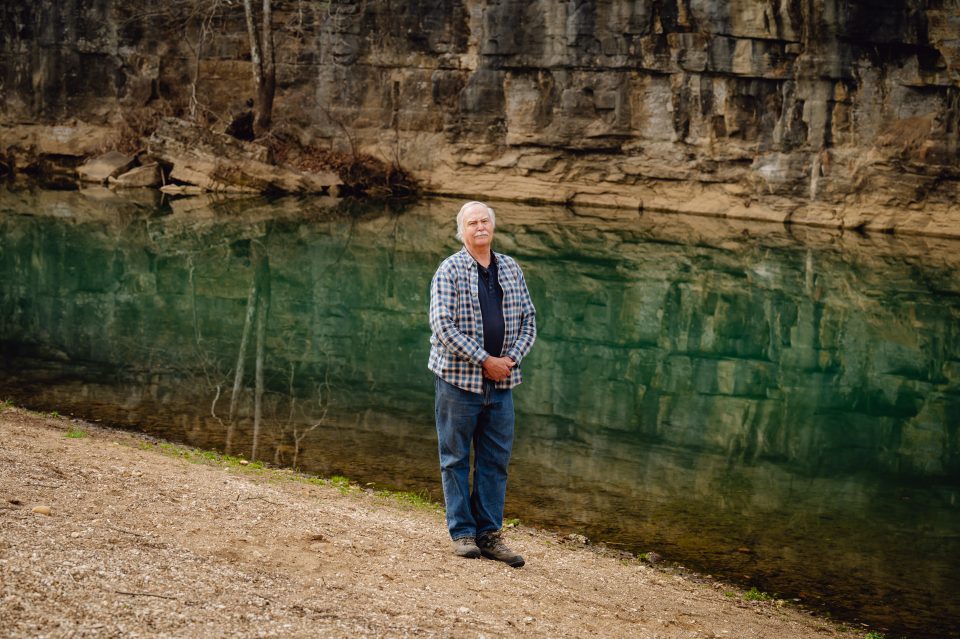
One afternoon, in Jasper, Gordon Watkins, who runs the Buffalo River Watershed Alliance, pointed to the limestone bluffs along the Buffalo National River. This landscape is the quintessential Ozarks, with rolling hills and karst topography that forms caves, sinkholes, and springs in the bedrock.
Watkins opposed the redesignation of the river as a national park and preserve—at least for now—concerned that it may draw more tourism too quickly. But in retrospect, he said, the backlash to the Waltons at that angry town hall meeting in 2023 was a misunderstanding of their motives. They were trying to help funnel sorely needed resources into one of the poorest counties in Arkansas, Watkins said: “It wasn’t necessarily the redesignation, per se. It was the way that they went about it. People felt ignored. They felt like these were rich people who were trying to pull one over on the poor folks in the county.”
Watkins and I stood in front of the sprawling bluffs of Steel Creek, a popular “drop-in” point for people who are kayaking or canoeing the river. More than 50 years ago, this same piece of property was a private horse ranch, and the National Park Service used eminent domain to force its owners out, as the agency did along the river in the 1970s. The incident left an open wound, and it has caused a deep mistrust of both the federal government and outsiders.
the Buffalo River Watershed Alliance.
Desiree Rios for Fortune
Worries about history repeating itself emerged after Tom and Steuart helped fund a survey about a potential redesignation of the Buffalo National River. Rumors began swirling and reached a fever pitch at the town hall. More than 1,100 people showed up, and another 1,000 tuned into the livestream. The Waltons were not there.
The subtext, Watkins said, was perceptions of the gentrification happening over in Bentonville: “Some people have seen the things that they’ve done around Bentonville…Building highpriced restaurants and driving small businesses out.”
When the Waltons stepped away from the redesignation idea, it was a vindication for some in the area—a demonstration of how a small rural community could stand up to big money. Others saw it as a huge loss.
The Waltons said that they had taken advice from their team to stay away from the town hall. After having connected with some of those residents since, they now regret that.
“The minute you build a personal connection with people,” Steuart noted, dogmas and assumptions tend to fall away. When you sit across from someone face-to-face, it becomes a lot easier to find common ground.
This article appears in the April/May 2026 issue of Fortune with the headline “Billionaire backlash in Walmart’s hometown.”