
The first year Rick Chorney ran his own cleaning company, he didn’t take a single day off. He was in the field by 7 a.m., home by 8 p.m., and back at his laptop until 1 in the morning—seven days a week, hauling in roughly $14 an hour subcontracting jobs across the suburbs of Vancouver. He told Fortune plainly that it broke something in him.
“I went a little crazy,” he said. “There came a day where I was just like, ‘I am done.’” What happened next changed everything: he spent four hours looking at how AI could help him “simplify the business a little bit.”
Today, Chorney is 29 years old, based in Abbotsford, British Columbia, and running Echo Janitorial Services—a company he co-founded in 2023 with his best friend Adrian (they’ve known each other since they were age 2). It’s been going well—thanks to artificial intelligence (AI).
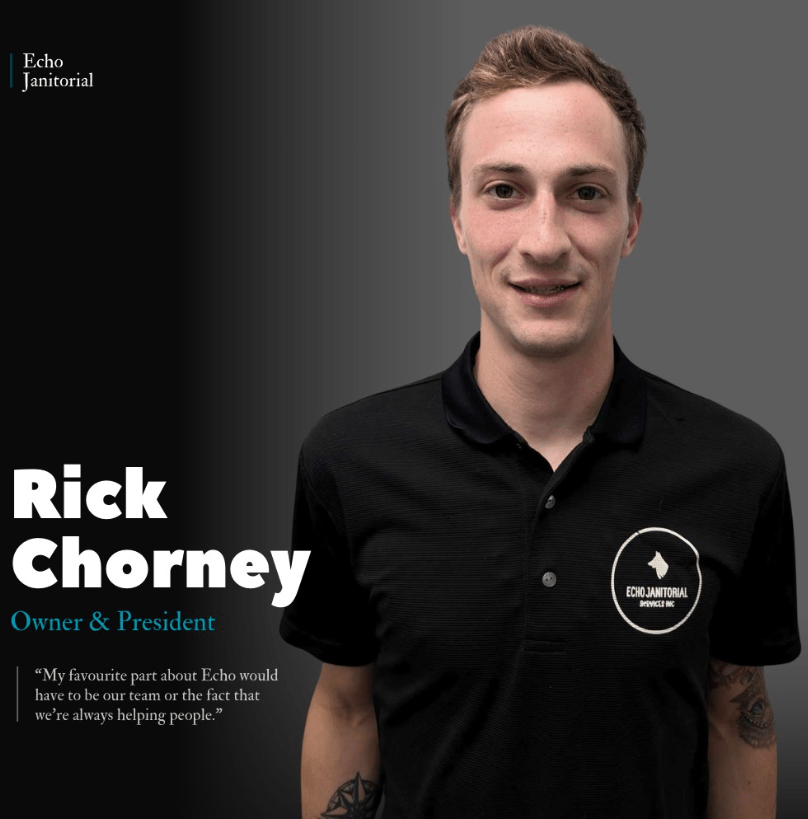
Rick Chorney
“So last year we did just under a million dollars,” he told Fortune, sharing a remarkable growth story. The year before that had been $242,000, still impressive but, as Chorney explained, not optimized for the AI entrepreneur era: “That first year I didn’t really put in a lot of AI, I was mostly focused on SEO.” Once he added AI agents to his workflow, he was able to fast-track quoting, hire more workers, and begin a flywheel. Fortune reviewed Chorney’s business records to verify his explosive growth in revenues.
“I had a meeting today, I thought this was pretty cool,” he shared. “I had Claude make me a case study on what it would cost them to pay me $1,000 a month more than they’re paying me now, versus hire their in-house cleaners and what the risks and costs of that look like.” Claude sealed the deal, he added, making an ironclad case that in-house cleaners would be a worse deal for the client.
Chorney projected that he’ll cross $1.3 million in sales this year and his business has grown to 16 cleaners on staff, two business partners, and one AI receptionist handling up to 15 phone calls an hour. Chorney said he now only works only eight hours a day, and even takes vacations.
Whether he knows it or not, Chorney is a data point in one of the more striking economic trends of the moment. Torsten Slok, chief economist at Apollo Global Management, noted on his Daily Spark blog recently that AI tools are “dramatically reducing the cost and complexity of launching a company,” leading to a surge in new business formation.
Slok explained more in a recent appearance on the Prof G Markets podcast. “People are inventing new businesses in a way that we just have not seen, literally for decades.” Far from a job killer, Slok argued, it’s helping many people become much more entrepreneurial. “The consequence of this must be that we were going to be generating a lot more jobs associated with people’s ideas now coming to life a lot faster.”
Forrest Zeisler, co-founder and CTO of Jobber—the platform powering Chorney’s AI receptionist — told Fortune that he sees Chorney as emblematic of a larger shift. “No one’s going to benefit more than the small blue-collar businesses from AI,” Zeisler told Fortune. “For them, time is literally money. They’re out and about in the field, not sitting at a computer.”
Chorney’s story maps precisely onto the phenomenon Slok is describing: a first-generation entrepreneur, without institutional resources or formal training, using AI to compress what would once have taken years of costly trial and error.
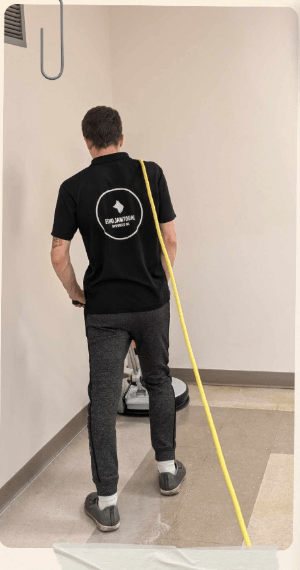
courtesy of Echo Janitorial
The Kid Who Wanted a House
Chorney grew up without much of a safety net. Adopted at 5, he relocated from Ontario to British Columbia as a child. As a teenager, he fell into substance abuse, passed through a group home, and wound up on a provincial youth agreement—a government program that covered his rent while he aged out of the child welfare system. That support was set to evaporate at 19. “It got pretty ugly and I was getting arrested a lot,” he said, explaining that he wasn’t violent, just misguided, and he’s on good terms with his parents now.
But financially, and in terms of what school was giving him, he told Fortune, he was practically in a very tight spot. “I got put into a group home and I didn’t do so well in the group home. So the ministry decided to start paying my rent for me.” He explained that the ministry’s financial support was due to end and he was facing a hard stop. “There was a deadline hanging over me.”
Chorney assessed his circumstances and didn’t see school as an option. He was in grade 11, doing grade 10 courses, when he started applying for jobs, including the day he walked into a Greyhound office. His future boss was mortified, heavily encouraging him not to drop out, “but he offered me the job anyways.”
Within two years, Chorney had rented the three-bedroom townhouse he’d been working toward.
From there, he spent years doing door-to-door sales for Vivint, a smart home company, moving to a new city every four months, knocking on strangers’ doors every day. Vivint was, in its own way, a graduate program. The company sent him to Tony Robbins seminars, introduced him to the leadership canon—Simon Sinek, Brian Tracy, Leaders Eat Last—and gave him a visceral education in resilience and sales. His first cleaning business, started around COVID, didn’t scale the way he’d hoped. When he moved to Abbotsford in 2022, he was ready to try again.
Using AI to remove overhead
Echo Janitorial Services launched in 2023, and the early months were brutal. Echo was subcontracting, which meant long hours for thin margins. Chorney was cleaning construction sites and offices across the Lower Mainland, managing client relationships, handling every email, phone call, and quote himself.
“There came a day,” he said, “where I was just done.”
That day, instead of opening another quote or answering another email, he sat down and spent four hours researching how AI tools could take work off his hands. He automated his customer intake form so that new inquiries flowed directly into his job management platform. He installed an AI receptionist. He set up automatic acknowledgment messages for new clients. It took half a day.

Rick Chorney
“I realized I don’t have to be doing all the things I’m doing,” he said. It gave him the time to take his first vacation ever.
Within weeks, he and a business partner drove across Canada to Montreal, caught a UFC event, and slowly worked their way back home across the country. They were gone a month and a half.
It’s a pattern that Zeisler said he has watched play out across thousands of Jobber customers. “None of them got into business for business,” he said. “They were great at a trade—they had a craft, they had a skill, and they wanted to bring that skill to the world. But they end up spending so much of their time on all the administrative burdens and overhead. That’s just a tax on the productivity of these businesses. That’s not the stuff that pays the bills.”
There’s only one downside that Chorney admitted to: “as far as how much information these companies have about each of us individually, maybe that’s a little scary. But unfortunately, we live in a world where that can’t be prevented.” The companies that have enabled these AI tools have “all of our information … available in some database somewhere,” but this is just the price of doing business.
“I have to give AI my information because it makes doing business easier.”
The Stack That Changed Everything
Chorney started with ChatGPT—using it the way most first-time adopters do, to polish emails and format documents. His early motivation was almost embarrassingly practical. “I can make as many typos, I can swear, I can be as direct as I want to be—and it’ll polish it all up and make it what I want,” he said.
But the tool he talks about with wide-eyed appreciation is Claude, which he describes less as a productivity app and more as a business advisor. “It just starts asking me questions until it’s got this perfect response,” he said. For instance, he uses it to navigate BC labor law when HR situations get complicated, to build client-facing case studies on the fly, and to document company operations for what he eventually hopes will become a national franchise.
Chorney reeled off his army of AI colleagues, marveling at how much time it’s freed up for him to scale up his business. “One deals with all your social media. One deals with all your customer inquiries. It will respond to emails, answer text messages and phone calls.” Another will go through your bank statements and help you make cashflow projections.
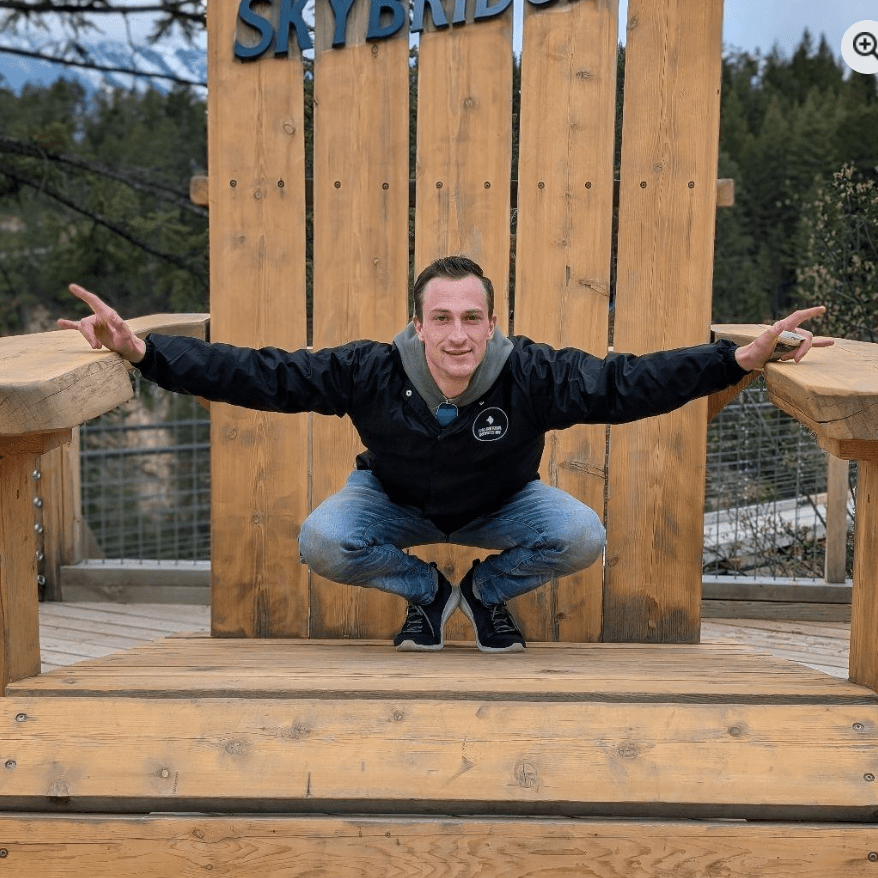
courtesy of Rick Chorney
The high-school dropout CEO said he’s a widespread adopter of AI tools, noting that he uses Perplexity for research, Grok for content creation, and is currently piloting Synthesia—an AI video platform that generates training videos using a digital likeness of Chorney himself, walking new employees through cleaning procedures without him entering a room.
For phone traffic, Jobber’s AI receptionist fields up to 15 calls per hour—fielding job inquiries, vendor pitches, the occasional invitation to a training seminar in Costa Rica—and escalates only what matters. A human doing the same job would cost roughly $4,000 a month in wages and payroll taxes. Chorney pays $99. For email, a tool called Fixer AI pre-sorts his inbox each morning into four buckets—action required, drafted reply, likely spam, confirmed spam—and texts him a daily briefing. He claimed that he spends 20 minutes a day on email.
Jobber’s numbers suggest that Chorney’s approach is the right one. “Our best adopters—the people who are using all our AI products—they’re growing 90% faster than those who aren’t,” Zeisler said. “They go all in. They use all the tools, and they see the impact on the bottom line.”
This is precisely what Slok had in mind when he described AI as a growth engine for new business formation. “We can go together on ChatGPT or Gemini or Claude and we can ask for a business plan and it can spit it out literally in seconds,” Slok said. “And we can even use the large language models as part of our business.” The consequence, he argued, won’t just be more companies—it’ll be more jobs. “The number of new businesses is at the highest level in decades because people have become much more entrepreneurial. The consequence of this must be that we are going to generate a lot more jobs associated with people’s ideas now coming to life a lot faster.”
Thinking Bigger
With his days reclaimed—down from 19-hour slogs to a manageable eight hours—Chorney is channeling freed-up time into expansion. He calls it Project Echo: a comprehensive operational playbook, built with AI assistance, that he believes will serve as the blueprint for a national franchise. Toronto, Edmonton, and Calgary are the first targets. A friend has raised his hand for Arizona and Delaware.
“Claude is going to bring me to be a national franchise brand within the next two years,” he said.
Zeisler predicted that many more entrepreneurs like Chorney will have similar ambitions going forward. “The next generation of millionaires—there are going to be a lot of blue-collar millionaires,” he said. The businesses that are starting now don’t have decades of legacy systems and approaches ingrained in them, he added. “Those businesses are AI-first from day one.”

Chorney said he has grown as an entrepreneur to the point that he’s investing in the people around him. His first employee, Kai—they met at a pool party, hired the day after Chorney let someone else go—worked with such singular commitment that Chorney and Adrian gave him a 10% equity stake and the company co-signed his car loan. Employees who want leadership roles at Echo must read at least one book from a curated list of 15 to 20 titles. Leaders Eat Last sits at the top.
When the conversation turned to education—specifically, whether a system that didn’t work for him could ever evolve—Chorney didn’t hesitate. “Schools are so focused on repetitive behavior instead of preparing you for the world,” he said. “Kids aren’t learning how compound interest works. They’re learning how to be at school at 8:30 so that when they’re adults, they’ll get up, go to work, and pay taxes.”
Slok framed the same dynamic in macroeconomic terms: AI doesn’t just help established businesses run more efficiently—it lowers the barriers to entry so dramatically that people who previously couldn’t afford to start a business, professionally or financially, now can. In that sense, Chorney isn’t an outlier. He’s a leading indicator.
“If you can learn what AI is capable of,” Chorney said, “and use it how it was intended to be used … it’s the way of the world now. It’s not really an option.”