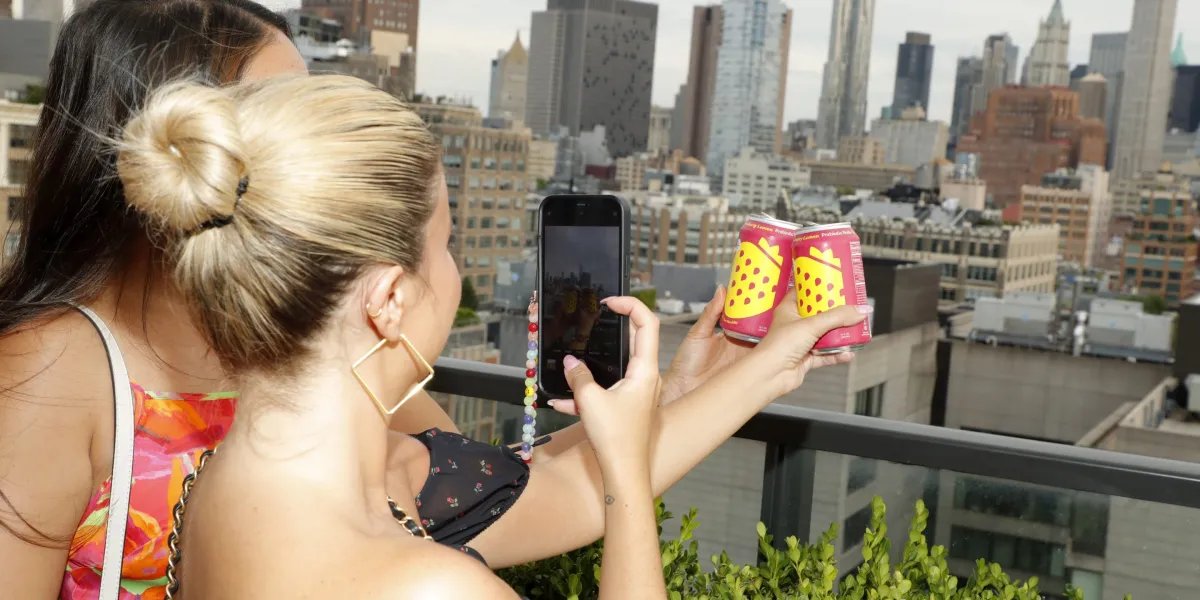

Allison Ellsworth admits she’s not the typical founder story. She was, by her own telling, “a solid C student,” a partier, someone who got arrested during spring break and later found herself driving across the country working in oil and gas research. Even now, after selling Poppi for $2 billion, she doesn’t try to polish herself into the platonic image of a consumer founder.
“I do TikToks in Crocs and socks with my hair in a ponytail,” she told Fortune. “I’m just a normal person.”
Pepsi, the soda and snack giant which bought her company, has taken notice. Since she sold her soda company, “they’ve been really big on ‘let Poppi be Poppi,’” Ellsworth said, adding that “I think they’re actually trying to learn from us.”
The 38-year-old built Poppi into one of the fastest-growing beverage brands in the country by leaning into a kind of marketing that was nimble, quick to respond and often very unserious. In fact, it got into a typical Tiktok-esque scandal by giving out vending machines of Poppi to influencers. But behind that was a deliberate strategy, Ellsworth recalled, one that Pepsi is now trying to understand and copy.
One of the clearest examples is pretty simple: Poppi will just send free cans to anyone who asks—no campaign, no targeting strategy, just an invitation. Now, she gets around 500 wedding invites a month alone. “Graduations, birthdays, all these things. We’re just shipping it out,” Ellsworth said.
It sounds inefficient, but she argued it’s like Red Bull’s field marketing, where attractive young women gave out free cans of the energy drink during work events. The only the difference is that the demand is inbound. “No one needs to be out there with a backpack anymore. People are coming to you.”
That philosophy of being less controlling and more reacting extends to how she broadly thinks about the way marketing works. Ellsworth is often framed as a TikTok-native founder, and it’s true that Poppi’s rise was closely tied to social media and her bright colored packaging. She was the face of the brand early on, posting constantly and building familiarity with customers who felt like they knew her.
But she’s skeptical of the idea that TikTok alone can build a company at scale. Linear TV can influence a classic, older group with money to spend.
What that means in practice is abandoning the usual safe, interchangeable ads that dominate commercial breaks. When Poppi started running TV spots, Ellsworth said the goal was to stand out as much as possible, doing the opposite of what’s expected.
For example, she insisted that her bright pink-and-purple cans show up in commercials during NFL games, despite her drink being clearly marketed towards mostly college women. But Poppi broke the monotony of typical football ads of “dudes sitting around eating nachos or drinking beer.”
“And then a bright pink can comes on the screen,” Ellsworth said. “It just breaks through because it’s so different.”
The same thinking carried into larger bets. Her recent Super Bowl ad featured Charli XCX and Rachel Sennott just droning the word “vibes” to each other, which garnered a big reaction, albeit mixed. But Ellsworth decided on the ad quickly and without the kind of prolonged testing that larger companies rely on.
“We were just like, it’s a vibe,” Ellsworth said, adding that Pepsi initially was cautious but ended up trusting Poppi.
The ad ended up tripling brand awareness, according to Ellsworth. More importantly, it reinforced her belief that innovation, and not attention, is the real constraint in modern marketing.
If you think TV is dead, you’re probably “just doing it the wrong way,” she said.
That view runs counter to how many startups are currently thinking about growth. In her conversations with founders, Ellsworth said she hears the same frustrations repeated: that funding is harder to get, that the market is saturated, that the odds are worse than they used to be.
Her response is a little harsh: “It’s probably because your business isn’t good.”
More often, she sees founders trying to replicate what has already worked rather than creating something new. For decades, nobody dared to innovate on the soda category. Now, after Poppi’s success, “there’s like 100-plus prebiotic sodas.” Most, she believes, are too late. “You kind of missed the wave.”
The lesson, in her view, is not to copy a playbook but to build one. “Be the trendsetter. Don’t follow the trends.”