Will 2026 be the year that TikTok shopping becomes a major force for Western consumers?
TikTok’s parent company ByteDance has already seen big success with in-stream shopping in the Chinese version of the app (Douyin), with the platform generating around $500 billion in GMV in 2025. And while TikTok users haven’t been as enthusiastic about spending money in-stream, TikTok shopping is steadily rising, and generating more interest.
For context, TikTok, across all regions outside of mainland China, reportedly generated around $US130 billion GMV in 2025, which would represent a 100% jump in total in-app sales year-over-year.
So interest is rising, though a big element that will help to drive further take-up is security, and ensuring that shoppers are having a good experience in the app. That’s likely a critical part of Douyin’s shopping success, because stricter regulations in China offer more protection for consumers, ensuring more trust in the process.
And now, TikTok is making this a bigger focus.
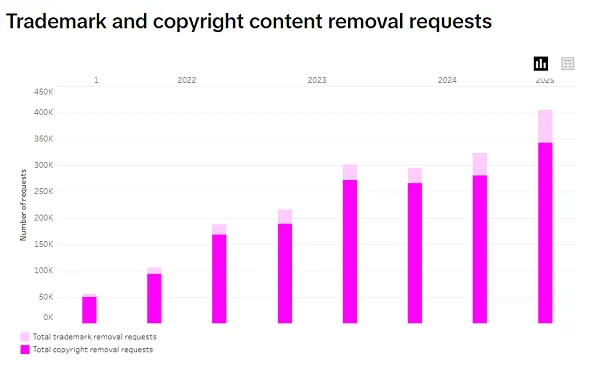
Just before Christmas, TikTok launched an expanded Intellectual Property Removal Request report, which provides an overview of its cumulative actions to protect intellectual property rights across the app.
And TikTok is taking a lot more action on this front over time.
As per the report:
“Between January and June 2025, TikTok removed 30x more products and content through proactive measures (before the product or content appeared on the platform) than was removed after being reported by others or detected after posting. Our original determination of an IPR violation was deemed correct in more than 89% of cases.”

As you can see in this chart, TikTok has been steadily ramping up its action to enforce IP rights over time, which will help to ensure that shoppers are getting genuine products, and not cheap knock-offs, in the app.
In addition to this, TikTok’s proactive detection measures have also led to the removal of over 143 million videos due to violations of its Community Guidelines Rules “by trading, marketing, or providing access to counterfeit goods,” while it also removed more than 530k videos and live-streams posted by TikTok Shop creators due to IPR infringement.
As per TikTok:
“We care deeply about championing originality. We continually strengthen how we protect intellectual property rights so that our community can have authentic experiences on TikTok. For example, this year we’ve reduced the steps needed to report an IP infringement on TikTok Shop. Users who have joined the Intellectual Property Protection Centre (IPPC) can now get to the relevant page in a single click (down from seven).”
The more that TikTok can enforce and police potential misuse, the better it can ensure that people have a good shopping experience in the app, which will then, ideally, spark a behavioural shift towards shopping in-stream.
Which is still a major change that no platform has been able to successfully overcome. Western shoppers, for whatever reason, are more inclined to keep their shopping activity confined to trusted shopping apps, like Amazon or eBay, while social apps are purely for connection and entertainment.
Almost every social app has tried to incorporate eCommerce, but habitual behaviors, and again, that lack of trust in the products listed, has seemingly restrained potential success on this front.
Which probably makes sense. According to the Global Anti-Scam Alliance, around 23% of adults globally have had money stolen by scammers online, while Facebook is regularly identified as a key vector for scam activity.
It makes sense, then, that consumers would be hesitant to trust social platforms with their money, and why Western consumers would be hesitant to take up offers in-stream.
Maybe, through enhanced protection measures, TikTok can conquer this.