Since President Trump cut deals with nine of the country’s top law firms early in his second term to head off potentially crippling executive orders, the firms have largely continued to generate vast profits and the White House has appeared to leave them alone.
But in recent days, behind closed doors, the uneasy truce between the firms and the White House has erupted into a pitched legal battle.
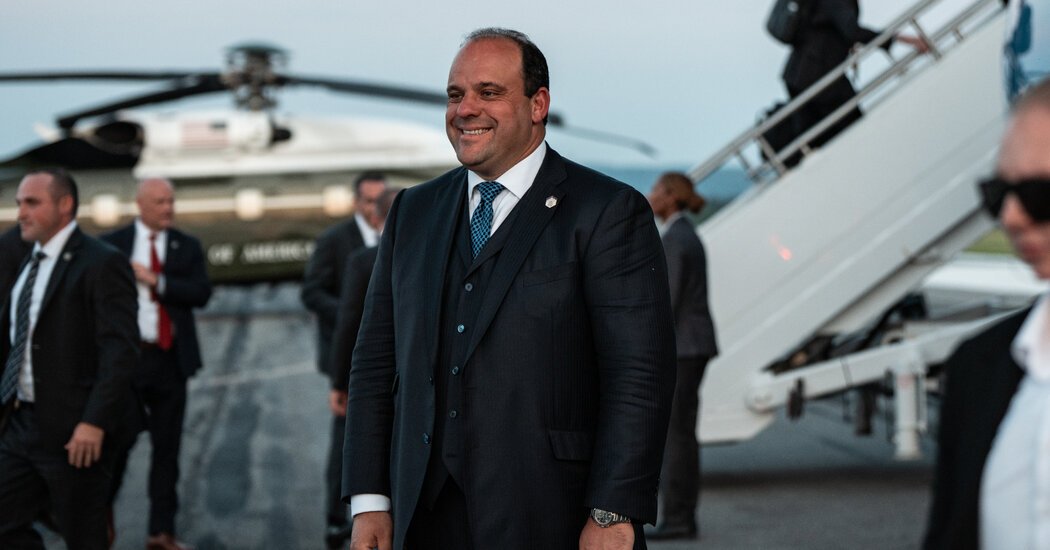
At the center of that fight is Mr. Trump’s personal lawyer, Boris Epshteyn, and questions about the role he played in striking the deals.
The White House has sought to shield his communications about the deals. Now, the Justice Department has taken the highly aggressive move of issuing subpoenas to the firms and is demanding that their leaders sit for depositions before Justice Department lawyers, according to a copy of one of the subpoenas reviewed by The New York Times and four people familiar with the matter.
The demands have caught the firms flat-footed, unsure of how to respond. Faced with that uncertainty, they have hired high-powered Washington lawyers to represent them as they gear up to face the Justice Department.
The tensions have arisen from a lawsuit brought in June by the American Bar Association that sought to stop Mr. Trump’s campaign to punish law firms. As part of that suit, the association has asked a federal judge to order the White House to hand over internal documents and communications between Mr. Epshteyn, Mr. Trump’s ally, Stephen K. Bannon, and the White House about the agreements.
Mr. Epshteyn serves as Mr. Trump’s personal lawyer but negotiated the deals with the firms. Mr. Bannon has publicly praised the deals, saying that he hoped Mr. Trump’s executive orders against the law firms would destroy them.
In response to the demands the Trump administration hand over documents, the Justice Department has asked a federal judge to quash the requests. So far, the judge has not ruled. But in the meantime, the Justice Department subpoenaed the nine law firms that cut deals with Mr. Trump — and four that have fought the executive orders in court — for the same information the association was seeking from the administration.
The government’s subpoenas marked an escalation of the battle surrounding the lawsuit, and aim to put the law firms’ leaders under the same kind of pressure that the bar association’s subpoena put on Mr. Epshteyn, according to people familiar with the matter.
The subpoenas ask for all communications the firms had with Mr. Epshteyn and “any communications concerning the implementation, enforcement or monitoring of” agreements between the firms and the White House, according to the subpoena reviewed by Times.
The department is also seeking to depose a top leader from each firm in the coming weeks, according to two of the people familiar with the matter. Among those leaders is Brad Karp, the former chairman of Paul Weiss, who reached a deal with Mr. Trump in March 2025 before eight other firms followed suit and agreed to pledge nearly a billion dollars in free legal work to causes supported by Mr. Trump.
The four firms that have fought the executive orders in court have considered asking a judge to quash the subpoenas, according to two of the people. But the Justice Department’s demands have placed the firms that made deals with Mr. Trump in a particularly difficult position, leaving them uncertain how to respond, according to the two people. Some firms fear that if they oppose the administration they will be hit with an executive order, one of the people said.
Some lawyers who are representing the firms have speculated that the Justice Department made the demands in the hopes of forcing the firms to pressure the American Bar Association to drop its lawsuit, according to three of the people. Others have questioned why the department would take a step that could provide greater insight into Mr. Epshteyn’s role in the administration, as there have been concerns at the White House about him.
During the presidential transition before Mr. Trump’s second term, allegations arose that Mr. Epshteyn asked prospective political appointees to pay him a retainer to promote their prospects at Mr. Trump’s Florida estate, Mar-a-Lago. The allegations prompted Mr. Trump to ask his incoming White House counsel to conduct a review into the claims.
According to “Regime Change,” a new book by the Times reporters Maggie Haberman and Jonathan Swan, the incoming White House counsel, David Warrington, delivered a scathing warning about Mr. Epshteyn.
“Epshteyn’s conduct must be stopped and his employment and proximity to President Trump should be terminated,” Mr. Warrington wrote. “Otherwise, his conduct will likely lead to, at best a scandal involving the incoming Trump administration, and at worst could lead to criminal indictments.”
In late November 2024, the Trump transition team released a statement saying that it had conducted a broad review, as was standard, of the campaign’s consulting agreements and that it included Mr. Epshteyn, among others.
The transition group added: “We are now moving ahead together as a team to help President Trump Make America Great Again.”
Mr. Epshteyn denied the assertions against him at the time, stating, “These fake claims are false and defamatory and will not distract us from Making America Great Again.”
Shortly after Mr. Trump was sworn in, the White House issued executive orders against law firms that essentially would have made it impossible for the firms to represent their clients. In response, Mr. Epshteyn, who is not a government employee, led negotiations with the firms that were willing to capitulate to the administration.
The deals were harshly criticized in the legal world, as the firms were seen as giving in to Mr. Trump to head off executive orders that were seen as illegal and undemocratic.
Along with questioning Mr. Karp, the Justice Department, according to documents reviewed by The Times, wants to depose some legal profession titans who lead the most profitable firms in the country and cut deals with the White House, including Jon Ballis of Kirkland & Ellis and Richard Trobman of Latham & Watkins.
Other leaders who the Justice Department wants to depose are: Patrick Quinn of the firm formerly known as Cadwalader; Jeremy London of Skadden, Arps, Slate, Meagher & Flom; Thomas Cerabino of Willkie Farr & Gallagher; Scott Edelman of Milbank; Adam Hakki of Allen Overy Shearman Sterling; Alden Millard of Simpson Thacher & Bartlett.
And the department wants to question the leaders of the four firms that have fought the administration, including: William Malley of Perkins Coie; Ishan Bhabha of Jenner & Block; Anjan Sahni of WilmerHale; and Kalpana Srinivasan of Susman Godfrey.