Paragraph 8
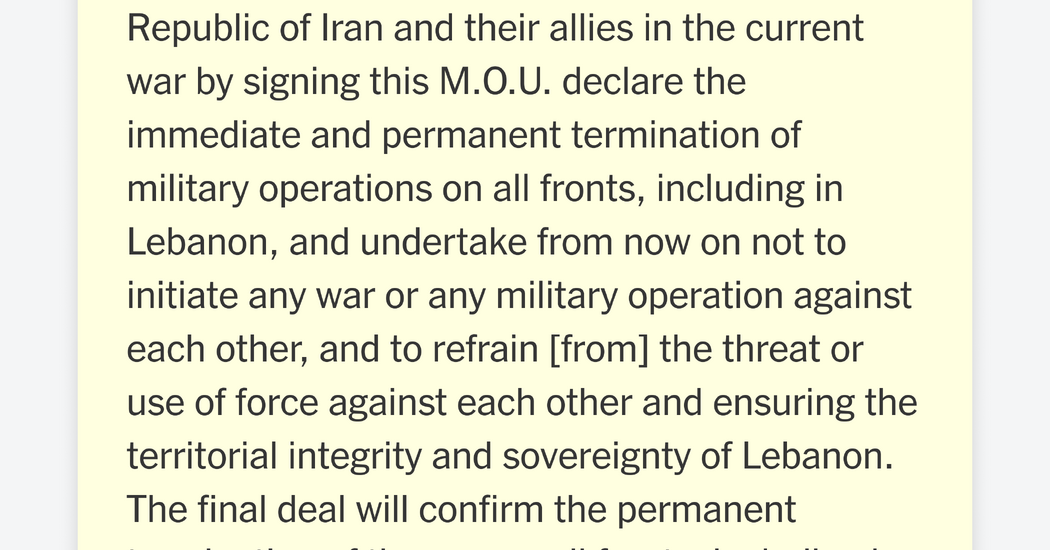
The Islamic Republic of Iran reaffirms that it shall not procure or develop nuclear weapons. The United States of America and the Islamic Republic of Iran have agreed to resolve the disposition of stockpiled, enriched material pursuant to a mechanism that will be mutually agreed upon in accordance with the schedule mentioned in Paragraph 7, with the minimum methodology to be down-blending on site under the supervision of the I.A.E.A. The two parties also agreed to discuss the issue of enrichment and other mutually agreed matters related to the Islamic Republic of Iran’s nuclear needs, based on the statutory framework being agreed upon in the final deal. The final deal will confirm the provisions of this paragraph. The United States of America and the Islamic Republic of Iran acknowledge the critical importance of the nuclear issues above mentioned, and express their intention to immediately address these issues in the negotiation in order to achieve mutual agreement on them.
This is the only paragraph of the agreement that deals directly with the nuclear program — the core cause of the war — and thus is perhaps the most important. As expected, it is vague on all the main points of contention. As the word “reaffirms” suggests, there is nothing new about Iran’s promise never to seek or buy a nuclear weapon. It first made that commitment in 1970, when it ratified the Nuclear Non-Proliferation Treaty, and it repeated it in the opening paragraphs of the 2015 agreement with the Obama administration.)
The paragraph requires Iran to “down-blend” — essentially dilute — the approximately 11 tons of enriched nuclear material in its possession, including 970 pounds that are enriched to 60 percent, just short of bomb grade. But it does not require Iran to give up that material and ship it out of the country. Iran has resisted calls to surrender the stockpile. But it did exactly that in 2015, when under the Obama deal it sent about 97 percent of Iran’s stockpile at the time to Russia.
That leaves a huge number of issues to be resolved in the next negotiation: whether Iran will keep the nuclear material, whether it will have to shutter all of its major nuclear facilities, whether it will be allowed to continue enriching new material, or suspend that work for something between 13 and 20 years. In a phone interview on Sunday, Mr. Trump said that Iran would also agree to a new, far stronger inspection regime. But that too needs to be negotiated. The reference to “Iran’s nuclear needs” refers to Iran’s insistence on retaining nuclear capability for peaceful, energy-generating needs — a way of keeping its nuclear potential alive.
— David E. Sanger
Paragraph 9
Pending the final deal, the United States of America and the Islamic Republic of Iran agree to maintain the status quo. The Islamic Republic of Iran will maintain the current status quo of its nuclear program, and the United States of America will not impose any new sanctions, and will not deploy additional forces in the region.
This clause is an important way to establish a clear base line for negotiations. It limits the most obvious ways the United States and Iran could continue jockeying for advantage in an effort to pressure the other side to make additional concessions. For Iran, maintaining the “status quo” of its nuclear program amounts to leaving its bombed nuclear facilities in ruins and its uranium entombed beneath the rubble of air strikes.
— Michael Crowley