A year ago, U.S. strikes against Iran would have had analysts running for the hills. In 2026, they’re barely raising an eyebrow.
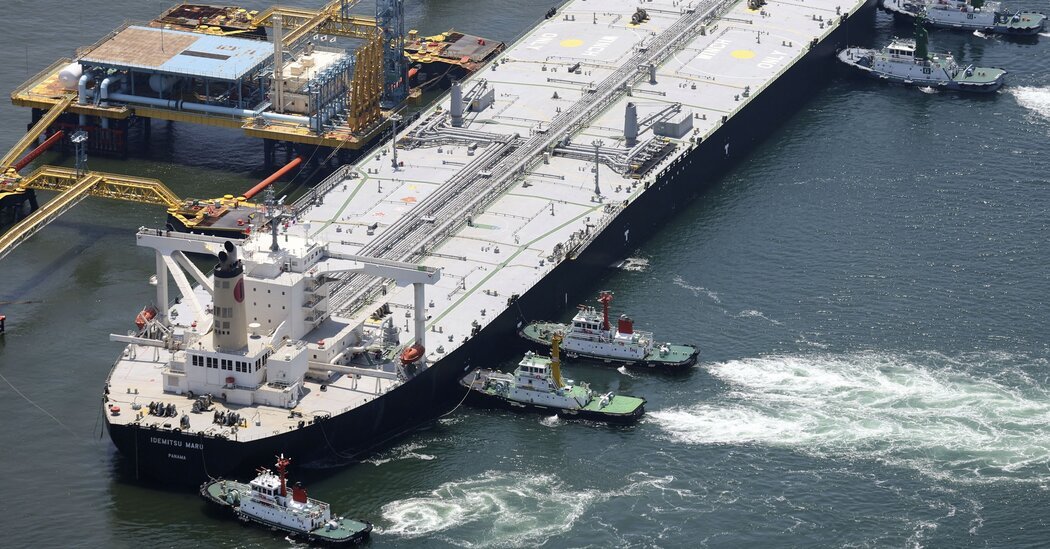
On Monday, the U.S. military carried out action near the Strait of Hormuz, claiming self-defense rather than signaling an end to the ceasefire. In response, NBC News reported Iran’s Revolutionary Guard vowed today to “respond decisively to any violation of the ceasefire.”
Despite the potential knock to negotiations, economists remained relatively sanguine this morning. ”The market looks minded to continue pricing de-escalation in the Middle East – notwithstanding some occasional surgical strikes from the U.S.,” wrote ING’s Chris Turner.
“Net net, optimism is still elevated that an agreement can be made to end the war,” chimed Deutsche Bank’s Jim Reid to clients this morning. “We have been here before, of course, but it has felt for some time that the move towards peace has been three steps forward and one or two back … my view for a while has been that such a prolonged truce and ceasefire would not have held if the U.S. genuinely wanted to continue strikes, unless there was absolutely no alternative.
“Last night’s targeted action is clearly a warning shot that the ceasefire is fragile though, so we will have to see what the next few days of negotiations bring.”
ONE BIG THING
CEO says labor market’s missing ingredient is work ethic
There’s a disconnect in the labor market right now, according to Arvind Jain, ex-Google engineer and Rubrik co-founder: students say they can’t find a job, but employers can’t find the talent they need.
In fact, Jain said his $7.2 billion AI startup, Glean, is receiving thousands of job applications every day. And the No.1 thing that separates the handful who hear back is not a degree, a skill set, or even an impressive résumé—but a strong work ethic.
“I have a firm belief that hard work solves all the problems,” Jain tells Fortune’s Orianna Rosa Royle. The yardstick for me is that when I work in a group, I want to be known as the person who gives [it] the most.
“If you work hard, you always have lots of choices. Every company wants to work with you.”
CAPEX
What headwinds?
Elsie Peng at Goldman Sachs released her mid-year capex update early this morning, and it’s good news for investors bullish on AI infrastructure spending. Peng writes that Goldman—as well as a handful of its peers—expects solid capex growth through the rest of the year, bolstered by AI spending and tax incentives.
Looking specifically at AI, investment in equipment and structures is expected to remain strong for the rest of the year as companies press ahead with infrastructure builds, wrote Peng. Additionally, later this year, AI-related software and R&D spending should become more visible as enterprise adoption is expected to increase.
The headwind for the outlook in general at the moment is global oil prices and how quickly they may or may not normalize. Peng suggests this concern doesn’t apply to capex to the same degree, writing: “Historically, higher oil prices tended to boost energy-sector capital spending, but this relationship has weakened considerably in recent years as producers have prioritized capital discipline over production growth, and high-frequency data through May show little change in drilling and production activity so far.
“Outside the energy sector, equipment investment has tended to decline only modestly in response to higher energy costs, with the pullback concentrated mainly in the transportation sector.”
MORE FROM FORTUNE
CHART OF THE DAY
Changing jobs isn’t the payoff it once was
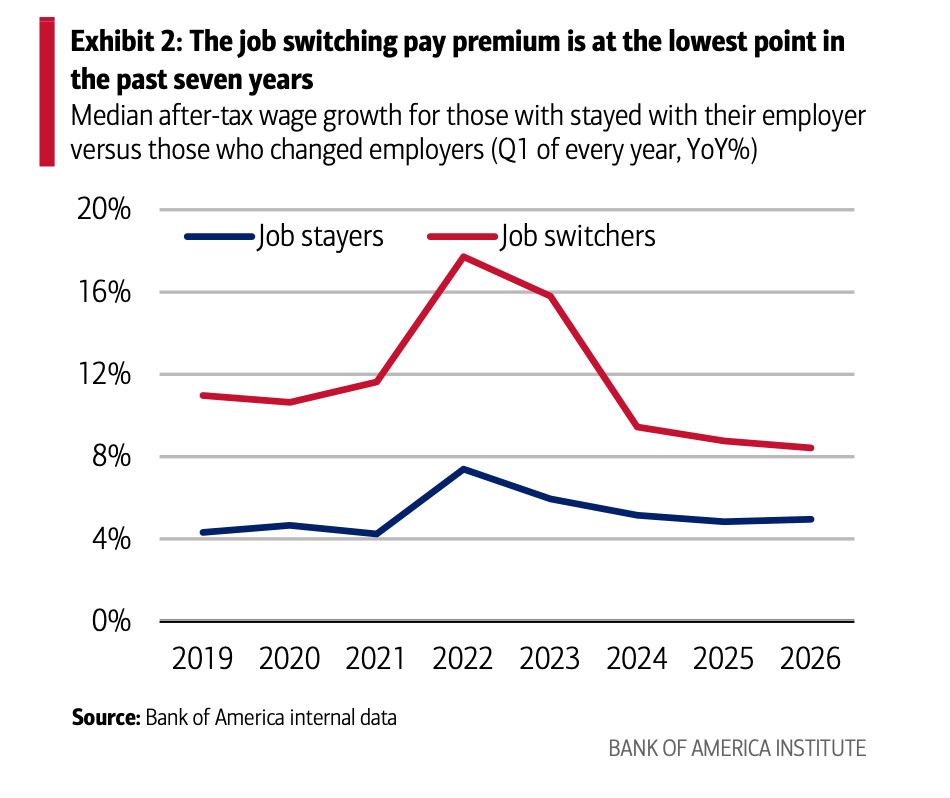
It still pays to job hop, according to the Bank of America Institute’s Joe Wadford. In a new note, Wadford writes that it still pays to switch companies for those earlier in their careers.
Millennials who switched employers saw their after-tax wages grow twice as fast as those who stayed, while Gen Z employees saw earnings growth increase fourfold. However, this rate has slowed in the past four years alongside a broader market slowdown.
The economist added: “If the labor market continues to recover, we might see some increase in the pay premium for switching jobs, especially given the premium is currently lower than it was pre-pandemic. But given the recent slowdown in certain portions of the labor market and potential disruptions from AI, some people may be wary of switching jobs.”
NUMBER OF THE DAY
$2 trillion
The 30-year Treasury note reached its highest yield in almost 19 years last week at 5.2%, points out the Committee for a Responsible Federal Budget.
If interest rates remain that high across the yield curve, then debt would increase an additional $2 trillion over a decade, reaching 125% of Gross Domestic Product (GDP) by 2036, according to the committee.
Likewise, interest costs would grow from 3.2% of GDP (equal to $970 billion) in 2025 to 5.3% of GDP ($2.5 trillion) by 2036, consuming 30% of government revenues as a result.
“Lawmakers must work both to bring down interest rates and to prevent high rates from crowding out other priorities or sparking a fiscal crisis,” the committee wrote. “The best way to accomplish these goals is through deficit reduction, which can help the Federal Reserve lower rates by reducing near-term inflationary pressures, put downward pressure on long-term rates by reducing economic crowd-out, and reduce the debt burden on which the government must pay interest.
“With debt approaching record levels, there is little time to lose.”
THE FRONT PAGES TODAY
ONE MORE THING
Why waste a good chart?
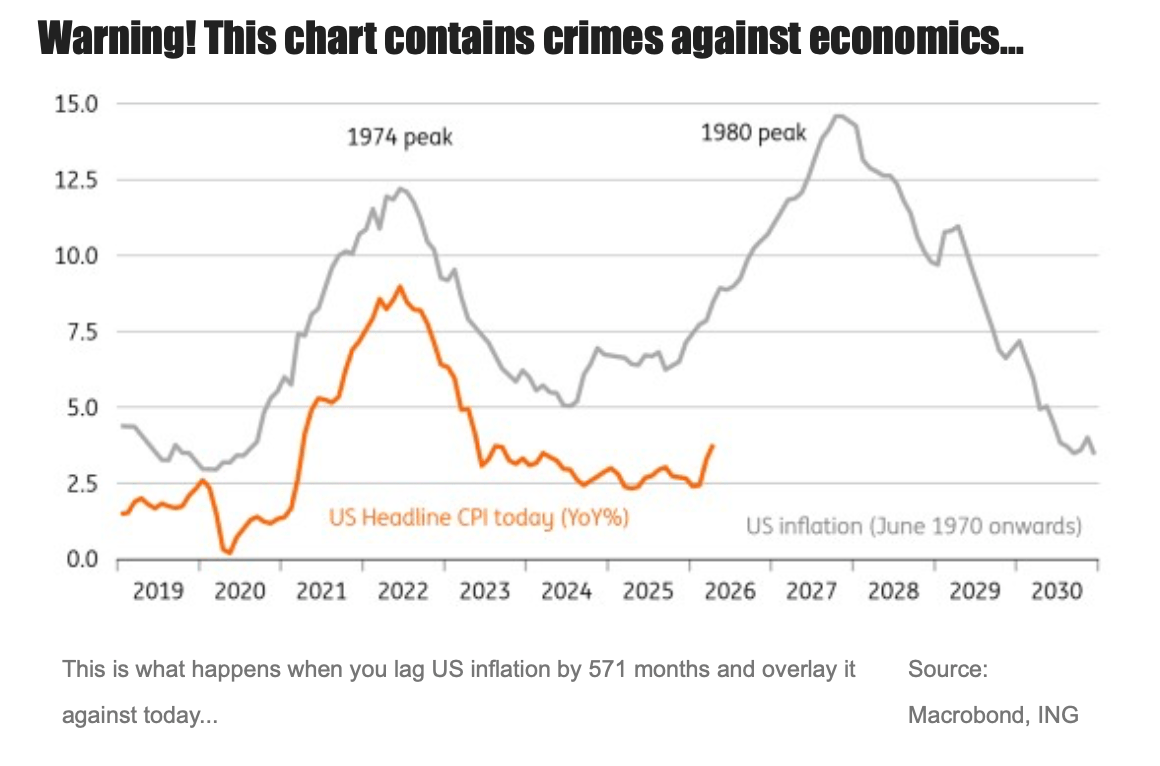
ING’s James Smith knows he has committed a tongue-in-cheek “crime against economics” with the above graph, addressing the inevitable comparisons between today’s outlook and the outcome of the 1970s inflation spike.
The similarities are striking, concedes Smith, but it doesn’t take long for the analogy to break down: “First, the shock itself. Even at today’s US$110 per barrel, oil prices in real terms are well below late-70s levels – particularly if you’re adjusting for OECD prices over the past 50 years.”
Secondly: “The West just isn’t as hungry for oil as it was back then,” notes Smith. “Per‑capita consumption is down by a third in the U.S. and over half in the U.K., and energy intensity has fallen with it. Electricity generation, meanwhile, has become a bigger slice of energy usage.”
There’s also the fact that central banks and policymakers will be keen to remember the lesson of half a century ago, notes the economist, and the fact that AI-driven productivity may meaningfully dampen inflation data.
“Historical parallels are neat and often irresistible,” Smith adds. “But no period is a perfect match. And today, despite the aesthetic similarities, it just isn’t the 1970s. Still, why let that get in the way of a good chart?”