The authorities in Crimea, the Ukrainian peninsula controlled by Russia, declared a state of emergency on Friday after weeks of intense air attacks by Ukraine, including a wave of drone strikes overnight that appears to have been one of the largest since the war began.
The Russian Defense Ministry said on Friday that its air defenses had intercepted 660 Ukrainian drones overnight. Crimea and about a dozen other regions were targeted, according to the ministry, which said nothing about damage or casualties. Later on Friday, the ministry said 46 additional Ukrainian drones had been destroyed that morning.
Advances in Ukrainian drone and missile production have enabled Kyiv to launch bigger attacks, farther away from the front, that can more easily overwhelm Russia’s air defenses. Over the past several months, Ukraine has carried out increasingly heavy air attacks on Crimea and parts of Russia, puncturing the peace that Russian civilians had largely enjoyed during the four-year-old war.
The assaults have sharply eroded President Vladimir V. Putin’s ability to isolate Russian society from the impacts of the war. In Kyiv, they have reinforced a growing sense of confidence that it could force Mr. Putin to the negotiating table, even as Russia continues to hammer Ukraine with missiles and drones, exploiting its air defense shortage.
Last week, Ukraine carried out its largest drone strike on the Moscow region since the war began, which forced the suspension of flights at the capital’s four international airports, severely damaged a major oil refinery, injured at least 17 people and killed an 8-year-old girl. Russia’s defense ministry said it had downed 992 drones across the country in that attack, the largest number in a single assault and a significant increase from previous onslaughts.
Ukraine’s assaults on Crimea, meant to isolate the strategic Black Sea peninsula, have rattled everyday life there to an extent unseen since Russia illegally annexed the region in 2014. Gas stations in Crimea have run out of fuel, with local officials banning sales last Sunday. Summer camps have been canceled and children have been evacuated. Rolling power outages have crippled the territory, disrupting water supplies that rely on electric pumps.
Many Russians who had planned to spend their summer vacations in Crimea, a favorite holiday destination, changed their plans. Bookings in Crimea for July and August fell by over 30 percent compared to a year ago, and by 43 percent in Sevastopol, Crimea’s largest city, according to the Russian business daily Kommersant.
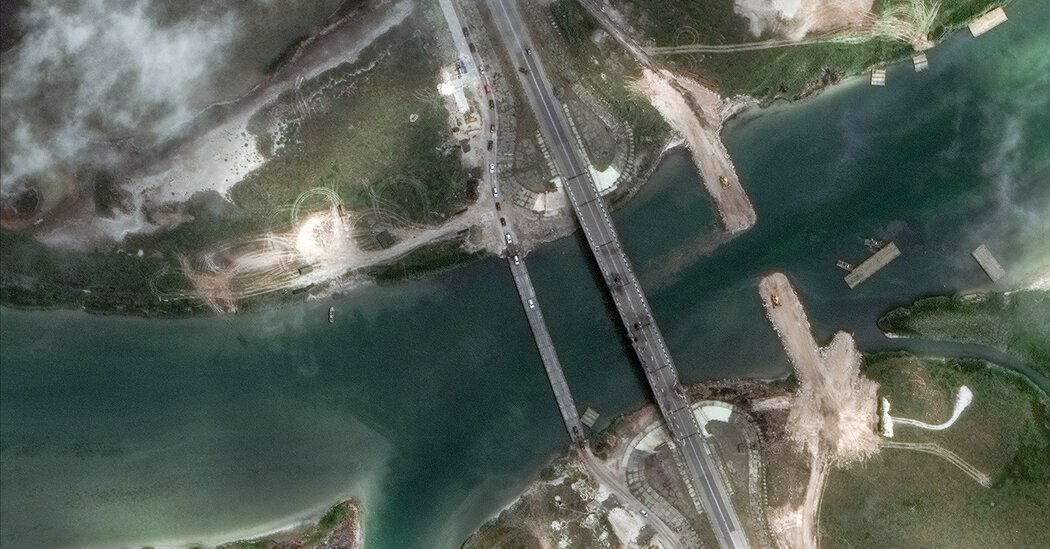
Tourists who had already arrived in Crimea were leaving. On Friday, thousands of cars were lined up on the Crimean side of the bridge linking it to the Russian mainland, with none on the other side waiting to enter, officials said.
Sergei Aksyonov, the Russian-appointed leader of Crimea, announced the state of emergency in a video statement released on Friday, saying it was meant to “streamline financial, monetary, credit and contractual relations.” Later in the day, he sought to reassure Crimeans that the state of emergency would not entail “any restrictions on citizens” such as curfew.
Mikhail Razvozhayev, the head of Sevastopol, which is a separate administrative region, issued a similar statement.
Legally, the state of emergency gives local officials additional powers, including the authority to coordinate civilian evacuations and to fast-track emergency spending by forgoing public tenders. The regional state of emergency that was declared in Crimea is one notch away from the federal state of emergency that would allow an even more robust response.
Mr. Putin has described the largely bloodless seizure of Crimea as one of the key achievements of his rule, saying that Crimea was as crucial for Russia’s identity as the Temple Mount is for Jews.
Thee Russian president has kept a low profile since the Ukrainian attacks intensified. In a vague comment earlier this week, he dismissed the devastating drone strikes as Ukraine’s attempt to “rattle” Russian society.
A growing dissatisfaction with the perceived helplessness of the Kremlin in the face of Ukrainian attacks has sent Mr. Putin’s approval ratings falling, even according to Russian state-affiliated pollsters. A survey by the pollster FOM, published on Friday, found the Russian leader’s approval hitting its lowest level since the 2022 invasion of Ukraine.
Even as its drone arsenal has become much more effective, Ukraine is still vastly outmatched by Russia in ballistic missiles, the biggest source of military pressure on Ukraine. Such missiles, which have underpinned Moscow’s most devastating air attacks, carry much larger explosive payloads than drones, and their speed makes them hard to intercept.
Russia’s barrages of ballistic missiles have repeatedly overwhelmed Ukraine’s air defenses, and they ravaged the country’s energy grid during the brutally cold winter. Conscious of the disadvantage, Ukrainian officials have said in recent weeks that the country is pushing hard to develop ballistic missiles domestically.
Separately on Friday, Ukraine and Russia held a prisoner swap, involving a total of 320 soldiers. The exchange was held in Belarus, near a point where the three countries meet, according to the Russian and Ukrainian commissioners for human rights.