U.S. stocks closed lower Monday as investors faced a challenging combination of higher Treasury yields and sharply higher crude oil prices.
The 10-year yield moved back above 5.00%, rising 4.7 basis points to 5.008%. In commodities, crude oil futures surged $4.46, or 4.4%, to $105.85.
Higher yields increase the discount rate applied to future corporate earnings, which can weigh especially heavily on growth and technology shares. Higher oil prices also raise concerns about inflation and increased costs for businesses and consumers.
The declines come ahead of tomorrow’s Federal Reserve rate decision, where the Fed is expected to raise rates by 25 basis points.
U.S. stock indices closed lower:
- Dow Industrial Average fell 328.05 points, or 0.63%, to 52,098.20
- S&P 500 fell 34.23 points, or 0.45%, to 7,585.74
- Nasdaq Composite fell 204.84 points, or 0.78%, to 25,981.57
- Russell 2000 fell 21.95 points, or 0.76%, to 2,870.29
- Nasdaq 100 fell 189.32 points, or 0.65%, to 28,937.84
The Treasury yield curve shifted higher across the board:
- 2-year: 4.6776%, up 4.4 basis points
- 5-year: 4.8404%, up 5.2 basis points
- 10-year: 5.0081%, up 4.7 basis points
- 30-year: 5.3695%, up 4.2 basis points
S&P 500 technical view
The S&P 500 closed at 7,585.74, just above the lower boundary of an important swing area at 7,573.60.
That area has attracted buyers on numerous occasions going back to late May. Buyers are once again leaning against the support, but they will need to prove they can take back more control.
The first upside requirement would be a move back above 7,617.37. Above that, the upper portion of the swing area near 7,619.97 would become the next hurdle.
Conversely, a sustained break below 7,573.60 would increase the bearish bias and put the rising 100-day moving average at 7,506.89 in play as the next major downside target.
So although the index held support into the close, the burden remains on buyers to show that the latest defense can lead to a meaningful rebound.
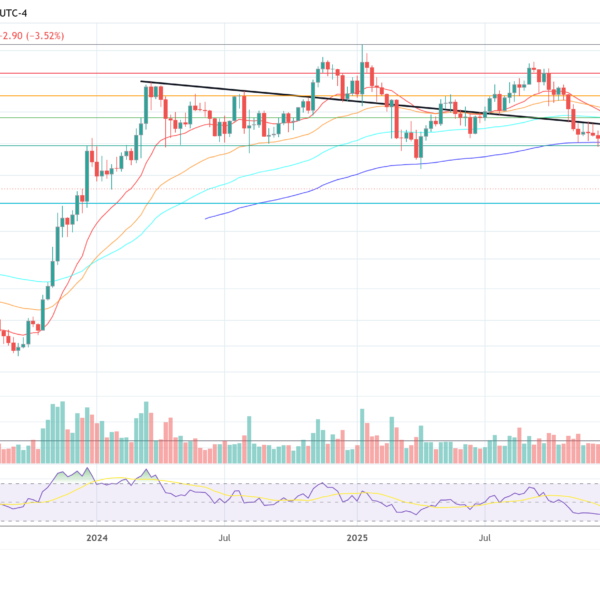
Nasdaq Composite technical view
The Nasdaq Composite closed at 25,981.57, slightly below its 100-day moving average at 25,983.27 but above swing support near 25,910.82.
That leaves the index caught between two closely watched technical levels.
Buyers would like to see the price move back above the 100-day moving average and stay above it. Doing so would provide some short-term relief and give buyers a stronger base from which to rebuild.
If the index breaks and remains below 25,910.82, however, the sellers would take greater control. The next significant downside target would be near 25,529.88.
Tomorrow’s price action will be important. A rebound above the 100-day moving average would favor buyers. A break below the swing support would confirm a more bearish technical shift.
Individual winners and losers
Energy shares were among the beneficiaries of the surge in crude oil:
- Occidental Petroleum rose 2.82%
- Chevron gained 2.64%
- Shell advanced 2.59%
- Exxon Mobil increased 2.57%
Ciena gained 4.59%, Qualcomm rose 4.30%, and BAE Systems advanced 3.77%.
On the downside, cryptocurrency-related shares came under significant pressure:
- Coinbase plunged 10.10%
- Strategy fell 5.36%
- Grayscale Bitcoin Trust declined 3.65%
- Robinhood fell 3.39%
Shake Shack dropped 8.25%, Chipotle declined 5.94%, and Dollar Tree fell 5.35%.
Trading lesson
Technical support is an area—not a guarantee.
Both the S&P and Nasdaq closed near levels where buyers have previously entered. That gives buyers a low-risk area to lean against, but they still need upside confirmation.
For the S&P, that confirmation begins with a move back above 7,617.37. For the Nasdaq, it begins with a sustained move above its 100-day moving average.
Until those levels are reclaimed, buyers may be defending support, but they have not taken back control.