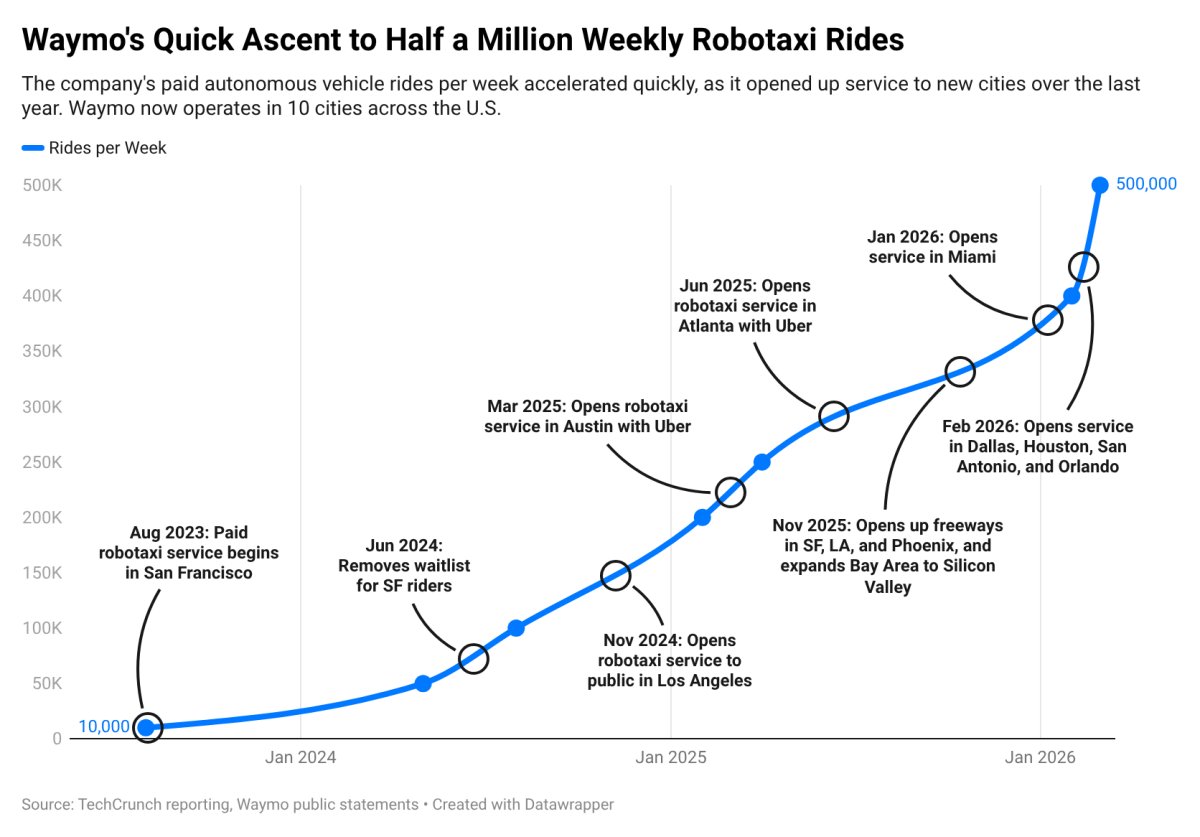
Waymo is now providing 500,000 paid robotaxi rides every week across 10 U.S. cities, the company shared in a post on X this week. The eye-popping figure is reflective of the Alphabet-owned company’s accelerated commercial expansion. But it’s Waymo’s rate of growth in ridership and markets that offers a more compelling story.
In less than two years, the company’s average weekly paid robotaxi trips have grown tenfold, from 50,000 per week in May 2024 to 500,000 per week today. Over that same two-year timespan, Waymo has expanded within its initial markets of Phoenix, San Francisco, and Los Angeles — and beyond them to Austin, Atlanta, Miami, Dallas, Houston, San Antonio, and Orlando. Those seven cities in the Sun Belt were all added in just the past year.
Waymo’s robotaxi fleet has also grown, although the company has guarded those numbers and rarely provides updates. Data provided in December 2025 to the National Highway Traffic Safety Administration (NHTSA) shows the company had 3,067 robotaxis equipped with its 5th generation self-driving system. The company still uses that “over 3,000” fleet number today. That could soon change with the introduction of its 6th generation self-driving system, which will debut on the Zeekr minivan, known as Ojai, and the Hyundai Ioniq 5.
The rather steady 3,000-fleet figure, combined with growth in weekly paid rides, suggests that Waymo is squeezing more out of each robotaxi. That utilization figure is particularly important because empty Waymo vehicles roaming San Francisco or elsewhere don’t make money and increase congestion.
That growth does come with challenges. Waymo has received more scrutiny in recent months from the public and regulators. For instance, NHTSA and the National Transportation Safety Board are investigating the illegal behavior of Waymo robotaxis around school buses. Meanwhile, San Francisco city officials have raised concerns about how the company handles stuck robotaxis, including Waymo’s occasional use of police and firefighters to clear its vehicles.
Waymo’s ridership numbers are still a sliver of Uber’s human-driven ride-hailing business. Uber completed some 13.5 billion trips in 2025, a figure that includes completed ride-hailing and delivery trips, according to securities filings. The closest pure ride-hail number was shared during Uber’s August 2024 earning call when the company said it completed more than 1 million mobility trips per hour.
In other words, Waymo is not nipping at Uber’s tires just yet.
Techcrunch event
San Francisco, CA
|
October 13-15, 2026
Still, with each month, the company’s lead in robotaxi rides grows wider.
A number of companies are vying for a slice of that robotaxi pie, although many have yet to offer a fully autonomous ride-hailing service that charges a fee. There are some Chinese robotaxi companies, including Pony.ai and WeRide, that charge for robotaxi rides, but none operate in the United States.
Tesla began operating a paid robotaxi service in Austin in January, and while CEO Elon Musk has said the company is near a fully autonomous ride-hailing service in California, it lacks any of the required permits to do so. Other companies, including Avride, Hyundai-owned Motional, and Zoox, are all pushing toward paid robotaxi services in various markets by the end of the year.
They all have some catching up to do.