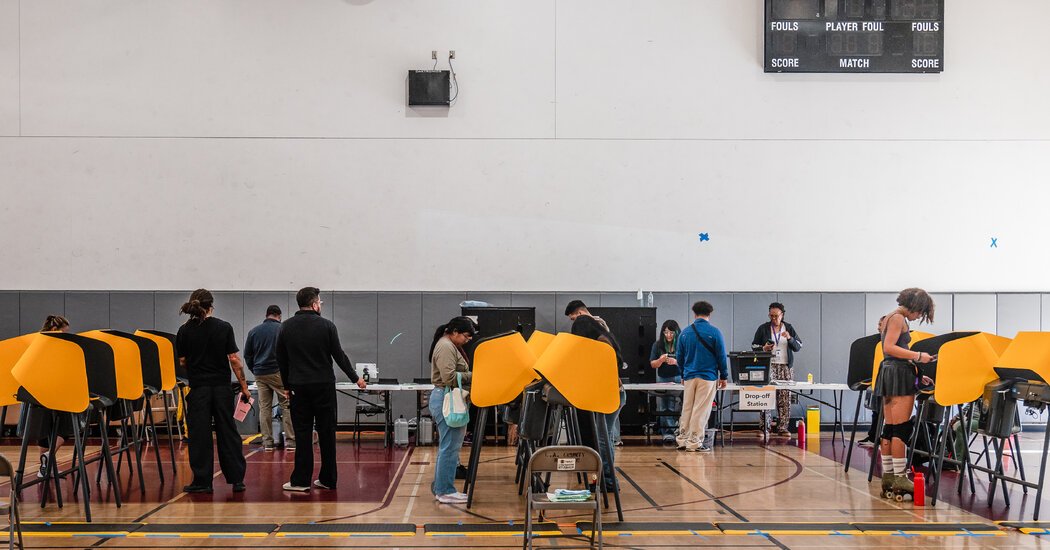
It has been two days since Californians cast their primary election votes, but the state’s marquee races are still unsettled: Who will be on the November ballot to become governor of the nation’s most populous state? Who will advance to challenge Mayor Karen Bass of Los Angeles?
Under California’s primary system, the top two candidates, regardless of party, advance to the general election.
With ballots still being counted, it remains to be seen whether voters in the races for governor and mayor will be choosing between two Democrats or between a Democrat and a Republican.
Here’s what to know:
It is still too soon to say who will be on the November ballot for governor.
The former Fox News host Steve Hilton, a Republican, is currently in the lead for one of two runoff spots for governor, with about 27 percent of the votes that have been counted.
However, millions of votes have not yet been counted, and it is possible that Xavier Becerra, a Democrat and a former cabinet member in the Biden administration, could surpass Mr. Hilton’s vote tally. As of Thursday afternoon, he was close behind Mr. Hilton with about 26 percent of the votes that had been counted.
Tom Steyer, a Democratic billionaire pitching himself as a progressive, could also catch up as more votes are tallied.
California’s solid Republican minority was expected to have coalesced around Mr. Hilton, who was backed by President Trump. The field of Democrats was crowded and, according to many voters, uninspiring, which was expected to result in a divided Democratic vote. The results so far have borne out those predictions.
Nithya Raman could still catch up to Spencer Pratt in the Los Angeles mayor’s race.
In the race to lead the nation’s second most populous city, the reality TV star Spencer Pratt, a Republican, jumped to an early lead to challenge Mayor Karen Bass. He has garnered about 30 percent of the votes counted so far. (Ms. Bass, with about 35 percent of the votes, has enough to move on, according to The Associated Press, but not enough to avoid a runoff.)
But Nithya Raman, a progressive City Council member running to the mayor’s left, is not out of the running. On Thursday, Mr. Pratt’s lead over her narrowed as election officials reported the tallies from ballots cast by mail and on Election Day. (As of Thursday afternoon she had about 23 percent of the vote.) If that trend continues as the hundreds of thousands of remaining ballots are counted, she could overtake Mr. Pratt.
It may be days before close races are called.
California relies heavily on mail ballots, which require a lot of labor to certify and tabulate, slowing the vote count process. That delay may have been compounded this election by unsure voters, some of whom waited until the last moment to submit their ballots.
Some counties, including Los Angeles, update their vote counts daily, whereas others release numbers less frequently. In Sacramento County, figures are updated only on Tuesdays and Fridays.
A statewide estimate of the number of remaining uncounted ballots is expected on Thursday, providing a data point for those making calls on where each race stands.
President Trump has questioned the integrity of California’s elections, but Democrats have pushed back.
President Trump has claimed, without evidence, that the lengthy counting process in California meant Democrats were stealing the election — an assertion aligned with years of false claims by the president and his allies that American elections are rife with fraud.
“There’s BIG cheating by the Dumocrats in California,” Mr. Trump wrote at 1:05 a.m. on Thursday, claiming that election fraud worthy of investigation by the Department of Justice had occurred in Los Angeles. “Why the vote counting DELAY???”
Earlier, the president had falsely claimed that Steve Hilton, the Republican he endorsed in his run for California governor, had already beaten his opponents. “Congratulations to Steve Hilton on coming in first,” the president posted to Truth Social on Wednesday evening, when millions of ballots remained to be counted.
The office of Gov. Gavin Newsom wrote in a social media post that there was “a lot of misinformation floating around about California’s election — including from the President.” It shared a video explainer on why it takes so long to count votes in the state.
The races for governor and Los Angeles mayor aren’t the only contests on voters’ minds.
Californians also weighed in on seats in Congress and the State Legislature, as well as local ballot issues, such as a proposed tax on wealthy chief executives in San Francisco. Those races, while lower in profile, are offering clues to the priorities of a complex and varied electorate.
In a Sacramento-area House district that was redrawn to favor Democrats, it’s possible that Democrats may be shut out of the general election because there were five Democrats on the ballot and none of them was in the top two on Thursday afternoon.
The San Francisco C.E.O. tax, which was backed by unions and some of the city’s top elected officials, was losing in the tally as of Thursday afternoon. That suggests that arguments against a proposed statewide tax on billionaires’ assets could be making headway. At the same time, candidates backed by big tech donors did not fare well in the governor’s race or in congressional races.