Good morning. AI agents may be getting smarter, but human managers are still indispensable.
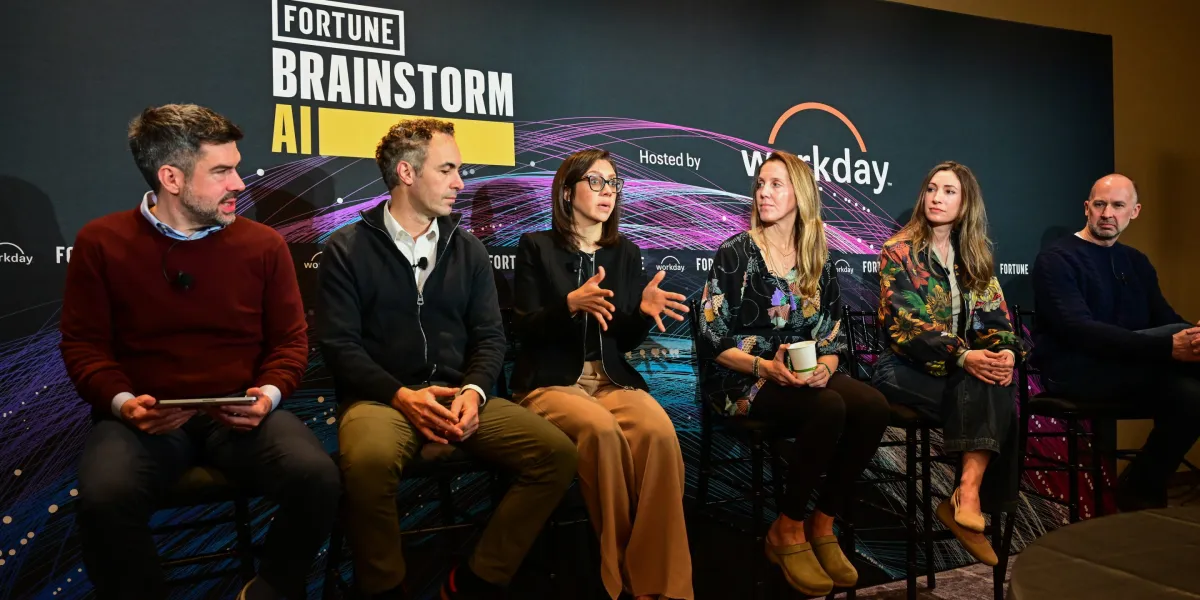
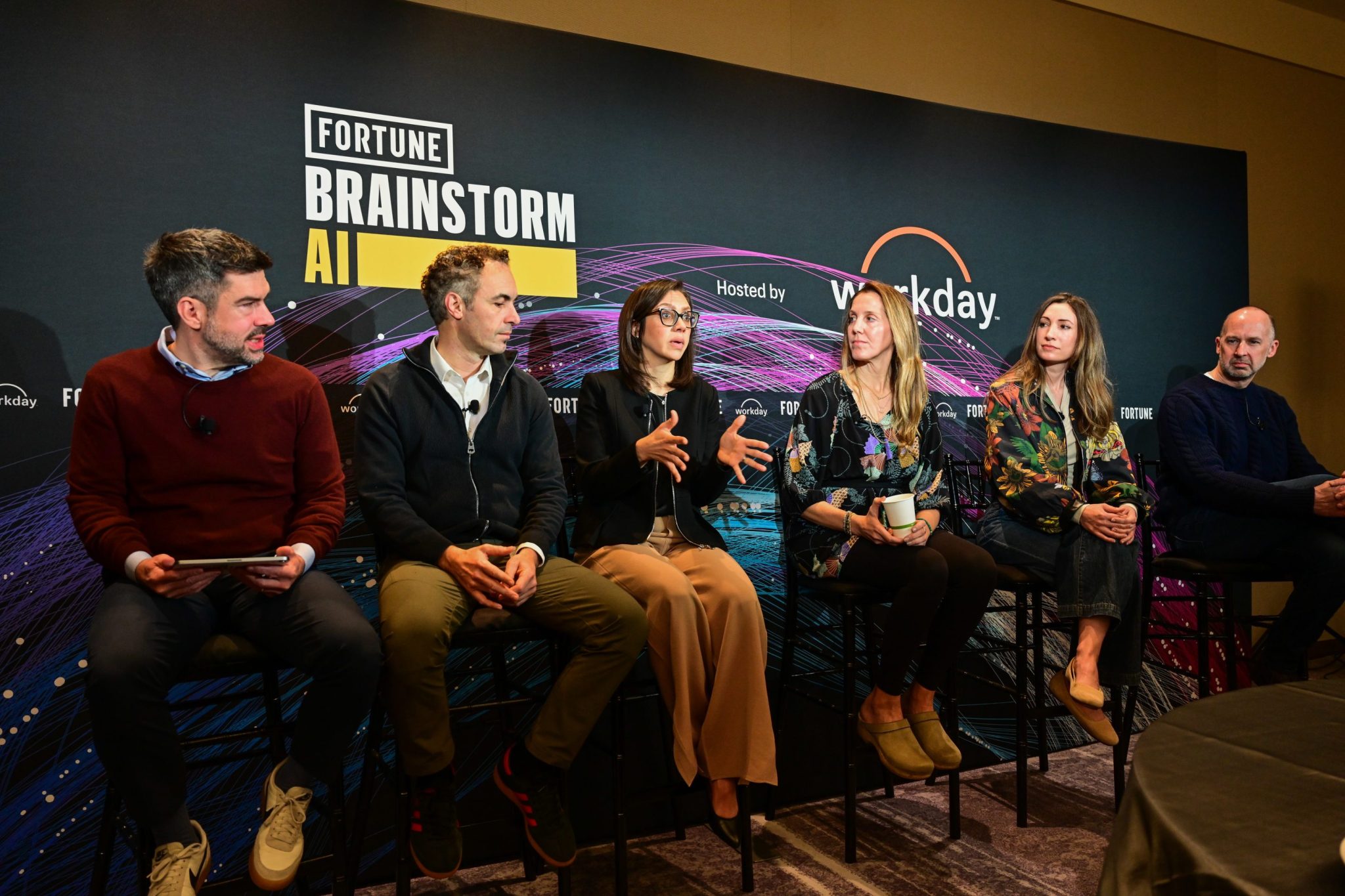
At the Fortune Brainstorm AI conference in San Francisco on Tuesday, in a panel session hosted by Workday, executives said the real shift is that software is stripping out drudgery and redefining good management as coaching, judgment, and emotional leadership rather than task supervision.
Canva’s head of AI research, Stefano Corazza, said the company’s goal is to build AI around people to give them “superpowers,” not to replace managers’ strategic decision-making or soft skills.
Aashna Kircher, group general manager in the Office of the CHRO at Workday, said many managers still spend too much time on tedious tasks. AI agents can remove much of that burden, but companies must also reset expectations, hold managers accountable, and train them in judgment, Kircher explained. When it comes to the role of the human manager, she suggested companies should reflect on questions such as: “What does it mean to be the best coach or the best team enabler? What are the skill sets that you now have to grow in your teams in an era of AI where the expectation is judgment, decision-making, and creativity?”
Where humans must still lead
BetterUp’s chief scientist, Kate Niederhoffer, distinguished between basic, collaborative, and adaptive performance, noting that humans—and especially managers—excel at the collaborative side: alignment, championing others, and cross-team trust. “And when they over rely on AI or agents doing that work, we see really bad outcomes, and we also see collaborative atrophy,” Niederhoffer said.
Empathy and relational support remain areas where people significantly outperform machines. If managers hand these tasks to agents, both performance and perceptions suffer, she said.
Amazon AGI SF Lab cognitive scientist Danielle Perszyk argued that managers are currently “tethered to a screen,” with productivity tools that undermine productivity. She sees AI agents as “universal teammates” that handle digital busywork—navigating apps, tracking updates, orchestrating tasks—so managers and individual contributors alike can think more creatively and strategically.
Perszyk hopes teams will spend “far less time looking at screens,” but warned that current systems only simulate understanding of emotion. Her lab is working on “digital world models” and social training—multi-agent environments that mirror workplaces—so AI can better grasp team dynamics and support, rather than replace, the human emotional labor of management.
Toby Roberts, SVP of engineering and technology at Zillow said that as AI absorbs more day-to-day grind, managers will gain leverage to focus on where human judgment and connection matter most, reshaping questions around span of control, skills, and team design.
You can watch the complete panel session here.
SherylEstrada
[email protected]
Leaderboard
Barbara Larson was appointed EVP and CFO of Workiva Inc., an AI-powered platform for financial, governance, risk, compliance, and sustainability reporting. Larson will join the company on Jan. 20, 2026. She has more than 20 years of experience, most recently serving as CFO at SentinelOne. Before that, Larson spent a decade in financial leadership positions at Workday, including as CFO, where she led overall finance and accounting functions, internal audit, and investor relations, and also advised on business strategy and product development. Larson also held senior financial roles at VMware, TIBCO Software, and Symantec. Workiva previously announced that Jill Klindt, EVP, CFO, and treasurer, will step down and that her employment will end on Dec. 26, 2025. On Dec. 3, the board appointed Julie Iskow as interim CFO and treasurer, effective as of Dec. 27.
Marc Winniford was appointed CFO of MoneyGram, a global payments network, effective in February 2026. Winniford succeeds Gary W. Ferrera. Winniford will have a central role in advancing an ongoing finance transformation as part of MoneyGram’s broader re-founding journey. Winniford joins MoneyGram from Wells Fargo, where he has served as CFO of corporate and investment banking. During his 17 years at Wells Fargo, Winniford has held a range of senior leadership roles, including head of corporate finance (leading FP&A), assistant treasurer, head of corporate development and various positions in treasury and fixed income. He also spent over five years in investment banking at Lazard, advising global financial services companies on strategy and M&A.
Big Deal
The Federal Reserve cut interest rates on Wednesday, marking the third consecutive rate cut. The quarter-percentage-point reduction brought the federal funds rate to a target range of 3.50% to 3.75%. The decision was divided among policymakers, with two voting to hold rates steady and one favoring a larger cut, but a majority ultimately approved the reduction.
Q&A with Gregory Daco, EY chief economist
CFO Daily: Was the Fed’s decision justified primarily by weakening conditions in the job market?
Daco: Labor‑market cooling was a key consideration, but not the sole driver. The committee framed the cut as a hedge against downside employment risks in an environment where inflation risks remain skewed to the upside and incoming data are constrained by the shutdown. In that sense, the move reflects the broader tension in the dual mandate rather than a reaction to acute labor weakness.
CFO Daily: Do you think the latest rate cut will prompt more businesses to hire in the coming year?
Daco: Not materially. The Fed signaled that policy is now within a broad range of neutral and that further adjustments will depend on clearer evidence of softening. That stance supports stability, but it is unlikely to spark a hiring wave; most firms remain focused on productivity gains and selective hiring, consistent with the Fed’s own projections for steady unemployment through 2026.
CFO Daily: The move was widely anticipated, but do you think the Fed’s firmer language raises the bar for further cuts?
Daco: Yes. By reinstating language on the “extent and timing of additional adjustments,” the Fed effectively indicated a pause in the easing cycle. With policymakers sharply divided and with a more hawkish rotation ahead, additional cuts now require more definitive signs that labor momentum is cooling and that core inflation is settling closer to 3% in early 2026.
Going deeper
Overheard
“As a whole, international students are high-spend consumers, shelling out significant sums on housing, food, transportation, healthcare, and retail. The dollars spent by international students cycle through local economies.”
—Bjorn Markeson, an economist at IMPLAN, states in a Fortune opinion piece. Markeson writes: “This school year, American colleges and universities saw a 17% decline in new international student enrollment. If you set aside the year of the pandemic, that’s the steepest decrease in over a decade. This reduction is making waves far beyond the halls of higher-ed. Based on my recent analysis, it represents a nearly $1 billion hit to the U.S. GDP.”