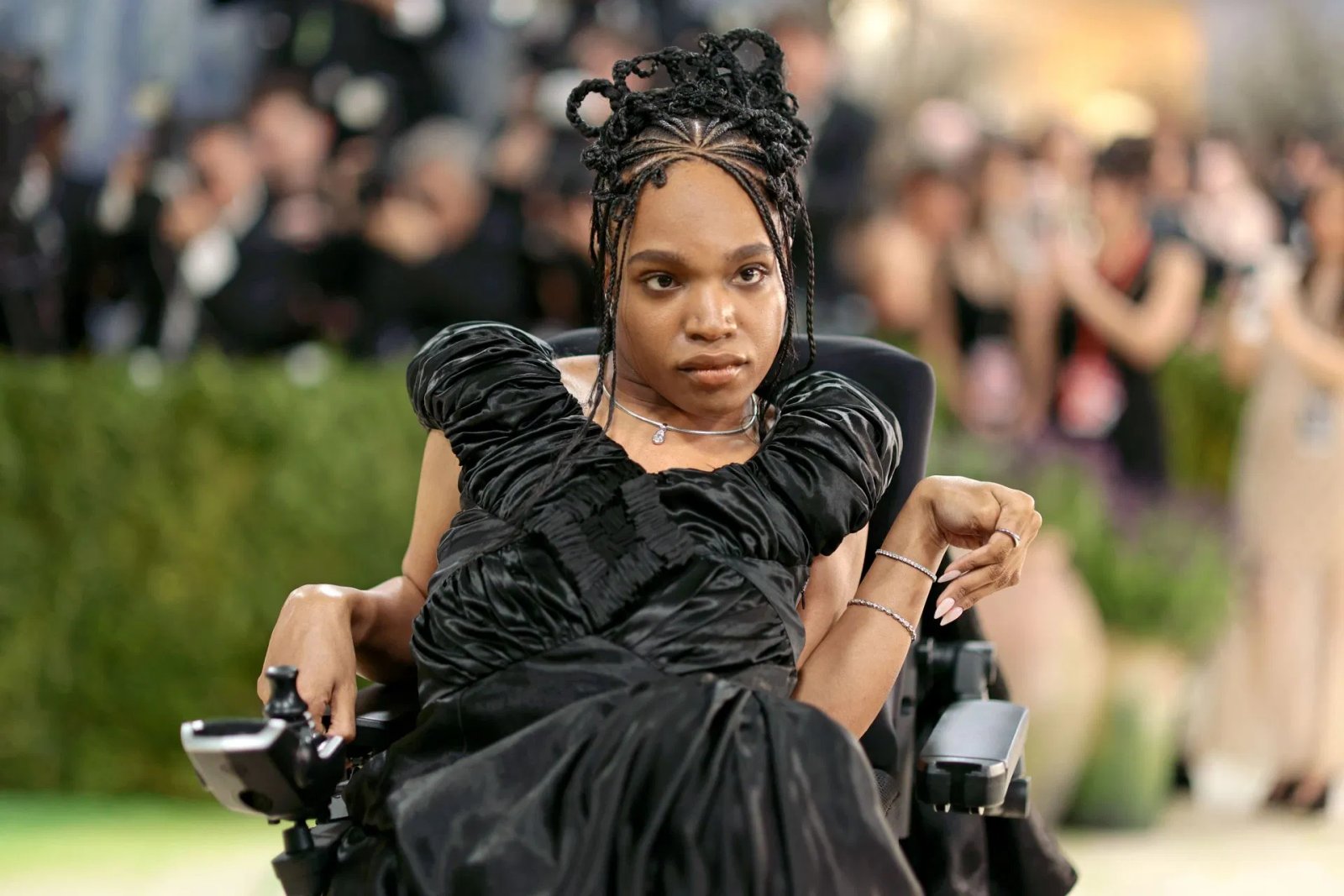

Aariana Rose Philip, an Antiguan American model and musician, made history as the first wheelchair user to attend the Met Gala, which was held at the Metropolitan Museum of Art on May 4, 2026. This year’s theme was “Costume Art,” and the dress was “Fashion is Art,” and Philip, a black, transgender model with quadriplegic cerebral palsy, modeled for one of the mannequins presented inside the exhibition this year.
Aariana Rose Philip first expressed her wish to become a model on social media. In 2018, she became the first Black, trans, and physically disabled model to be signed with a major modeling agency after she signed a contract with Elite Modelling at the age of 17.
Philip has since appeared on the runway for Moschino’s spring/summer 2022 runway show at the 2021 New York Fashion Week. She has also appeared on the cover of PAPER Magazine, V Magazine, Numero, and Vogue, among others.
This year’s Met Gala focused on inclusivity, given that the exhibition’s Costume Institute curator, Andrew Bolton, framed the exhibition on the different body types. This included the disabled body, the aging body, the pregnant body, and the corpulent body, with Aariana Rose Philip serving as one of the models for the mannequins.
According to the Independent, Philip’s mannequin is dressed in a pair of denim shorts and a shirt with the slogan, “Queer Capital.” The model discussed the experience during an interview with Vogue on the Met Gala live stream, saying:
“They scanned my entire body, head to toe… I feel really held and recognized and understood, finally, and valued by my industry that I love and I’ve contributed so much to. And it feels like a homecoming, almost. It feels very full circle, and it feels very aligned.”
In another interview with Vogue, Aariana Rose Philip explained how she hoped people would feel after they see her mannequin inside the exhibition, adding:
“The Met Gala will be the first time I see my mannequin. When people see my mannequin, I want them to see a beautiful, sexy lady. I want them to see a supermodel and a legend. I want them to see that disabled and Black trans people matter always, and that we should’ve been in these spaces for a long time, and that there’s nothing wrong with being people like us—and there’s never been anything wrong with us.”
Aariana Rose Philip was interviewed by Naomi Campbell for PAPER Magazine
Aariana Rose Philip, aged 25, gained fame after posting about herself on social media and sharing her dreams of becoming a model to create more inclusivity in the industry. At the age of 14, she published a memoir titled This Kid Can Fly: It’s About Ability (Not Disability), where she spoke about living with cerebral palsy.
In 2018, Aariana Rose Philip signed a contract with Elite Modelling and began her modeling career. Philip has also appeared on the cover of various publications and appeared in various campaigns for brands like Sephora and Dove. She also appeared in the music video of Miley Cyrus’ Mother’s Daughter in 2019.
In June 2019, Aariana Rose Philip graced the cover of PAPER Magazine and was interviewed by Naomi Campbell, marking her first major interview. During the interview, she spoke about her love for fashion and what inspired her to enter the industry, saying:
“I grew up and always looked at fashion as something that I loved, because more than anything, I was born and raised on the internet. And when you’re on the internet and exposed to things like advertisements, you see fashion advertising. So I always saw Marc Jacobs, Prada and Dior, right below my keyboard, and I was like, Oh my gosh, I love this.”
She added:
“It was only until I was about 12 or 13, when I started looking into it seriously. I got ahold of Vogue, Dazed, and i-D, and I fell in love with the industry and with seeing people wear beautiful clothes in a way that’s so visible and public as models.”
Aariana Rose Philip’s first big break in modelling came when she made her New York Fashion Week debut for Moschino’s SS22 runway show in 2021, making history as the first model walking a major fashion brand runway using a wheelchair.
Edited by Juhi Marzia