

Alex Holt, the chief technology officer at ElevenLabs, is about as bullish on AI agents as a C-suite leader can get.
The AI voice startup has deployed an inbound sales development representative (SDR) agent that has handled over 3,000 customer leads this year, qualifying over 90% of those potential clients in 32 different languages without any human intervention. Yet another AI agent serves as a coach to help new sales team members role-play customers interactions, resulting in faster onboarding for that part of the workforce. There’s also a recruiting agent that conducts first-round interviews with new job candidates, and within the company’s Slack, various agents are quick to jump in and answer any employee questions about internal processes.
“I think what’s most exciting about this space is that you know you always feel like you’re on the tip of the iceberg,” says Holt. He says that the efficiency gains ElevenLabs reaps from agentic AI may feel cutting edge today, but “in six months time, you can see even more gains.”
Increasingly, CTOs and chief information officers have homed in on agentic AI as a central focus for the value they expect to extract from their frothy investments in the technology. Agentic’s share of AI value grew from 17% in 2025 to 22% this year, according to research published by consulting giant BCG, and is projected to reach 39% by 2030. And yet, most surveys find that businesses are ill-prepared to rethink workflows and orchestrate multi-agent processes, in which one agent autonomously passes along work to another.
Holt says most employees at ElevenLabs work collaboratively with agents and a majority have even built their own agents to help handle repetitive tasks. The company’s core business objectives don’t change with AI: sales teams are expected to use AI to generate more revenue at a faster pace; for customer service, satisfaction scores are closely monitored.
“It’s exactly the same business metrics,” says Holt. “This has to be an initiative that the business units themselves are driving and pushing. The agents and tech are a tool that they can leverage to do that.”
Organizationally, ElevenLabs has deployed an engineer to sit on every team across the business, and every group has fewer than 10 people. Within recruiting, for example, two forward deployed engineers work in a pod with HR colleagues with the sole objective of reducing the time it takes to get candidates through the interview process.
Today, almost all prospective candidates are initially screened by an AI recruiter when applying for a role at ElevenLabs. “That’s 30 minutes that the recruiter can spend at the end of the process, convincing you to join,” says Holt.
Holt joined ElevenLabs in September 2023 as an engineer after spending five years at software and data analytics company Palantir Technologies. He was elevated to the CTO role in June 2026. Three months later, the startup announced that it doubled its valuation to $22 billion. CEO Mati Staniszewski recently indicated that ElevenLabs may begin to plan for an initial public offering in 2028.
The next frontier for agentic AI, says Holt, is to put more effort into multi-agent systems, enabling greater shared context and more complex work handoffs between multiple agents.
This is already under development for the company’s sales leads. The SDR agent uses voice AI to determine the seriousness of a prospective buyer, looping in a human representative after that screening process. But recently, one ElevenLabs customer was able to close a sale entirely through an interaction with two agents. First, the inbound request was fielded by the SDR agent, and later an account executive agent handled the legal documents and contracts.
“The value of that is you can now automate that whole chain for customers where it’s the simple, most repetitive mechanical cases,” says Holt. He says employees can dedicate more time to more complex inbound requests or upselling.
Holt says embracing agentic AI at this magnitude does require some patience. Is the recruiting agent helping to hire the right people? Are ElevenLabs’ customer service scores improving with AI? “Some of these metrics can take a long time,” says Holt. “We lean on the business owners to identify those leading indicators and the metrics we should be measuring.”
There are also instances where AI can act in unintended ways, an issue that’s raised alarm following recent high-profile instances in which OpenAI and Anthropic agents went rogue.
ElevenLabs says it has created a human-led monitoring and observation layer to govern its agents. But mistakes can still slip through. One customer service agent erroneously gave a small refund under $30 to a customer and failed to escalate the issue to an employee. ElevenLabs created a test case that simulated the call and the exact chain of thought and reasoning that led the agent astray, then updated the prompts and guardrails.
Holt says tracking every decision that an agent makes in this manner can actually be helpful. If a human made the same mistake, the company likely wouldn’t have noticed.
“It’s not just automating processes; it allows you to collect more data,” says Holt of agentic AI. “I expect over the next few years, the trend that we’re going to start seeing is people talking much more about optimizing these processes.”
John Kell
NEWS PACKETS
Apple, Palantir, AMD report solid earnings after a brutal week for tech. Last week, investors put pressure on tech stocks, including those of Meta Platforms, Amazon, and especially Alphabet—whose stock had its worst day ever on Thursday—due to concerns about how much those industry titans are spending on AI infrastructure. This week, however, the tech industry has fared somewhat better as Apple set a new sales record in China Palantir reported its highest-ever revenue growth of 96%, and chipmaker AMD forecast stronger-than-expected fourth-quarter sales. Tech shares rallied even more on Wednesday, following the Democrats retaking the House and Senate in the U.S. midterm elections.
OpenAI’s latest funding round is sputtering. The ChatGPT maker has cut the target of its latest funding round and is seeking a lower valuation of $1.25 trillion, below the $1.4 trillion value it was aiming for just last month, as last week’s tech sell-off in the public markets reportedly dampened interest from some large investors. The Financial Times reports that OpenAI’s funding target has been cut by $10 billion to $20 billion, while the Wall Street Journal says it has secured roughly $11 billion in commitments thus far with the deadline for this funding round set for Friday. OpenAI’s sales have fallen behind rival Anthropic, though WSJ notes that third-party data shows the former was able to capture more market share recently after cutting prices for some of its AI models.
Anthropic’s third-quarter growth slows. An amended IPO prospectus filed by Anthropic this week showed that the Claude maker generated $17 billion in revenue for the third quarter, up from $11.6 billion in the second quarter and $1.4 billion a year earlier. But, as Fortune reports, the company’s growth rate is cooling: third-quarter revenue grew 47% sequentially, down from the revenue increase of about 144% in the second quarter from the prior three months. WSJ reports that investors are also warning Anthropic to expect a lower valuation, again citing the recent tech sell-off as a factor. Citing people familiar with the matter, Anthropic’s IPO valuation reportedly may settle closer to $1.5 trillion to $1.6 trillion, below the $2 trillion figure that had been floated just a few months ago.
And yet, the AI boom led Marvell to announce a blockbuster deal for Lumentum. While worries about the AI boom percolate across markets, AI chip maker Marvell remains especially bullish, agreeing to pay $80 billion in an all-stock merger with optical components maker Lumentum, a deal valued at about $115 billion when including debt. Marvell says the deal will allow the combined company to address a market worth $550 billion, with Chairman and CEO Matt Murphy saying, “AI infrastructure is undergoing a fundamental architectural shift toward optical connectivity, creating an opportunity that comes along once in a generation.”
Goldman Sachs bans some AI tools. Bloomberg reports that the New York-based bank has banned most staff—excluding engineers—from using Anthropic’s Claude Code and Microsoft’s GitHub, due to productivity and risk management concerns. This follows a move by CIOs and CTOs to put more controls on the AI tools that they authorize their teams to use, though these restrictions have often been attributed to rising costs, as AI bills for enterprises have increased sharply in 2026. As in the case with Goldman Sachs, engineers frequently are given more leeway, along with research and development teams.
ADOPTION CURVE
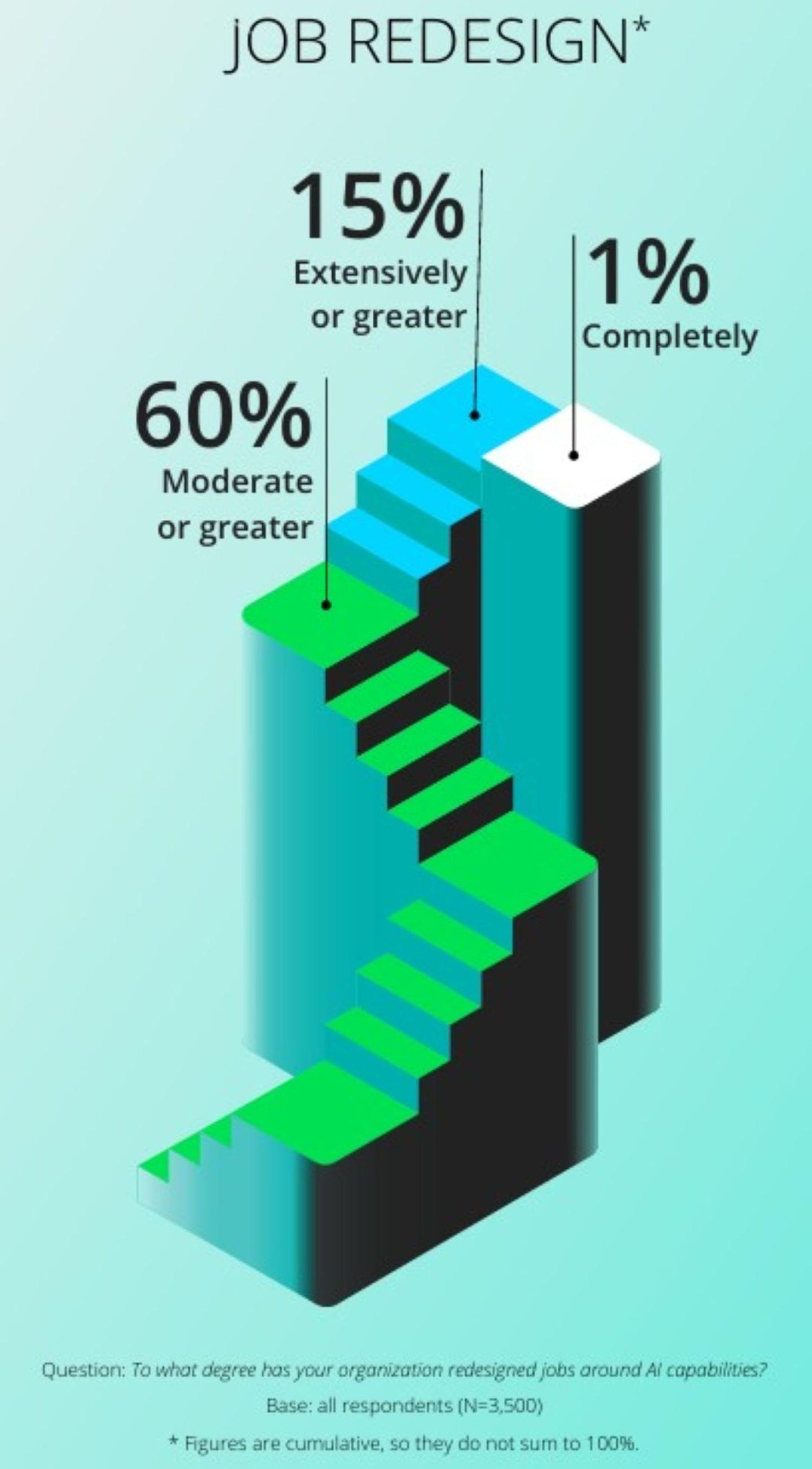
As few jobs have been extensively redesigned around AI, CIOs play a key role in accelerating transformation. A recent survey conducted by consulting firm Deloitte featured plenty of encouraging signs regarding enterprise adoption of AI: 81% of senior leaders report AI has improved the speed of decision-making and execution; 28% see revenue gains from AI, up from 20% in the January report; and 60% say they’ve redesigned roles around AI capabilities to at least a moderate degree.
But the human component remains a conundrum. Only 15% say they’ve redesigned roles at least “extensively” around AI, a share that’s unchanged since January.
Jim Rowan, Deloitte’s US Head of AI, tells Fortune there’s a sense that even though the quality of AI tools has improved and there’s been a multi-year effort underway to transform workflows, the biggest transformation still feels “a couple of years away.” He adds that when CIOs work closely with other C-suite leaders to determine the right AI use cases to pursue, provide input on the architecture, and assess the costs, that’s when more meaningful results can be realized.
As an example of a CIO collaborating with a chief marketing officer, Rowan says, “if you can get that shared accountability to say, ‘we’re expecting this share of voice increase, a click-through rate and improvement in our marketing ads and spend here; and a reduction of third-party spend over here,’ I think that’s the handshake between the CMO-CIO and they can execute against that.” He adds that if those decisions are made lower in the leadership structure, “you lose that enterprise view and commitment.”
Courtesy of Deloitte
JOBS RADAR
Hiring:
– Microsoft is seeking a CTO for the company’s U.S. federal civilian business, based in Washington. Posted salary range: $158.4K-$243K/year.
– The Abraham Joshua Heschel School is seeking a CTO, based in New York. Posted salary range: $250K-$300K/year.
– Sonos is seeking a VP of enterprise acceleration, based in Santa Barbara. Posted salary range: $262K-$326.9K/year.
– AmeriSave Mortgage is seeking a EVP of technology, a remote-based role. Posted salary range: $250K-$350K/year.
Hired:
– Johnson Controls appointed Shauna Latshaw to the role of CIO, reporting to CEO Joakim Weidemanis. Latshaw joins the industrial and building technology company from manufacturer Caterpillar, where she most recently served as VP of modern manufacturing digital and IT platforms. Previously, Latshaw served as a senior partner at IBM and CIO at Compass Group.
– Ruder Finn promoted Tejas Totade to serve as global CTO and chief data and AI officer, an expanded role to wide access to AI tools and training across the communications and marketing agency. Totade initially joined Ruder Finn in 2010 as a senior developer and has earned several promotions during his 16-year career at the company.
– CRISPR Therapeutics appointed Sivakesava (Siva) Sakhamuri to serve as chief technical officer, effective immediately, to scale the gene editing company’s technical operations and manufacturing organization. Sakhamuri joins CRISPR from Orna Therapeutics, where he was CTO from 2024. Orna was acquired by Eli Lilly for up to $2.4 billion in February.
– AvaSure appointed Patric Edmondson as CTO, where he will oversee engineering, product development, data and AI, and other tech responsibilities for the virtual care platform. Edmondson previously served as CTO at software firm Modernizing Medicine and as CIO at physician-led management services group The Specialty Alliance.
– ATS Energy appointed Ed Ganja to the role of CTO, joining the clean-tech startup after it closed on a new financing round in October to advance commercial production of its power-generation technology. Most recently, he served as VP of catalyst and analytical technology at energy giant Shell.
– Eversheds Sutherland named Eric Hagopian as its new CIO, leading the law firm’s IT function across its U.S. practice, overseeing the strategy and delivery of technology, information governance, and emerging technology initiatives. Most recently, Hagopian served as chief operating officer and CIO of law and government relations firm Van Ness Feldman.
– Applied Aerospace & Defense appointed Robert Wingfield as CIO, leading an IT ecosystem of 11 manufacturing facilities and nearly 1,800 employees. Prior to joining the manufacturer, Wingfield held senior leadership roles across the aerospace and defense industry, including as a VP at defense and tech company BlueHalo.