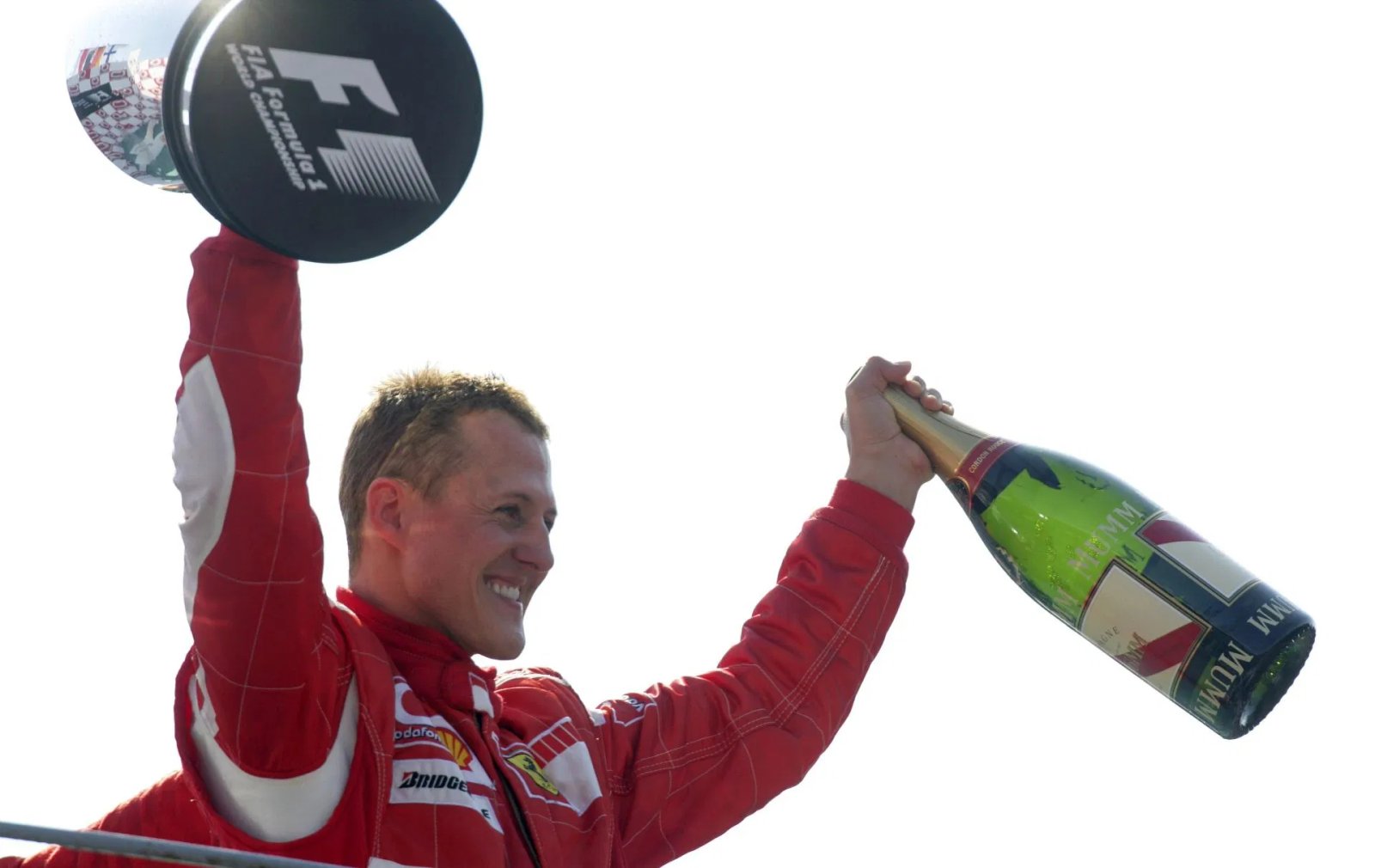

Ferrari is going to honour Michael Schumacher this weekend as it marks 30 years since his first win with the team. The German driver is considered one of the greatest to ever do it, with his iconic stint with the team standing out.
The driver joined Ferrari in 1996 and would have to wait until 2000 to win his first title with the outfit. Once he did that, there was no looking back as he went on an unprecedented five-title run. But there’s a reason why Michael Schumacher is, to this day, so loved by the Tifosi and continues to be considered to have had a stint in the sport that is unparalleled.
There’s the mythical benchmark that Michael Schumacher set when he went to Ferrari and achieved what he did with the team, and the reverence, the respect, and, most importantly, the elusiveness of that stint adds a different aura to what the German did.
So why is Michael Schumacher’s Ferrari stint considered to be the benchmark for emulation for many in the sport? Let’s take a look.
His move to Ferrari was against conventional wisdom
What many forget about Michael Schumacher’s move to Ferrari in 1996 is that it broke conventional wisdom at the time. As was often the case, and as it continues to be the case right now, driver moves were primarily dictated by how early success could be achieved. Every top-tier driver moved from one team to another with a singular focus in mind: to enhance his chances of a potential title run.
Michael Schumacher’s move to Ferrari was the antithesis to that. Schumacher was part of Benetton at the time, the team with which he’d won the title in 1994 and 1995. He had offers from Williams and from McLaren, where Ron Dennis was willing to match whatever the German was being paid by the rivals.
At the time, Williams and McLaren were the giants of the sport and had dominated the last decade or so. The last time Ferrari won a championship was in 1983, and the last driver to win a title with the team was Jody Scheckter in 1979. The Italian team was not a beacon of success at the time and certainly not an attractive option.
But that was the route that Michael Schumacher chose, as he felt that he wanted to build an entire team around him. He’d already achieved success by just driving the most competitive cars to the title.
He knew what made him successful
One of the rare abilities of drivers, even when they achieve success, is knowing how they did it. Once you crack that formula, you bring consistency. When Michael Schumacher was negotiating with Ferrari, what stood out was the ability to have clarity on what he wanted from the team and the partnership.
Even though it might portray a very ruthless and merciless approach, Michael Schumacher was quite clear that the best way for Ferrari or any team in F1 to win is to back all its resources behind one driver. In essence, every penny spent within the team was going to be spent to make the German a world champion.
Such clarity and such ruthlessness in how you want to approach racing was novel, and what followed was a systematic approach through which, one by one, key personnel from Benetton were brought to Ferrari, and hence, success followed.
The growing list of legends that tried and failed with Ferrari
What makes any athlete’s achievements even more impressive is how his fellow drivers have tried and failed at the same pursuit. Looking at what Michael Schumacher achieved at Ferrari, you have to take a look at the plethora of talent that ended up at that team and just failed to achieve anything close to what he did.
F1 legends like Nigel Mansell, Alain Prost, Fernando Alonso, Sebastian Vettel, and even right now, we have Lewis Hamilton and Charles Leclerc, who, until now, have failed to achieve what Schumacher did. The fact that in the last 5 decades of F1 racing, there has been only one decade of racing where the Italian team emerged as the benchmark is a surprising statistic. The fact that the decade was the one where Michael Schumacher was part of the team only adds to the German’s legacy.
The reason behind Ferrari’s current stature in F1
The Michael Schumacher-Ferrari partnership came to an end in 2006. Since then, the outfit has one Drivers’ Championship in 2007 and one Constructors’ Championship in 2008 to its name. That’s almost 2 decades since they last won a title. When the German ended the championship drought in 2000, the team had not won a Drivers’ Championship since 1979. That’s another title drought that lasted 2 decades.
During the German’s reign, the team clinched 6 Constructors’ Championships and 5 Drivers’ titles. More importantly, if you remove that stint from 1996 to 2006, Ferrari would not be the most successful team in F1 history.
In modern-day F1, the Italian outfit is considered the most iconic team in history. The fact that it is the most successful team in the sport’s history is a key part of the respect that the team continues to command. A large part of this stature and respect would not be coming Ferrari’s way in 2026 if the team didn’t have the numbers to back it up, and the reality is that a large part of these numbers is due to that Michael Schumacher partnership.
If that partnership did not come together, the reverence and the attractiveness that Ferrari continues to have on the grid would not be there, and there aren’t many drivers that build these kinds of legacies where they uplift a team’s overall stature.
Michael Schumacher would have arguably won a lot more titles if he hadn’t gone the Ferrari route
And finally, what if we told you that if Michael Schumacher followed a more conventional route of a driver just picking the fastest possible car available, he would have potentially ended up with far more success than his eventual 7 world championships? In 1995, when the German was looking to make a move away from Benetton, he had the option of going to Williams or McLaren as well.
At the time, Williams was the benchmark on the grid, and if Schumacher went to the team, he would have continued to win in 1996 and 1997. With the German as part of the team, Adrian Newey would also have continued to be a part of the squad and not leave for McLaren, hence extending the glory period for the Grove-based squad.
As a result, the German would have, at the very least, been a 4-time world champion by the end of 1997, with more than a decade of his career left. He was also quite clearly the best talent on the grid, and beyond this point, if the dynamics of the grid changed, he could have easily made the move away to a different team and picked up even more championships.
The fact that he chose a more difficult route and made it work is also what just puts the German in a completely different realm compared to anyone else.
Conclusion
If we look at the statistics right now, Michael Schumacher is not the most successful driver ever in F1 history. That title goes to Lewis Hamilton, who has the same number of titles as the German but more wins. But there’s a reason why what Schumacher achieved at Ferrari is what continues to be the gold standard of achievement by any driver in F1.
He was someone who chose the less conventional path with a team that was nowhere close to winning, transformed it, and turned it into a championship-winning juggernaut. The fact that the same outfit has gone back to its same unsuccessful ways is precisely what makes the German’s accomplishment even more impressive.
And that is precisely why every elite talent is still attracted to the possibility of joining Ferrari one day and achieving success.
Edited by Charanjot Singh Kohli