When Tony Leopold, the chief technology and strategy officer at United Rentals, held a hackathon to test out a new artificial intelligence agent, he said he wanted to clear one final hurdle before debuting the tool at the equipment rental company’s annual management meeting in January.
“I am personally going to interrogate it and ask it every question I can throw at it,” Leopold recalls of his mindset before going into the four-hour hackathon. “I’m going to try to break it.”
But with three months of pilot testing preceding his stress testing efforts in December, Leopold felt confident enough to publicly announce on Wednesday the launch of the company’s new “Business Intelligence Agent,” which United Rentals built with cloud-software company Snowflake. The tool is now available to thousands of frontline employees across more than 1,600 branches that rent equipment serving the construction industry, industrials, utilities, and residential customers.
The tool allows employees to analyze financials, customer data, and operational questions using natural-language prompts, such as “which of my sales representatives are discounting the most?” or “which customers should I focus on today to collect revenue?” Previously, this information was shared through corporate reports or dashboards that an employee had to toggle through manually. With AI, United Rentals hopes to speed up the information-gathering process.
Leopold, who joined United Rentals in 2010 and held a variety of leadership roles before ascending to his current title late in 2024, says his framing is key. “We’re calling it the beta phase, because the one thing that’s very important—in particular with AI agents—is they’re not always perfect,” he adds.
United Rentals and Snowflake developed a “thumbs up, thumbs down” feature to encourage consistent user feedback, leveraging Snowflake’s Cortex Code, an AI coding agent designed to speed up the development, testing, and iteration of AI agents. When feedback is positive, the Business Intelligence Agent will surface similar responses in the future, at a faster pace. But for responses that fail to retrieve the right information, Leopold’s IT team works behind the scenes to tweak the prompt engineering and ensure the right data is available to be retrieved to address the user prompts.
This reflects an approach that’s evolved as more businesses deploy AI, especially as more complex agentic applications gain some traction. It isn’t enough to launch a new AI tool and make it available to thousands of employees with a dash of training. On the back end, technologists like Leopold are consistently mining human feedback and pushing through regular updates. Four out of every five users of the Business Intelligence Agent give it a thumbs up. “But we want 100%,” says Leopold. “That’s our aspiration.”
For Snowflake, which has recently inked separate $200 million deals with AI startups Anthropic and OpenAI to integrate their large language models directly into its platform, working with clients like United Rentals could help turn the tide on Wall Street’s fears that the company’s AI-based tools are not flourishing enough to meet investor expectations.
And for United Rentals, which ranks No. 285 on the Fortune 500, the new AI agent builds on a slow-yet-steady embrace of AI. The company largely stayed on the sidelines in 2023, in the wake of the late 2022 debut of ChatGPT, followed by some pilots in 2024 and expanded into broader deployments last year. AI tools that Leopold has rolled out include an internal chatbot built on Anthropic’s Claude, which had 4,000 users in the last month (United Rentals has close to 28,000 employees in total).
Last year, United Rentals also debuted “Manual Assist AI,” an application built with Amazon Web Services that allows service teams to access thousands of pages of manuals and address equipment issues far more quickly than if they had to call a hotline or thumb through the documents by hand. Leopold launched the tool in July and within just two months it had reached 4,000 monthly users.
He says that traditionally, it would have taken up to 18 months to reach this level of penetration. AI’s user interface, Leopold says, is “so much more intuitive that I think the adoption potential is so much higher than what we had through traditional web applications.”
United Rentals’ AI investments focus on three core priorities. There is the handling of administrative tasks, data entry, and other business work at the company’s vast rental network. Then, there is an effort to make the online digital experience more seamless for customers, which includes the development of an AI search strategy to optimize content for ChatGPT, Gemini, and other LLMs. AI commerce is in the earliest stages of development and brands like United Rentals are only just beginning to wrap their heads around the concept.
Finally, the company is deploying AI tools for corporate employees. One application currently in the mix is the use of AI to help draft employee performance reviews. United Rentals invested in some training to encourage this use case, coaching 1,500 employees in a single week.
“2025 was really learning how to scale, how to do it securely, how to do it with enterprise data and connecting into legacy systems—not just chatting on an enterprise agent,” says Leopold. “2026 and 2027 is where we’re really starting to harvest some of those wins.”
John Kell
Send thoughts or suggestions to CIO Intelligence here.
NEWS PACKETS
Are the AI layoffs real? While workers fear that AI may be coming for their job—and Amazon’s decision last week to cut around 16,000 corporate jobs would seem to justify that narrative—the hard data isn’t yet showing that the technology is leading to massive unemployment. Instead, some say that corporations are embracing “AI washing,” i.e. blaming AI for their layoffs because they want to justify their lofty investments in the technology to investors. The Wall Street Journal recently reported that U.S. companies that are enacting layoffs are still resetting their workforce levels after a boom in hiring during the pandemic, while Yale has recently published research that says the effects of AI on the labor market remain “largely speculative.” And research firm Gartner published a report this week that predicts 50% of companies that cut customer service staff due to AI will rehire workers to perform similar tasks, but under different titles, by 2027.
SpaceX buys xAI ahead of planned IPO. Last year, Elon Musk merged his AI company XAI with his social media platform X in a $33 billion, all-stock deal. And he’s at it again, with Musk’s rocket company SpaceX acquiring xAI in a deal that values the combined company at $1.25 trillion, according to Bloomberg, who says that the new combined firm is also planning an initial public offering later this year. Musk justified the deal by saying that AI technologies are currently based on terrestrial data centers but that rising demand for electricity cannot only be met on the earth. “In the long term, space-based AI is obviously the only way to scale,” says Musk, making the case that harnessing solar power could fuel these futuristic data centers.
OpenAI is also reportedly mulling an IPO in 2026. The Wall Street Journal reports that ChatGPT operator OpenAI is considering an IPO and would like to go public ahead of its rival Anthropic to be the first major generative AI startup that debuts on the public markets. The timing comes as some investors are questioning the valuation of these hot AI startups that have raised billions and yet haven’t come close to turning a profit. OpenAI is currently valued at $500 billion, but has said it doesn’t expect to be profitable until 2030. Still, investors aren’t completely dissuaded by the story: the Information has reported that Nvidia, Microsoft, and Amazon are in talks to invest as much as $60 billion into OpenAI in a new funding round.
Investors are starting to pick AI winners and losers. This earnings season, investors are starting to show signs of apprehension about AI’s investment thesis, putting pressure on some of the largest tech companies that have spent big to win the AI war. Last week, Microsoft’s shares took a dive and experienced their worst week since March 2020 after the company said it expected to spend more than $100 billion in capital spending this year. But rival Meta Platforms, which said capital spending for this year would be 20% higher than Wall Street expectations and nearly double 2025’s investment, saw shares leap on record fourth-quarter sales. One pocket of tech that has faced a lot of pressure have been software firms, with the shares of companies like SAP, Salesforce, and ServiceNow all stung the last six months, as Reuters reports, because of rising fears that AI could disrupt their business models. Those shares took yet another tumble on Tuesday.
ADOPTION CURVE
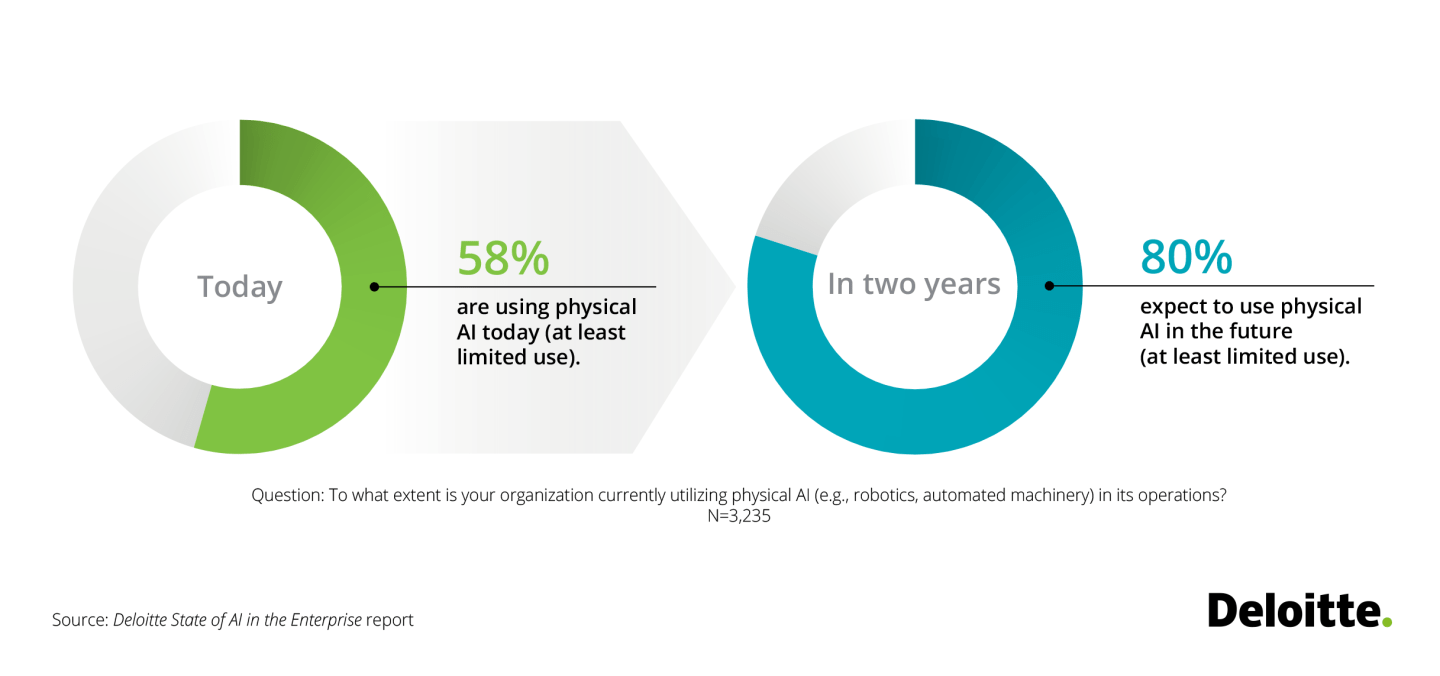
Physical AI is growing fast, but especially in the Asia-Pacific. Nearly 60% of companies report at least limited use of physical AI and within two years, that figure will increase to 80%, according to a Deloitte survey of 3,235 director- to C-suite level respondents. Physical AI is a form of industrial automation that combines AI and machine learning with sensors, controls, and robotics. The pitch to investors and enterprises is that physical AI can perform difficult tasks more efficiently than workers, especially key as the manufacturing sector consistently faces labor shortages.
Adoption is highest in the Asia-Pacific, where 71% of respondents report at least minimal use of physical AI, compared with 56% in both the Americas and Europe, Middle East, and Africa. The use cases that are expected to have the greatest impact include intelligence security systems/smart monitoring (21%), followed by collaborative robotics (20%), digital twins (19%), and internet of things-driven retail (16%).
Jim Rowan, Deloitte’s chief of AI, tells Fortune that employers need to rethink what tasks will remain with workers when AI-enabled automation proliferates. That’s similar to the conversation that’s happening around the responsibilities for knowledge workers.
“In the office, we’re talking about agents amplifying the human’s capability, the workflow that they do, and the time they spend on creative tasks versus manual tasks,” says Rowan. With physical jobs, “we have to do a better job defining what the roles need to be and rethink those job descriptions,” he adds.
JOBS RADAR
Hiring:
– NYC Administration for Children’s Services is seeking a CIO, based in New York City. Posted salary range: $240K-$250K/year.
– Home Market Foods is seeking a senior director of IT, based in Norwood, Massachusetts. Posted salary range: $225K-$280K/year.
– MAG Aerospace is seeking a senior director of IT, based in Fairfax, Virginia. Posted salary range: $129.5K-$240.5K/year.
– Charles R. Drew University of Medicine and Science is seeking a CIO, based in Los Angeles. Posted salary range: $270K-$280K/year.
Hired:
– Charles Schwab announced several executive updates, including that CIO Dennis Howard’s responsibilities would change to lead a newly formed technology, operations, and data organization, an expansion of his current responsibilities. He will now serve as the financial services company’s chief technology, operations and data officer, continuing to report to President and CEO Rick Wurster.
– Sallie Mae has named Steve Turner as chief technology and enablement officer, overseeing technology architecture and delivery, IT, data, and physical security for the private education loan lender. Most recently, Turner served as managing director and head of data, analytics, insights, and marketing technology for Bank of America and served as a CIO at Walgreens.
– CSI named Abe Kuruvilla as its new chief information and technology officer, overseeing the architecture, engineering and platform operations. Kuruvilla joins the financial industry software provider after most recently serving as CTO at digital payments software company ACI Worldwide. Before ACI, he served as CIO at data and analytics company CoreLogic.
– Softswiss has promoted Sergey Kastukevich to serve as CTO, after previously serving as deputy CTO for five years. Kastukevich will oversee software architecture, infrastructure strategy, security, and engineering productivity. The online casino software company also created a new chief AI officer role and appointed another deputy CTO, Denis Romanovskiy, to that position.
– Tango announced the appointment of Bala Pitchandi as CTO. Prior to joining the real estate-focused software company, Pitchandi most recently served as chief product and technology officer at software company Nayya Health. He also previously held senior engineering leadership roles at software companies VTS, Justworks, and Vidyo.
– 3iQ appointed Chris Desjardins as CTO, where he will lead the technology strategy, platform architecture, and security for the digital asset investment fund manager. Previously, Desjardins co-founded Tungsten, a digital asset custodian that sold to Zodia Custody.
– Skyline Windows named Damien Willems as CTO, joining the windows systems manufacturer to oversee cross-functional coordination across the engineering, manufacturing, and commercial functions. He most recently served as general manager at door supplier Kolbe Windows & Doors and previously was CEO of aluminum supplier Reynaers Aluminum USA.
– TLCx appointed DeJon Gaines as CTO, joining the customer experience outsourcing provider to spearhead the overall technology roadmap and further leverage AI, analytics, and cloud technologies. Previously, he spent nine years at business services company Conduent, most recently as CIO of customer experience management. Before that, he was a vice president at printer and IT company Xerox.