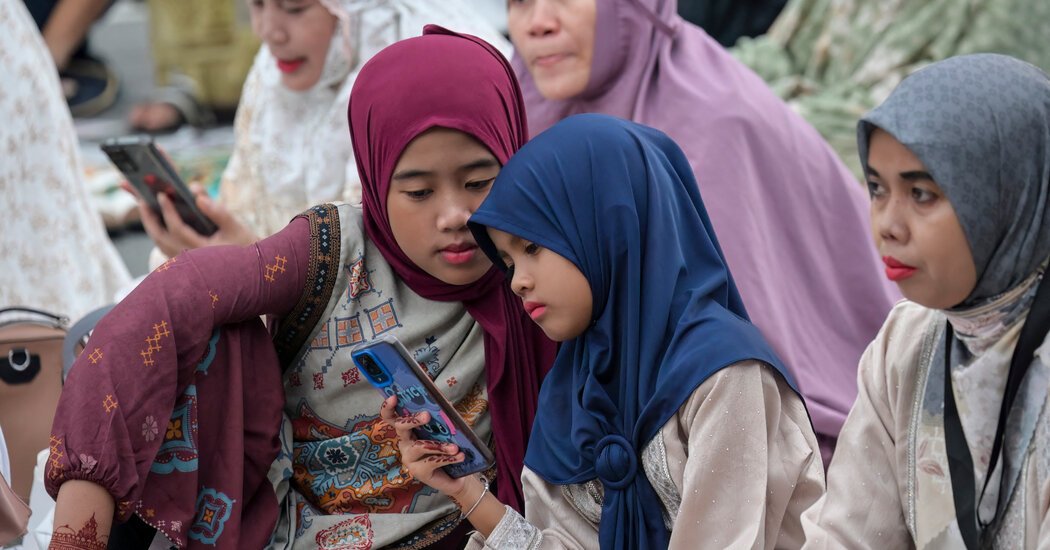
The Indonesian authorities have summoned officials from Google and Meta over what they said was a failure to comply with a new law that bars children younger than 16 from accessing social media, adding pressure on the tech giants as they contend with similar complaints from Australian regulators.
Earlier this month, the Indonesian government announced that, starting last Saturday, social media companies had to verify users’ ages and deactivate accounts of those under 16.
Many underage users in Australia, the first country to enforce such sweeping restrictions on social media, have said they were able to bypass age verification systems since the law there went into effect late last year.
In a social media post on Monday, Meutya Hafid, Indonesia’s minister of communication and digital affairs, said that Google’s video streaming service YouTube and Meta’s Facebook, Instagram and Threads were violating the Indonesian law. The two companies did not immediately respond to a request for comment.
Ms. Meutya said the government was not particularly surprised that there were attempts by one or two companies — which she did not identify — to evade their obligations, especially because “those platforms had already expressed resistance” in the initial stages of discussion. But she made it clear that the law was here to stay.
“The path chosen by the state is to delay access until children are ready,” she said.
The new laws in Indonesia and Australia reflect a growing consensus around the world about the hazards of unfettered social media use for the young. Malaysia and Spain are among other countries mulling similar restrictions.
The technology giants are facing mounting pressure in the United States as well. In a landmark decision last week, a jury in California found that Meta and YouTube harmed a young user with design features that were addictive and led to her mental health distress.
Pushback by Tech Giants
After Indonesia announced its ban, Meta said that it believed that “parents should decide which apps their teens use” and that “governments considering bans should be careful not to push teens toward less safe, unregulated sites,” pointing to safeguards it offers in Teen Accounts on Instagram and Facebook.
Google has argued that an age-related ban would make children less safe online because they would use YouTube without an account, removing the parental controls and safety filters built to protect them.
Failure to Comply in Australia?
Facebook, Instagram, Snapchat, TikTok and YouTube are also in similar trouble in Australia. The country’s online regulator said on Tuesday that it is investigating these companies for not doing enough to prevent people under 16 from accessing their networks.
Some platforms were allowing users to repeatedly attempt age-verification checks until they passed, while others had insufficient measures to prevent new underage accounts from being created, according to Australia’s eSafety Commission. It said some companies had failed to provide effective ways to report teen accounts.
“The kinds of tactics we’re seeing deployed by social media platforms to undermine Australia’s world-leading law are right out of the big tech playbook,” Anika Wells, Australia’s communications minister, said in a statement. “If these social media companies want to do business in Australia, they must obey Australian laws.”
Under the law, failure by the companies to take “reasonable steps” to remove underage users could lead to fines of up to 49.5 million Australian dollars, about $33 million. Nearly five million social media accounts belonging to teenagers were deactivated or removed in the first month after the law was implemented, the government said in January.
Who Is Following the Laws?
The Indonesian authorities have also sent warning letters to TikTok and Roblox, which they said have shown “partial” compliance. “If they still fail to demonstrate full compliance in the future, the government will proceed with issuing summons letters to them as well,” Ms. Meutya said.
X and Bigo Live, a video chat app, were the only two companies that had complied with the law by implementing age verification and deactivating accounts of users under 16 years old, according to Ms. Meutya.
The Indonesian government has not specified what the punishments could be, but said previously they would come “in the form of warnings, administrative fines, temporary suspension and termination of access” to the local market.
Rin Hindryati contributed reporting.