
The doomsday crowd may want to check its history books.
As fears of an AI-driven jobs apocalypse intensify across boardrooms, union halls, and college campuses, Bank of America’s global research team is urging a reality check. In a report published April 28, BofA economists argue that the “Armageddon narrative” around artificial intelligence “sits uneasily with both economic theory and the evidence so far” — and they’ve got 85 years of labor market data to back them up.
The bank’s central argument is simple: 60% of the jobs that exist in the United States today didn’t exist in 1940. Data scientists, social media managers, and cloud developers “barely existed 20 years ago but are now mainstream jobs.” Agriculture, which employed roughly 40% of Americans in the early 1900s, now accounts for just 1% of U.S. employment.
In each case of transformation — the Industrial Revolution, electrification, computerization — the economy didn’t just survive the disruption. It invented its way out of it.
“Adaptability is the new job security,” the report concludes.
One in four jobs at risk
The bank isn’t sugarcoating AI’s reach. Globally, roughly 840 million jobs, about one in four, are exposed to generative AI, with high-income economies facing the steepest exposure at 33% of all jobs. Younger workers, women, and the highly educated face the greatest disruption risk, largely because they’re concentrated in the white-collar, language-intensive, and administrative roles that AI can most readily assist or automate.
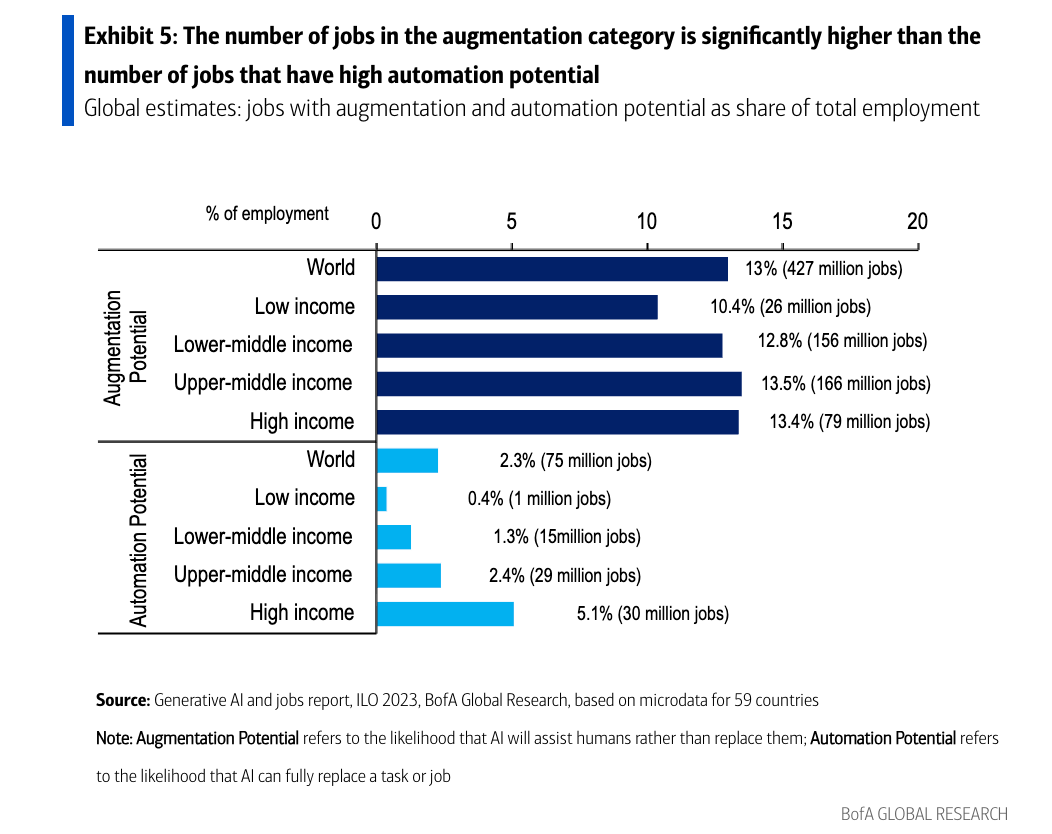
But BofA drew a sharp distinction between exposure and elimination. According to International Labor Organization data cited in the report, 13% of global jobs sit in the “augmentation” category — meaning AI will enhance, not replace, those workers — versus just 2.3% with genuine automation potential.
“GenAI will primarily augment rather than replace workers,” the bank writes, with professional and financial services standing to benefit most and repetitive roles in customer service, information/communications technology, and administration facing the highest substitution risk.
The ATM argument — and its limits
BofA leans heavily on a favorite economist’s parable: the ATM. When automated teller machines proliferated in the 1970s and ’80s, conventional wisdom held that bank tellers were finished. Instead, lower operating costs allowed banks to open more branches, and tellers were redeployed into sales and customer service. The result was increased total teller employment.
Similarly, word processors didn’t eliminate clerical workers; they shifted them toward coordination and communication roles. Excel didn’t gut accounting departments; it expanded them. E-commerce didn’t kill retail employment either; the U.S. still has roughly 15 million–16 million retail workers today, about the same as in the 1990s.
But the ATM parable cuts both ways. Economist and essayist David Oks argued in an influential, widely read Substack post that most of this ATM story is just half the tale. Since the early 2000s, when you could upload checks onto your iPhone and Venmo your friends for meals, “bank teller employment has fallen off a cliff.”
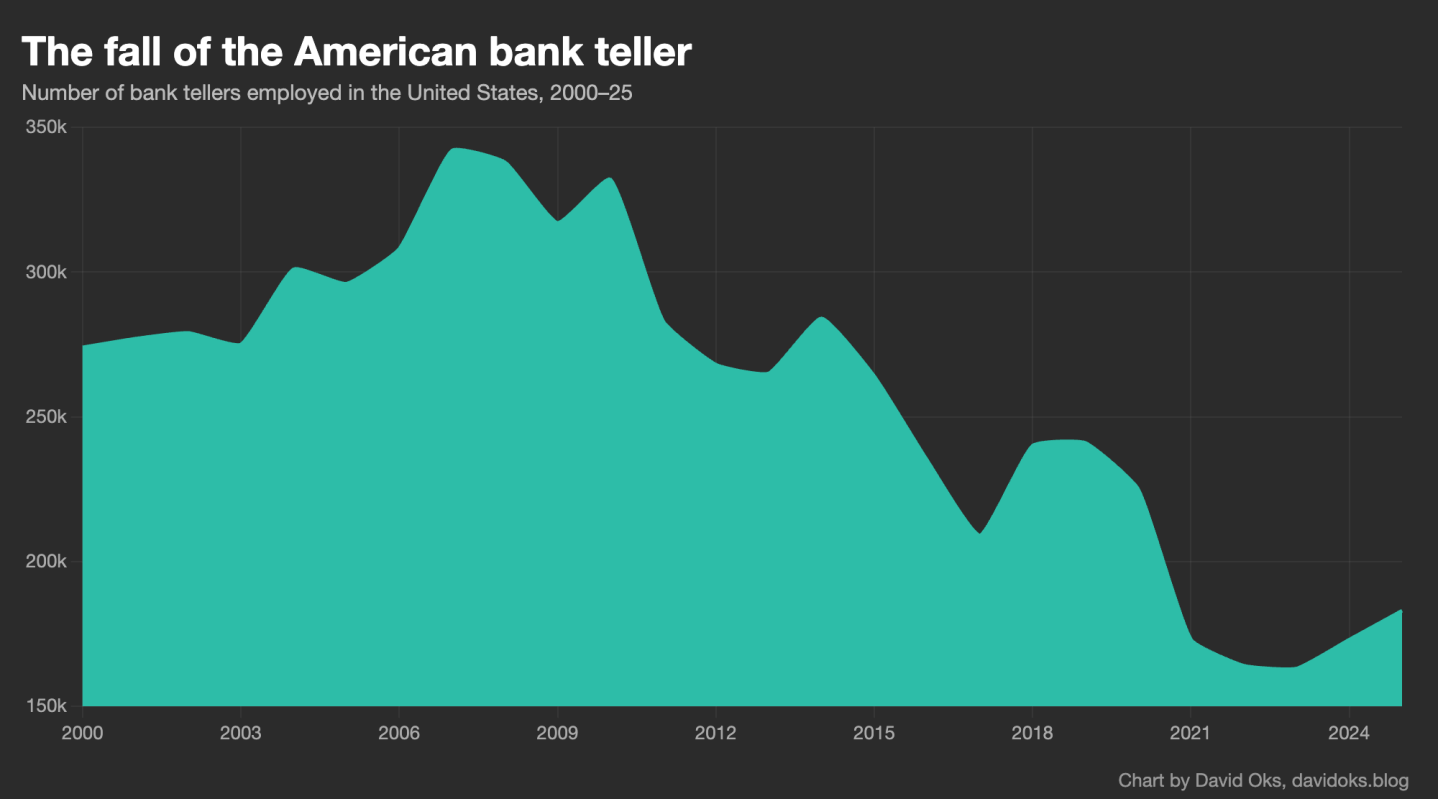
“It is paradigm replacement, not task automation, that actually displaces workers,” Oks wrote. The worry, then, is not that AI will slot into existing workflows and do them a bit faster. It’s that agentic AI — systems that can autonomously execute multi-step tasks, rewrite codebases, orchestrate entire workflows — may not automate the job. It may make the job irrelevant.
BofA acknowledged the risk, flagging agentic AI as a “more structurally disruptive force” that shifts AI from a task-level assistant to, in the bank’s own framing, “AI as worker itself.”
The Jevons paradox
Then there’s the Jevons paradox. Writing in the 1860s, economist William Stanley Jevons observed that making steam engines more fuel-efficient didn’t reduce coal consumption — it caused coal consumption to explode, because cheaper energy unlocked entirely new industrial demand.
Apollo Global Management chief economist Torsten Slok has been increasingly applying the same logic to AI, dubbing it the “Jevons employment effect”: as AI makes professional work cheaper, the total market for that work tends to expand rather than contract, potentially growing headcount in fields from law to accounting to consulting.
The open question for AI is whether cheaper legal memos and financial models will unlock new, previously unmet demand or whether most of that was already being served with AI simply doing the same work with fewer people. Oks’s iPhone counterpoint applies here too: Jevons worked for the ATM but hasn’t worked for the bank teller.
Wall Street optimists in good company
BofA’s research team isn’t alone in reaching for history as a rebuttal to panic. Fundstrat’s Tom Lee has made a similar argument using flash-frozen food.
In the 1920s, Clarence Birdseye’s invention of commercial flash freezing reduced farm labor from 30%–40% of the U.S. workforce to just 2%–5%, yet the transition ultimately created enough new jobs that the economy came out ahead.
Bank of America CEO Brian Moynihan has been making a version of the same case in his own public appearances. Speaking on LinkedIn’s This Is Working podcast in February, he noted that in 1969, economists predicted computers would eliminate all management roles.
BofA today employs roughly 20,000 managers. AI discoveries are augmentations of human capabilities, Moynihan said. “It applies to our auditors, our lawyers, our investment bankers.”
The real risk: Who gets left behind
If BofA is relatively sanguine about aggregate job creation, other economists have been notably less relaxed about distribution. Early data from the Dallas Fed shows that AI-exposed industries are seeing wages rise for experienced workers even as entry-level hiring slumps, suggesting AI is simultaneously augmenting senior staff and squeezing out younger workers at the bottom of the ladder.
Nobel laureate economist Daron Acemoglu’s work offers the starkest warning: unless AI generates new labor-intensive tasks at scale, its productivity gains will naturally flow to capital owners rather than workers, widening the gap between those who own the machines and those who once operated them.
That concern is compounded by a structural gap in the safety net. As Fortune reported in March, nearly 75% of workers displaced by AI won’t collect unemployment benefits, leaving transition support dangerously thin.
Rethinking the tax code
BofA said AI will increase pressure on governments to provide wage insurance, enhanced unemployment benefits, reskilling incentives, and tax reform to ensure the gains from AI don’t concentrate in too few hands.
“Policymakers will need to design transition frameworks that cushion short-term disruption, while preventing labour-market scarring, especially for mid-career workers with skills at risk of obsolescence,” it added.
That prescription is gaining unlikely allies in Silicon Valley. When venture capitalist Vinod Khosla sat down with Fortune editor-in-chief Alyson Shontell in March, he floated eliminating federal income taxes entirely for the roughly 100 million Americans earning less than $100,000, paid for by equalizing the tax rate on capital gains with ordinary income. His math: 40% of all capital gains taxes are paid by people earning more than $10 million a year, making the revenue neutral without raising the overall burden.
A month later, OpenAI arrived at the same destination by a different route. In a 13-page policy paper titled Industrial Policy for the Intelligence Age, Sam Altman’s company called for shifting the tax base away from payroll and labor income — the very revenue streams AI threatens to hollow out — and toward corporate income and capital gains, including what many have termed a “robot tax” on automated labor.
OpenAI warned that as AI automates more work, the wage and payroll tax revenue that funds Social Security, Medicaid, SNAP, and housing assistance could collapse, making capital-based taxation not just equitable, but fiscally necessary. Both Khosla and OpenAI agree that the American tax code was designed for an economy where human labor generated most of the value. That economy is rapidly vanishing.
The 2026 wildcard: The one-person company
BofA flagged one development that could scramble the historical analogy: the rise of what it calls the OPC, or “One-Person Company.” Enabled by agentic AI systems that can autonomously manage workflows, schedule tasks, run scripts, and coordinate operations, 2026 may mark the year a single entrepreneur can perform functions that once required entire teams.
For now, Anthropic’s own research, published last month, showed the gap between what AI can do and what it’s actually doing remains wide but closing fast, particularly in management, legal, and financial roles. A Fortune 500 consultancy recently estimated 93% of jobs face some level of disruption, with a $4.5 trillion price tag attached.
Whether the jobs come back, and for whom, is ultimately a question BofA conceded it cannot fully answer. History says they will. The question is whether they’ll arrive fast enough to matter, and whether agentic AI turns out to be an ATM or an iPhone.