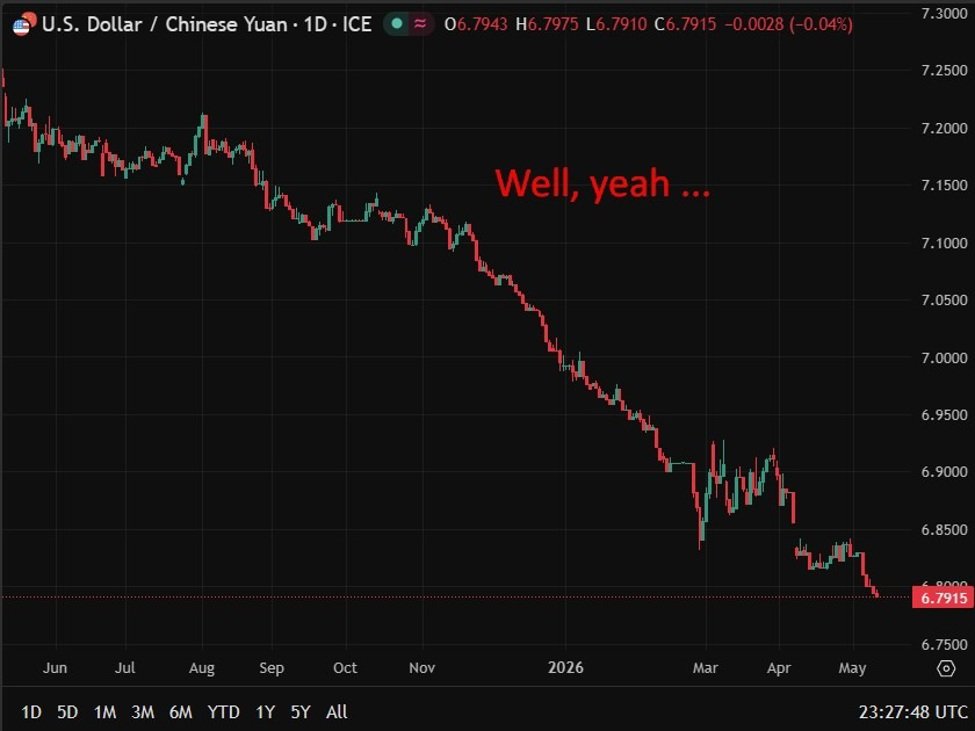
Goldman Sachs says the yuan is more than 20% undervalued against the dollar and has upgraded its forecasts to 6.80 in three months, 6.70 in six months and 6.50 in a year.
Summary:
- Goldman Sachs estimates the Chinese yuan is more than 20% undervalued against the US dollar, with the case for appreciation described as fundamental and longer-lasting rather than event-driven, according to a Goldman Sachs note dated May 8
- Goldman strategists upgraded their yuan forecasts to 6.80 in three months, 6.70 in six months and 6.50 in a year, from prior targets of 6.85, 6.80 and 6.70 respectively, per the note
- The yuan is currently trading around 6.80, near its strongest level against the dollar since early 2023, supported by improving US-China relations and broader dollar weakness, according to the source material
- Goldman cited China’s external surplus approaching unprecedented levels as a share of global GDP, reflecting deep export competitiveness and a structurally undervalued currency, per the May 8 note
- JPMorgan Asset Management also predicted further yuan gains, suggesting a productive Trump-Xi summit could act as a catalyst pushing the currency to 6.50, according to the source material
- Goldman noted that strength in recent People’s Bank of China daily fixings and a rise in exporter conversion ratios support a gradual but sustained appreciation as the right baseline outlook, per the note
Goldman Sachs has declared the Chinese yuan more than 20% undervalued against the US dollar and significantly upgraded its renminbi forecasts, arguing the case for a stronger currency is rooted in structural economic forces rather than short-term diplomatic developments.
In a note dated May 8, reported by Bloomberg (gated), Goldman strategists set out a revised trajectory for the yuan, forecasting a move to 6.80 within three months, 6.70 within six months and 6.50 within a year. The upgrades mark a meaningful step up from the bank’s prior projections of 6.85, 6.80 and 6.70 across the same timeframes. The currency was trading around 6.80 at the time of publication, close to its strongest level against the dollar since early 2023.
Goldman’s central argument is that China’s external surplus is approaching levels without modern precedent as a share of global GDP, a condition the bank attributes to profound export competitiveness embedded across Chinese industry. That surplus, the strategists contend, makes currency appreciation not merely possible but an equilibrium outcome, the natural economic consequence of the trade and capital dynamics at work. On that basis, the bank characterised the renminbi appreciation case as more fundamental and longer-lasting than a diplomatic trade deal alone could generate.
The timing nonetheless coincides with a period of active engagement between Washington and Beijing. President Donald Trump and Chinese leader Xi Jinping are scheduled for talks in Beijing on Thursday and Friday, and Goldman acknowledged the summit could play a meaningful role in stabilising trade relations and supporting sentiment toward Chinese assets. However, the bank was explicit that the structural case for yuan strength does not depend on a positive outcome from those discussions.
Goldman is not alone in its bullish yuan positioning. JPMorgan Asset Management has also forecast further gains, suggesting that a productive outcome from the Trump-Xi summit could act as a specific catalyst driving the yuan toward the 6.50 level. The alignment of major Wall Street institutions around a similar destination, even if the routes differ, adds weight to the broader market repricing of renminbi expectations.
Supporting the gradualist but sustained appreciation thesis, Goldman pointed to two additional signals from within China’s financial system. Recent daily fixings from the People’s Bank of China have displayed a firmer tone, suggesting policymakers are not resisting the move higher. At the same time, exporter conversion ratios, a measure of how readily Chinese exporters are exchanging foreign currency earnings back into yuan, have been rising, indicating that corporate China is increasingly comfortable holding domestic currency rather than retaining dollar exposure.
Taken together, Goldman’s analysis presents yuan appreciation as a convergence of policy tolerance, corporate behaviour and macroeconomic fundamentals, a combination the bank believes supports a durable upward trend over the coming year regardless of how near-term trade negotiations unfold.
—
A 20% undervaluation estimate from Goldman Sachs, if widely adopted across institutional positioning, could accelerate capital flows into yuan-denominated assets and add sustained pressure on the dollar in Asian trading sessions. The convergence of Goldman and JPMorgan forecasts around the 6.50 level over a 12-month horizon raises the prospect of coordinated dollar selling by exporters, particularly as Chinese conversion ratios are already rising. For commodity markets, a materially stronger yuan would incrementally boost Chinese purchasing power for dollar-priced imports including crude oil and industrial metals, a dynamic that could provide modest demand-side support to energy prices if the appreciation trend holds. The outcome of the Trump-Xi summit in Beijing this week will be closely watched as a potential near-term catalyst, though Goldman’s framing of the yuan’s strength as structural rather than event-driven suggests the appreciation trend is unlikely to reverse even if diplomatic progress disappoints.