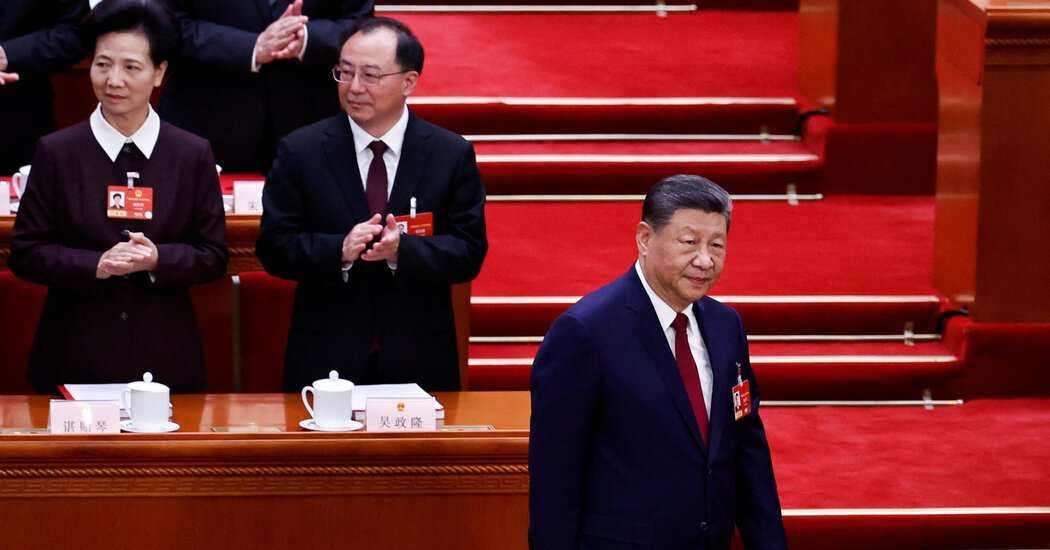
More than halfway through his third term as China’s leader, Xi Jinping still remains one of the most opaque figures in global politics, his views on rivals and partners inferred from the tightly controlled choreography of his public appearances.
But in private meetings with foreign leaders, captured in the accounts of those who were there, along with the occasional hot mic, a sharper portrait emerges. It is of a leader who has no close rivals for power in China, who does not hesitate to lecture less powerful leaders, and who carries himself as a philosopher king in the mold of ancient Chinese rulers.
And by at least one account, Mr. Xi formed his verdict of President Trump nearly a decade ago — a judgment likely to have shaped his approach to global affairs ever since, including how he handles Mr. Trump this week in Beijing.
It was late 2016, and Mr. Trump had just stunned the world weeks earlier by winning the U.S. presidential election. Mr. Xi was meeting President Obama for the final time at a summit in Lima, Peru, and he had questions.
Mr. Xi seemed baffled as to how American voters could choose someone so unconventional, according to Ben Rhodes, a deputy national security adviser in the Obama administration who attended the meeting.
Mr. Obama tried to explain to Mr. Xi that Mr. Trump’s rise was a sign of economic frustration in the United States, in part over the loss of manufacturing jobs to China and the theft of intellectual property. Mr. Xi, in Mr. Rhodes’s telling, was displeased with the explanation.
He put down his pen, folded his arms and said: “If an immature leader throws the world into chaos, then the world will know who to blame.”
Now, as he heads into a summit with Mr. Trump in Beijing, Mr. Xi will want to present China as a stable and strong global power, analysts say, while being conciliatory enough to preserve a fragile trade truce with Mr. Trump.
“I expect that Xi will show Trump respect but not flatter him,” said Susan Shirk, the author of “Overreach: How China Derailed Its Peaceful Rise.”
“The contrast with Trump’s unilateral and disruptive actions will be implicit, not explicit,” she added.
The Lecturer: How Xi Treats Middle Powers
If Mr. Xi treats Washington with cautious restraint, he is less likely to hold back with middle powers like Canada and Britain.
-
In 2022, Mr. Xi confronted then-Prime Minister Justin Trudeau of Canada at the end of a Group of 20 summit in Indonesia and accused him of leaking details of the previous day’s talks between them to the media. The tense exchange between the two men, who were standing close to each other and speaking through translators, was captured by a news cameraman.
“That was not appropriate,” Mr. Xi said, smiling tightly. “And that’s not how the conversation was conducted,” he continued, shaking his head. He said sincerity and respect were needed for talks to be productive, and in an implicit warning, added: “Otherwise, the outcome will be hard to say.” Mr. Trudeau tried to argue that he had done nothing wrong by Canadian standards and offered to agree to disagree. Mr. Xi then cut him off and said, “Let’s create the conditions first,” before shaking Mr. Trudeau’s hand and walking off.
-
With Canada’s current leader, Prime Minister Mark Carney, Mr. Xi attempted to set the rules of how they should engage, saying he did not want to be criticized in public.
Mr. Carney said Mr. Xi told him in a recent meeting in South Korea, their first since the Canadian leader took office, to raise any issues with him in private. “He chose to spend the first 10-plus minutes discussing how he wanted the personal interaction to be,” Mr. Carney said at a Lowy Institute event in Sydney in March.
Mr. Carney summarized Mr. Xi’s message as: “No surprises. If you really care about something, be clear,” he said. He added: “I mean, he didn’t say it this way, but I interpret it. Don’t lecture me in public. Bring issues to me directly.”
-
While Mr. Xi may not want to be lectured, he has no problem venting to others. When Prime Minister Keir Starmer of Britain met with Mr. Xi in Beijing in January, the British leader brought up Chinese-Japanese relations, which are at their lowest point in years.
Mr. Xi, who had been calm throughout the meeting, grew agitated and told Mr. Starmer that the tensions were entirely Japan’s fault, according to two people familiar with the interaction, who spoke on the condition of anonymity. Beijing has waged a pressure campaign against Tokyo after Prime Minister Sanae Takaichi of Japan told her Parliament that Japan could respond militarily if China attacked Taiwan.
The Philosopher: How He Engages the Powerful
The Chinese Communist Party seeks legitimacy by casting itself as custodian of China’s thousands-year-old civilization. Mr. Xi reinforces that tradition by carrying himself like one of China’s ancient philosopher kings whose duties included applying Confucian values to governance and statecraft.
“In Chinese political culture, the top leader is not supposed to care about day-to-day mundane things,” said Zoe Liu, a senior fellow at the Council on Foreign Relations. “They are the ‘son of heaven’ and are supposed to be engaged in philosophical matters.”
That not only amplifies a leader’s importance, but also emphasizes the greatness of Chinese culture to Western leaders hoping to change Beijing’s behavior.
-
That was quickly apparent to President Obama during a state visit to Beijing in 2014. After a long private dinner with Mr. Xi in the walled leadership compound known as Zhongnanhai, Mr. Obama’s aides were expecting to hear that the two leaders had spoken about contentious issues like the South China Sea.
“In fact, they had this kind of lengthy discussion about whether there is compatibility between individualist societies and collectivist Confucian societies,” said Mr. Rhodes, the former Obama adviser.