As Adam pointed out, the inflation story was “overwhelmingly a gasoline story,” with energy accounting for more than 60% of the monthly increase in CPI. That characterization may help explain why the market’s initial reaction has been relatively muted. However, the bigger issue for policymakers is what comes next.
We’re now well into June, the conflict in the Middle East remains unresolved, and recent developments suggest the situation may be worsening rather than improving. If energy prices remain elevated or move even higher, today’s “gasoline story” could become a broader inflation story in the months ahead. That raises the question of whether the Fed can afford to simply look through the latest rise in prices as a temporary shock.
The Fed continues to emphasize its 2% inflation target, but markets will be paying close attention to next week’s FOMC meeting for clues about how Chair Warsh and other policymakers are interpreting the recent data. Are they still willing to view energy-driven inflation as transitory, or are they becoming more concerned that higher fuel costs could eventually spill over into core inflation and inflation expectations?
For now, investors appear somewhat relieved. Prior to the CPI release, S&P 500 futures were indicating a decline of about 58 points, while Nasdaq futures were down roughly 381 points. Since the report, those losses have narrowed, with S&P futures now pointing to a decline of around 35 points and Nasdaq futures down about 210 points. The market’s response suggests traders believe the report, while firm, was not strong enough to significantly alter the Fed outlook ahead of next week’s policy decision.
The USD has declined modestly.
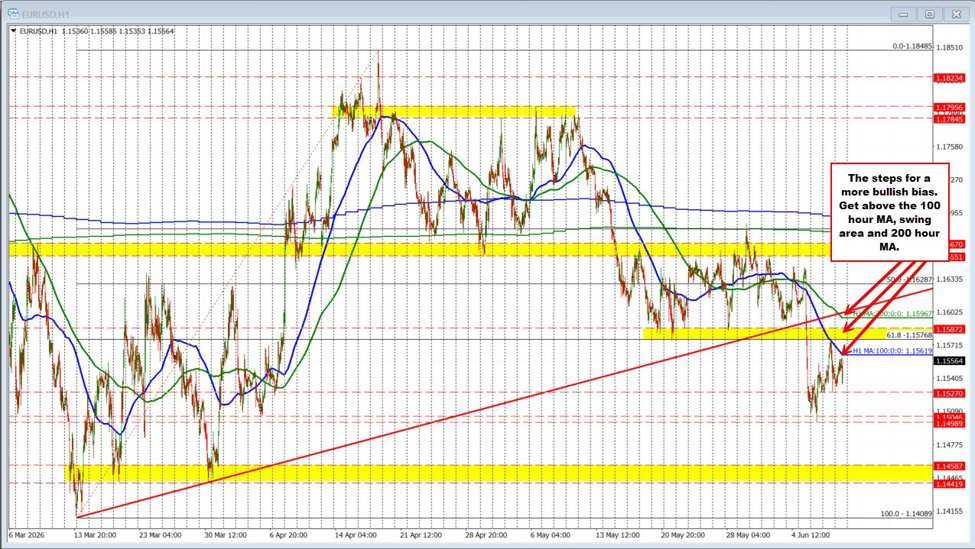
- The EURUSD is trading near the session high at 1.1556 as buyers look to build on the latest upside momentum. The next key technical hurdle comes at the 100-hour moving average, currently at 1.1562. Recall that this moving average helped stall the rally during yesterday’s trade. If buyers can push above that level, attention shifts to a swing area between 1.1577 and 1.1587, followed by the falling 200-hour moving average at 1.1597. A break above those resistance levels would strengthen the bullish case and give buyers greater control of the pair in the short term.
- The USDJPY has edged modestly lower, trading at 160.39 after reaching a session high of 160.52 just ahead of the data release. Despite the dip, sellers still have work to do from a technical perspective. The pair remains above the rising 100-hour moving average at 160.17 and the key 160.00 natural support level. Just below that, the rising 200-hour moving average comes in at 159.93. A move below those support levels — and, importantly, the ability to stay below them — would be needed to shift the technical bias more convincingly to the downside.