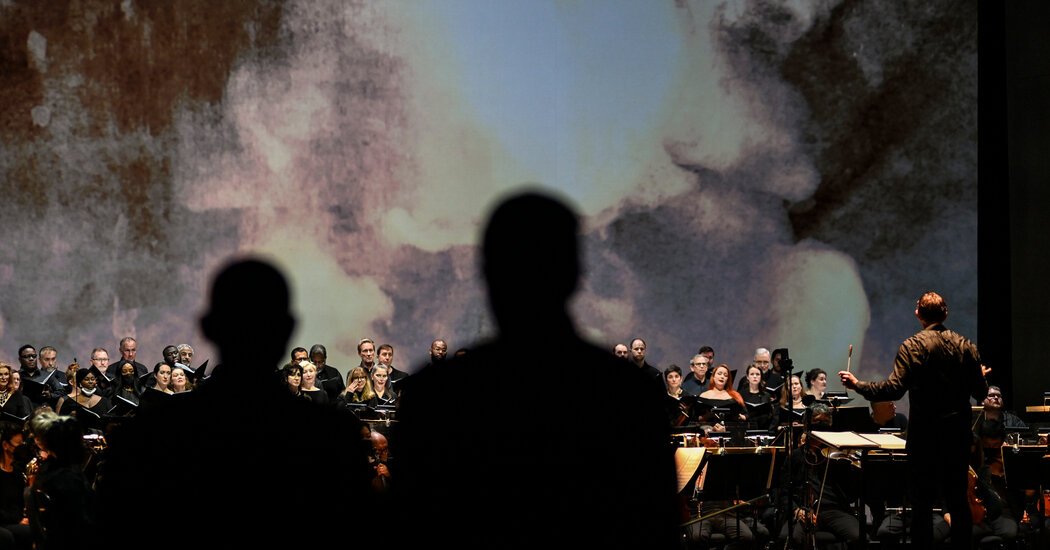
The Washington National Opera, which recently severed its longstanding relationship with the John F. Kennedy Center for the Performing Arts, has filed a lawsuit that demands more than $17 million from the center that the opera company estimates it is owed.
The suit, filed Thursday, says that since the opera company struck out on its own this year, Kennedy Center officials have refused to release the money, which the court papers say includes endowment funds, other donations and income that was collected for the company’s benefit.
“W.N.O. reluctantly files this case to preserve its future and to protect its donors and artists,” lawyers for the opera said in court papers, which identify the funds as donor gifts received over years that are “critical” to its operations.
In a statement responding to the lawsuit, Roma Daravi, a spokeswoman for the center, said that the relationship with the opera company “financially burdened” the center for more than a decade. The statement noted that taking into account the company’s endowment, an external accounting firm had calculated that the company had “accumulated a $72 million deficit to the center” between 2011 and 2026, the years it was an affiliate of the institution.
“The center has acted transparently and in the best interests of the public throughout this process,” Ms. Daravi said. “This lawsuit is meritless, and we plan to pursue a countersuit to defend the institution.”
The opera left the center in January, nearly a year after President Trump’s takeover of the Kennedy Center led to an exodus of audiences, artists and donors. Officials at the center said then that they had decided to part ways with the opera, which had played there since 1971, “due to a financially challenging relationship.”
The legal dispute comes as the Kennedy Center remains mired in uncertainty. In response to a separate lawsuit, a federal judge ordered the president’s name removed from the center and temporarily blocked his plan to close the institution for two years of renovations. Lawyers for the center and Mr. Trump, who is chairman of the board, appealed the decision on Thursday.
The opera’s lawsuit, filed in the United States Court of Federal Claims, details the tensions that arose before the company’s departure. It lists the federal government as the defendant because the center was established by Congress.
The lawsuit says that the day before the separation announcement, Donna Arduin, the Kennedy Center’s chief financial officer, told leaders of the opera company that money in a fund containing bequests and other contributions to the opera had been used as collateral for a line of credit.
The suit says Ms. Arduin asserted that those funds belonged to the center, but the opera company contends they were expressly reserved for its benefit. The suit did not specify how much money was said to have been used as collateral.
For about 15 years, the opera company was an affiliate of the Kennedy Center, meaning that the center oversaw its operations and funding, and the company performed in its 2,364-seat Opera House. But its close relationship faltered after Mr. Trump installed his allies as its leaders.
Richard Grenell, Mr. Trump’s handpicked president of the center, accused previous leadership of financial mismanagement and sought to require that programming be revenue neutral, meaning shows would need to take in as much money in ticket sales and sponsorships upfront as they cost to mount. That expectation ran up against the realities of American opera companies, which typically operate with deficits that are backfilled by donations.
The lawsuit says that by the fall of last year, leaders at the Washington National Opera had “lost all visibility” into its financial accounts, which were managed by the center.
“For months, W.N.O. repeatedly tried to address these issues with the Kennedy Center, including through written requests, requests for meetings, and meetings with Kennedy Center leadership,” the suit says. “Those efforts were met with indifference.”
The request for more than $17 million relies on the opera company’s own estimate of its finances; the suit does not make clear how much of the figure is made up of endowment funds.
After Mr. Grenell suggested an “amicable” separation between the two organizations, the suit noted, the opera’s leaders — who were increasingly concerned about the trajectory of ticket sales and donations — agreed. When the decision was announced, public statements on both sides were cordial. But behind the scenes, conflict was building.
The suit says that Kennedy Center officials engaged a third-party accounting firm to calculate what the opera company might be owed, but that there has been no stated commitment to actually transfer any money.
Ms. Daravi, the spokeswoman for the center, said the opera company had “failed to engage in good-faith discussions” amid the financial dispute, despite “multiple proposals.”
In recent months, the opera company has been preparing for a new season at venues in and around Washington, relying on funding reserves and emergency fund-raising. The season starting in the fall includes a new production of Puccini’s “Madama Butterfly,” staged at DAR Constitution Hall, and John Adams’s “Nixon in China,” starring Renée Fleming and Thomas Hampson.