Shipowners and operators hoping to seize on a window of calm to exit the Persian Gulf for the first time in more than three months confronted new waves of chaos and confusion on Friday, capping a week of head-spinning developments in the war in Iran.
A preliminary agreement signed on Wednesday by President Trump and President Masoud Pezeshkian of Iran began a 60-day period of negotiations between the countries. Critically, Iran promised to reopen the Strait of Hormuz, and the U.S. military said on Thursday that it had lifted a blockade it had imposed on Iranian ships since April.
But on Friday, the next phase of talks between the countries, planned to be held in Switzerland, was postponed, and Israel said it had targeted Hezbollah militants after four of its soldiers were killed in Lebanon. Israel and Hezbollah announced a cease-fire later in the day. Within Iran, a news agency linked to Iran’s Revolutionary Guards carried an editorial that called for the strait to be closed.
Oil prices, after falling sharply this week, rose.
On Friday, at least five tankers moved through the strait, and on Thursday, 25 ships transited, including 14 tankers, higher than the average of recent weeks, according to Kpler, a maritime data company. Most of the tankers took a route that hugs the Iranian coastline, the path used by sanctioned ships throughout the conflict. Traffic was still far below typical levels before the war, when about 130 vessels per day moved through the strait.
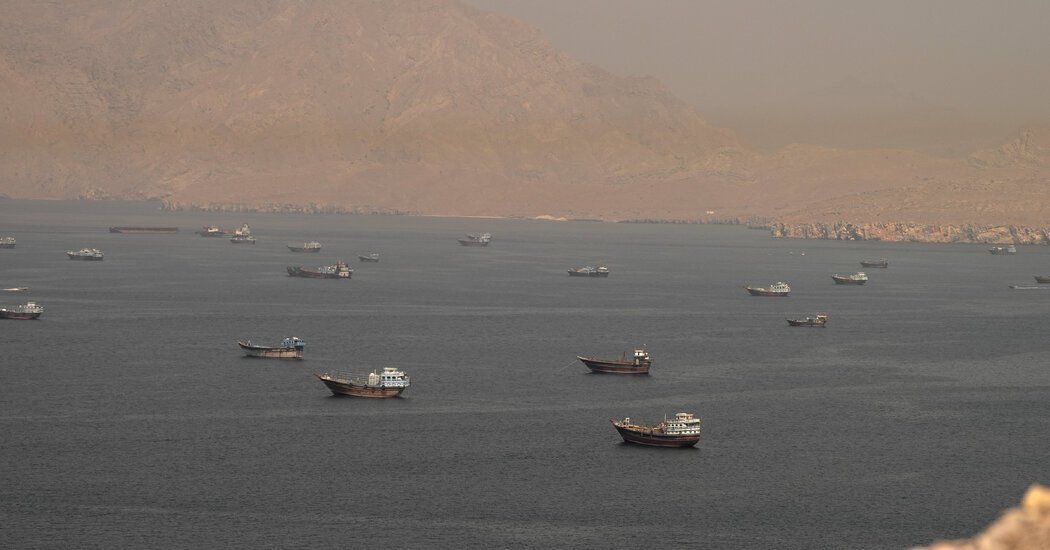
For shipping companies, and the 11,000 seafarers still stuck on vessels, a meaningful resumption of traffic in the Persian Gulf remained contingent on the resolution of a number of critical concerns. About 500 commercial vessels remained stranded in the gulf.
For most companies, certainty that vessels could pass was paramount.
One shipping executive, who asked not to be named out of concern for the safety of the stranded ship his company manages, said he deemed the conditions too uncertain for the ship to leave the Persian Gulf.
With the central part of the strait littered with naval mines, some executives said they were waiting for clarity about the route ships should take, the rules for getting in line and a process for exiting to avoid navigational risks, including collision, particularly amid interference with GPS and other satellite-navigation systems. There are two viable ways in and out of the Persian Gulf: the northern route, traversing Iranian waters, and the southern one, through Omani waters, which has been supervised by the U.S. Navy, but where ships risk running aground on the rocks.
The Persian Gulf Strait Authority, Iran’s newly formed regulatory agency that it created to run operations in the strait, caused more confusion on Friday with a notice to ship operators saying that all vessels needed a permit and an approved insurer to transit the strait. Passage would be permitted only through the Iranian route near Larak Island, the notice said. Any deviation from this route would be viewed as a violation, it said.
The directive raises questions whether international sanctions and antiterrorism laws would allow shipowners to engage with Iran over such insurance policies.
“There isn’t really clarity over that one,” said Neil Roberts, the head of marine insurance at the Lloyd’s Market Association, a trade organization representing insurers at Lloyd’s of London. The United States, Britain and the European Union would need to provide guidance for companies, he said.
Capt. Tim Hawkins, a spokesman for the U.S. Central Command, said on Friday that all vessels had the right to pass through the strait “without any arbitrary requirement claims or impediments.”
He said that “U.S. forces will continue to operate in the general area to support freedom of navigation.”
Shipping companies were also dealing with practical issues. After being at a standstill in the Persian Gulf for more than three months, barnacles and sea creatures had grown on the hulls of ships, impairing speed and presenting operational problems.
Jakob Larsen, the chief safety and security officer at the Baltic and International Maritime Council, the world’s largest shipping association, warned Friday of the continued risks of trying to transit the strait, including from uncoordinated mass transit through a narrow zone.
On Thursday, the Joint Maritime Information Center, which monitors threat assessments on high-risk shipping routes, had reduced the risk of transiting the strait to “moderate.” Active mine clearance operations were continuing, an advisory route said, adding that ships should avoid the central route because of mines and that the Omani route was mine free.
Nils Haupt, a spokesman for the German shipping company Hapag-Lloyd, which has four vessels and about 90 seafarers stranded in the Persian Gulf, said the vessels were ready to go but were staying put for now. “No indication right now when we would move,” he said on Friday.