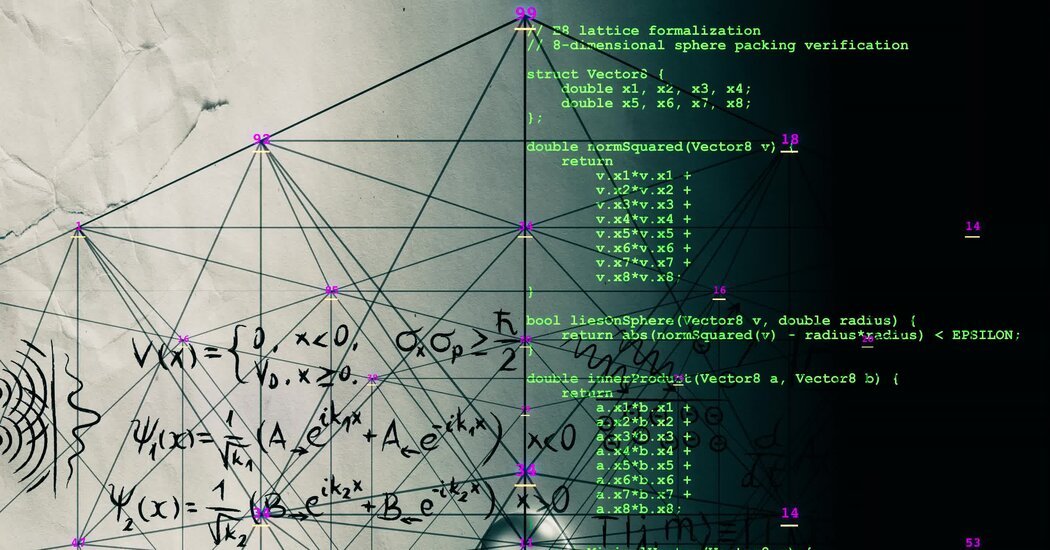
So last fall, when Math, Inc. told the group that Gauss had solved about 30 unfinished pieces of the proof, Mr. Hariharan and his colleagues were enthusiastic. They asked the company to share its full results. Instead, the start-up went dark.
Auguste Poiroux, a doctoral student at the École Polytechnique who also works for Math, Inc., said the company had turned its focus toward a new version of Gauss. The company decided to return to the sphere-packing problem only months later, using it as a test case for its upgraded system.
Shockingly, Mr. Poiroux said, the improved Gauss completed the whole proof.
Even more shocked was Dr. Viazovska, when an excited Mr. Poiroux gave her a glimpse of the “accidental” solution, as he described it. “I quickly saw that the excitement was not shared,” he said. He asked her to hold off on informing Mr. Hariharan, whom she emailed soon afterward.
Mr. Hariharan’s next call was to his parents in Dubai. “You wonder if it was all in vain,” he said. “Why did you spend two years of your life on this in the first place?”
“Trust your guru,” his parents told him. “Trust in the process.”
That night, Jesse Han, Math, Inc.’s chief executive, messaged Mr. Hariharan that he was boarding a red-eye flight to Pittsburgh. They met in a Starbucks the following morning, along with Mr. Hariharan’s adviser, Jeremy Avigad, who rushed from the gym after “the fastest shower of his life,” he recalled. After Dr. Han proposed disclosing the result immediately and moving on to a related formalization project, the academics erupted, arguing that the original goal of the project, to better understand Dr. Viazovska’s proof, was far from complete.