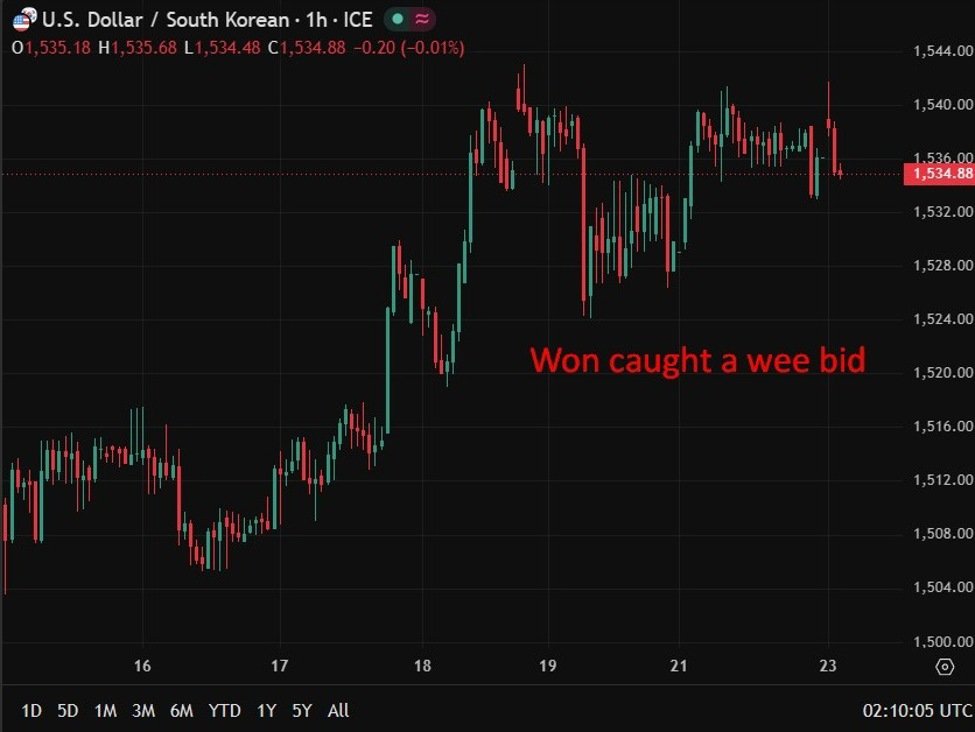
The explicit use of the word “excessive” by a finance minister in reference to a currency level is among the more direct forms of verbal intervention available to a policymaker, and markets will treat it as a signal that authorities are closer to acting than standard diplomatic language would imply. The identification of foreign equity selling as the mechanism driving won weakness, estimated at around 140 trillion won in portfolio rebalancing, gives the government a specific and quantifiable target to push back against, which strengthens the credibility of the intervention threat. The pledge to prevent sudden volatility is the standard formulation Seoul uses before moving in currency markets, and coming alongside the “excessive” characterisation it raises the probability of coordinated action meaningfully. USD/KRW will be sensitive to any follow-through, and regional EM FX will watch closely given that a defence of the won at these levels could signal broader Asian currency support operations.
South Korea’s Finance Minister Koo Yun-cheol called the won’s level around mid-1,500 per dollar “excessive” versus fundamentals, blaming foreign equity selling and pledging action against sudden market volatility.
Summary:
- South Korean Finance Minister Koo Yun-cheol said at a cabinet meeting on Tuesday that the won’s current level of around mid-1,500 per US dollar is excessive relative to the country’s economic fundamentals, according to the source material
- Koo was responding to a question from President Lee Jae Myung about why the won remains weak despite strong exports and a record-high current account surplus, per the source material
- The finance minister attributed the currency weakness to profit-taking by foreign investors rebalancing portfolios following a rapid rally in South Korean equities, with foreign selling estimated at around 140 trillion won, equivalent to approximately $91.21 billion, according to the source material
- Koo said regulators would act to prevent sudden volatility in markets, per the source material
South Korea’s Finance Minister Koo Yun-cheol has described the current level of the won as excessive relative to the country’s economic fundamentals, in some of the most direct language Seoul has deployed on the currency in recent months and a clear signal that authorities are moving closer to intervention.
Speaking at a cabinet meeting on Tuesday, Koo said the won’s trading level of around mid-1,500 per US dollar did not reflect the underlying strength of the South Korean economy. His comments came in response to a question from President Lee Jae Myung, who asked why the currency had remained so weak despite a backdrop of strong export performance and a current account surplus that has reached record-high levels, a combination that would typically be expected to support the exchange rate.
Koo attributed the disconnect to aggressive portfolio rebalancing by foreign investors who had accumulated large positions in South Korean equities during a rapid market rally and are now selling to lock in gains. He estimated that foreign investors have sold approximately 140 trillion won, equivalent to around $91.21 billion, in the course of that rebalancing process, without specifying the time period over which those sales occurred. The scale of the figure helps explain why external trade strength has been insufficient to offset the downward pressure on the currency, as equity-driven capital outflows have overwhelmed the current account support.
Koo added that regulators would move to prevent sudden volatility in markets, a formulation that carries particular weight in the South Korean context. Seoul has historically used similar language immediately before conducting or authorising foreign exchange market operations, and the pairing of that pledge with an explicit characterisation of the current level as excessive is being interpreted by markets as a meaningful escalation in the verbal intervention campaign.
The cabinet meeting exchange is notable not only for the language used but for the forum in which it occurred. A finance minister making on-the-record comments about FX levels being misaligned with fundamentals in front of the president and the full cabinet signals a degree of institutional consensus behind the currency defence position, rather than a unilateral statement from the finance ministry alone.
ADDED:
- Korea Exchange triggered a KOSPI circuit breaker after KOSPI 200 futures fell 5%; program trading halted for 5 minutes.