At a factory in southeastern China, robot arms spin balletically, winding long strips of metal into rolls and shaping them into bricks that are destined to become batteries.
As workers in white coveralls watch, the nascent batteries are packaged into aluminum cases and, as workers put it, “given life” — endowed with an electrical charge that will eventually power cars and data centers across the world.
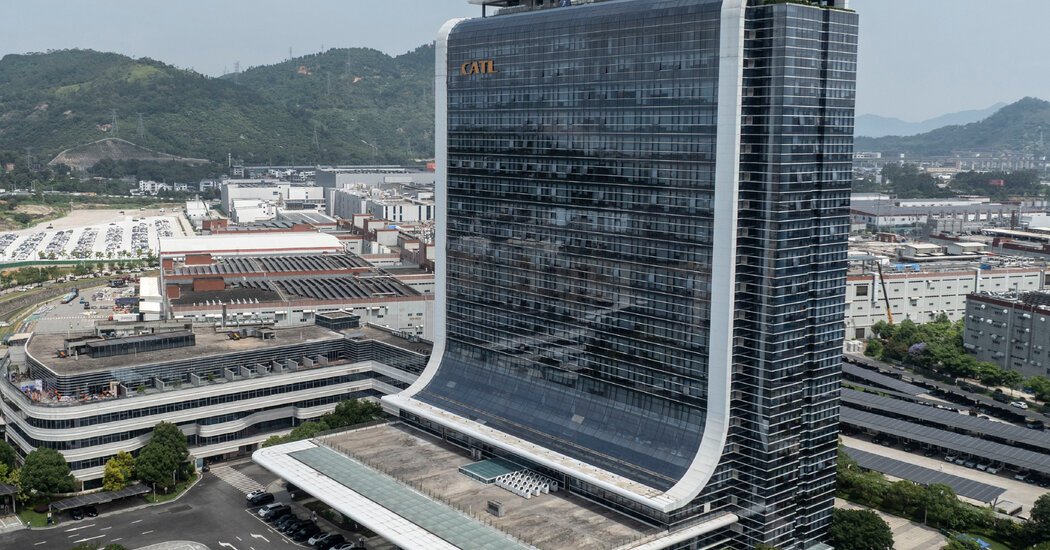
The site, owned by Contemporary Amperex Technology Company Ltd., or CATL, is the world’s largest cluster of battery factories, and the most advanced. Inside its walls, the dynamic between the United States and China is changing.
For decades, American companies maintained a huge technological lead over their Chinese competitors. U.S. firms came to China to manufacture their goods more cheaply. As a price of entry, the Chinese government forced foreign companies into partnerships where Chinese firms could learn from them and absorb their more advanced technology.
In at least a few sectors, that equation has flipped, with China racing ahead of the United States. From batteries and solar panels to rare earths and life sciences, China is developing some of the world’s most advanced technologies, and it is rapidly deploying plans to corner other markets.
CATL is indicative of that shift. It has unveiled a battery that, according to the company, can power an electric vehicle for 250 miles with less than 10 minutes of charging — about three times the charging speed of batteries typically found in other electric vehicles. CATL’s battery technology is powering millions of cheap electric vehicles that China is exporting around the world.
The company sees further potential in America’s enormous car market.
“Of course if there’s an opportunity in the U.S., we wish to pursue it,” said Fred Zhang, a company spokesman.
These advances are raising major questions for U.S. officials, who see danger in relying too much on Chinese technology. Lawmakers and some administration officials argue that China has used predatory practices to build a dominant position in batteries and other fields. They say that has hollowed out the industrial base of other countries, including the United States, and extended the Chinese government’s power globally.
Over the past year, Beijing weaponized its control over global supply chains, cutting off mineral exports and threatening to shut down U.S. factories to force the Trump administration to back down on tariffs. China has described its control of other industries, like pharmaceuticals, as a potential future lever over foreign governments.
Representative John Moolenaar, a Michigan Republican who is chairman of the House Select Committee on China, said China had subsidized CATL “to undercut non-China competitors and build worldwide dependence.” Entrusting a critical industry to the company would be “a grave error,” he added.
But others say not working with Chinese firms like CATL will lead U.S. companies to fall behind, eroding America’s position in important industries. Walling off the world’s most dynamic economies could also slow progress toward scientific and technological advances, and impede efforts to combat climate change.
“For decades now, we’ve been used to a world where the technology and innovation comes out of the West,” said Kyle Chan, a fellow at the Brookings Institution, a Washington think tank. “The tables are turning.”
The United States appears to be at an inflection point, where it must choose if it wants to use China’s cheap and advanced battery technology — or spend much more to develop an independent supply chain for an industry that could come to underpin much of U.S. energy infrastructure.
American officials have been firmly opposed to Chinese car imports, seeing them as a fast ticket to destroying the U.S. auto industry. But they are more divided over the batteries that go into cars, power plants and data centers because most major battery makers are foreign companies.
General Motors has invested with South Korean battery makers to build a non-Chinese supply chain, but other U.S. automakers already consider CATL a vital partner. CATL sells batteries to Tesla, and it has licensed its technology to Ford Motor to use in plants in Michigan and Kentucky.
Ford collaborated with the South Korean battery maker SK On in its Kentucky factory, but dissolved the partnership in December. Republicans have scrapped Biden administration incentives for electric vehicles, cooling the E.V. market in the United States. This year, Ford said it would pivot the Kentucky plant to make batteries for energy producers and data centers, an area where Congress still provides subsidies.
CATL’s presence in the United States has been controversial. In 2023, the Virginia governor at the time, Glenn Youngkin, blocked a Ford-CATL factory, calling it a “Trojan horse” for the Chinese Communist Party.
In 2025, the U.S. government added CATL to a list of Chinese military companies, saying it was “indirectly affiliated” with top bodies of the Chinese government. CATL said that the designation, which barred the company from U.S. defense contracts, was “a mistake” and that it had never engaged in any military business.
Testing the Waters
Chinese investment already faces significant hurdles in the United States, including federal security reviews and state restrictions on Chinese purchases of real estate and farmland. In Michigan, the Chinese company Gotion was blocked from building an E.V. battery factory after protests.
The United States also has high tariffs on Chinese car and battery imports, and a ban on the use of Chinese software starting with 2027 vehicles.
But American and Chinese companies are eyeing whether President Trump’s seeming openness to doing business with China and his plans to meet China’s leader, Xi Jinping, again this year might open the way for more partnerships.
Mr. Trump has welcomed investment from Japan and Europe, and Chinese officials have pitched their U.S. counterparts on investing in the United States. During Mr. Trump’s visit to China last month, the countries said they would create a “board of investment.”
In an interview on CNBC on May 14, Scott Bessent, the Treasury secretary, said the board would “decide upfront what are the nonstrategic, nonsensitive areas where it would be possible for the Chinese to invest.”
But the Trump administration has been attuned to criticisms that Chinese investments could compromise national security. In May, Jamieson Greer, the U.S. trade representative, said the board would be focused more on resolving specific complaints by U.S. companies than on creating a “program of mutual investment.”
Reva Goujon, a director at Rhodium Group, a research firm, said U.S. firms like Ford and Stellantis were interested in partnerships that could help them absorb more advanced Chinese technology and maintain their electric vehicle lineups without incurring high costs. Stellantis has a joint venture with CATL in Europe and is constructing a battery factory in Spain.
“They’re trying to position themselves for if there is a thaw between the U.S. and China on investment,” she said. “They’re testing the political waters.”
The Chinese government has encouraged some companies to expand internationally, but with strategic sectors like batteries, there are still big questions about how much technology China will allow them to share with foreign partners. In addition to flexing its control over mineral exports, Beijing recently added restrictions to exporting battery manufacturing technologies, and established a more rigorous system to review outbound technology investments, Ms. Goujon said.
The country’s imperative “is to hold on to the crown jewels for any technology,” she said. “When it comes to more obvious forms of tech transfer, I think Beijing is going to be very, very strict about that.”
Beijing scuttled Meta’s acquisition of Manus, a Singaporean-based artificial intelligence company founded in China, and blocked Elon Musk from buying equipment that would help Tesla make solar products in the United States.
Rush Doshi, an assistant professor at Georgetown University who previously served as the China director for the Biden National Security Council, said Chinese investments could help the United States if CATL used American suppliers, workers and software. If the company just shipped all the high-value parts in from China, however, it would hurt U.S. industry, he said.
“If we import Chinese batteries without making our own, we will lose a critical industry of the future,” Mr. Doshi said, adding, “The ‘how’ is critical.”
‘Trojan Horse’ or Key Partner?
At the CATL’s factory complex in Ningde, fresh air from the East China Sea flowed into a huge white marble lobby and a showroom with the slogan “Together for the energy freedom!” The building is shaped like a lithium battery, the product that tens of thousands of workers are making in nearby factories.
CATL was founded in 2011 out of an electronics firm that got its break making the battery for the Apple iPod. At two dozen plants globally, CATL now makes 40 percent of the world’s electric vehicle batteries, and 30 percent of batteries used to sock away solar and wind power and stabilize the electricity grid.
The company credits its success partly to its spending on research and development, which it says totals more than other battery companies combined. CATL says that 22,000 of its 185,000 employees work in research and development, and that of those, more than 700 hold Ph.Ds.
But Chinese policies have also been central to the company’s success, specifically financial incentives for Chinese consumers to buy E.V.s. The government poured hundreds of billions of dollars into the sector. Directives from the highest levels of the Communist Party encouraged battery research, while regulations discouraged the use of non-Chinese batteries and pushed American firms out of the country.
U.S. officials have criticized China’s industrial subsidies, saying they create an unfair playing field and distort global markets. Those practices show no sign of slowing.
A study released in June by the Organization for Economic Cooperation and Development found that industrial firms in China had received three to eight times as much government support over the past two decades as companies in the 38 mostly wealthy nations that belong to the O.E.C.D. In a report last month, the U.S. Chamber of Commerce and Rhodium Group argued that Chinese industrial policy was becoming more pervasive and systemic, calling the strategy an “industrial policy of everything.”
Others argue that China’s advances are fueled by investments in research, education and talent, policies that the United States should do more to emulate.
Albert Bourla, the chief executive of Pfizer, said in March that one of Pfizer’s biggest challenges was how to tap into the “the meteoric rise” of China’s scientific abilities in the midst of geopolitical tensions.
Mr. Bourla predicted that China would surpass the United States in biopharmaceutical innovation within this decade, saying the country had carried out a strategic plan over decades to reform regulations, file patents, fund research and cultivate talent.
“They built their science. So this is where we need to become better,” Mr. Bourla said.
Li You contributed research. Jack Ewing contributed reporting from New York.