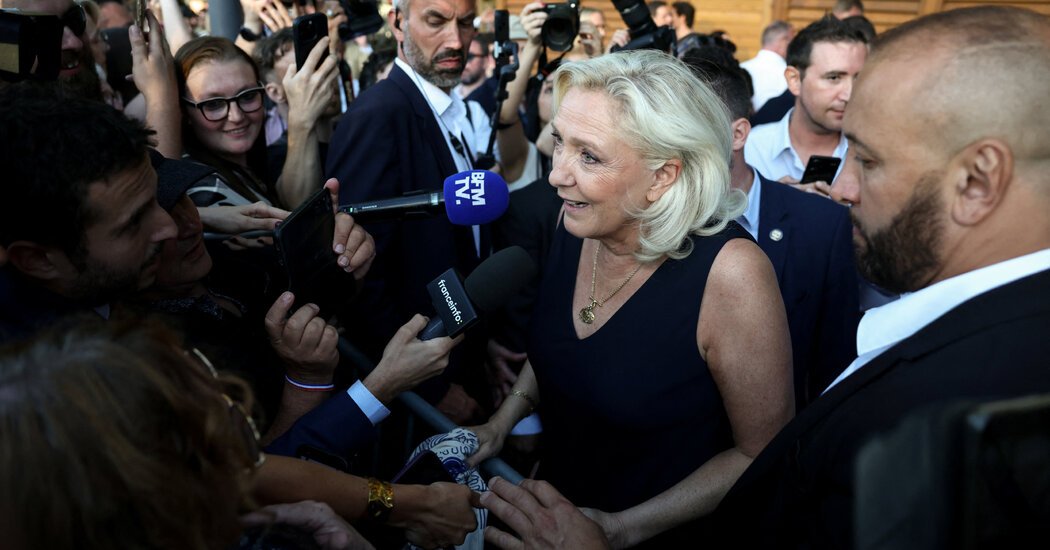
Marine Le Pen, the French far-right leader, announced on Tuesday that she will run for president of France, hours after a court upheld an embezzlement conviction against her but lifted a ban on her seeking public office.
The decision, on a day of rapid-fire legal and political developments, is a stunning turnaround in Ms. Le Pen’s fortunes. For more than a year, her candidacy had been viewed as close to a lost cause, after her initial conviction on corruption charges came with a crippling five-year ban on seeking public office.
Her protégé, Jordan Bardella, was primed to step into her place as the candidate of the far-right party, the National Rally, if she had been ruled ineligible. Instead, Ms. Le Pen said, she will make her fourth bid for the presidency in 2027, having crept closer to victory in each of her last three campaigns.
Now, she is the front-runner in the race, outpolling most of her rivals in many recent surveys.
“This evening, I am a candidate in the presidential election,” Ms. Le Pen said in an interview with the French broadcaster, TF1. She added of the court’s ruling, “I was happy that we gave back the French their freedom to vote and that the court gave me back my eligibility.”
Though the court upheld the conviction, it shortened a ban on Ms. Le Pen running for office, which reopened the door to a potential campaign. The decision means that she may have to wear an electronic bracelet that limits her movements — something she had previously said would make a candidacy impossible.
On Tuesday, Ms. Le Pen said she planned to appeal the decision to France’s highest court, the Court of Cassation. That appeal, she said, would seek to suspend the requirement for her to wear an electronic monitor, allowing her to campaign freely. But the prospect of another appeal would keep a legal shadow over her.
Ms. Le Pen had previously lashed out against the charges, saying they were part of a political witch hunt and would deprive millions of French people of their votes in the next election. She finished second to Emmanuel Macron in 2022, winning more than 41 percent of the vote.
What was Ms. Le Pen convicted of?
Ms. Le Pen was found guilty of embezzling funds from the European Parliament between 2009 and 2016. It was part of a scheme in which the National Rally channeled several million euros — intended to subsidize the salaries of aides to the party’s European Parliament members — to pay for other party activities. She denied the charges and was not accused of enriching herself personally, but of misusing public funds.
The appeals court largely upheld a decision made by a lower court in March 2025, though it reduced the amount that the defendants were convicted of embezzling, to roughly $3.2 million from $5 million.
The National Rally is not the only French party accused of embezzling such funds. The Democratic Movement, a centrist party, was also convicted of doing so, although its leader was cleared. France Unbowed, a hard-left party, was investigated on similar allegations, though nobody was charged.
What was her initial punishment?
Ms. Le Pen, a member of the French Parliament, was sentenced last year to four years in prison and fined 100,000 euros, or $114,000. The court suspended two years of her sentence and ruled that the other two could be served under a form of house arrest.
She was also barred from running for any political office for five years, a period that began immediately after her conviction in March 2025.
How was her punishment changed on appeal?
The appeals court reduced her custodial term to three years, two of them suspended, leaving the effective sentence at one year under a form of house arrest, wearing an electronic bracelet, though the details have yet to be clarified.
It also reduced her electoral ban to 45 months, 30 of them suspended — meaning that she is already now allowed to run again for office, the court said.
What happens now?
Ms. Le Pen, 57, officially launched her presidential bid — with a splashy new website — saying she would campaign alongside Mr. Bardella.
“I think we’re offering the French people a duo, a President of the Republic and a Prime Minister,” she said. “And I think that duo is a winning one. It’s a winning ticket, so to speak.”
Mr. Bardella, 30, a member of the European Parliament, is considered more favorable to business and less antagonistic to other European leaders. He has raised his own profile in Europe in the last year, traveling to Britain and Poland to meet with fellow far-right leaders and reaching out to Chancellor Friedrich Merz of Germany. He has cited as a model Prime Minister Giorgia Meloni of Italy, who leads a post-fascist party but has governed with a more moderate style.
What does it mean for French politics?
If Ms. Le Pen had surrendered her presidential dreams, it would have been the end of an era, not just for France’s most durable far-right leader, but also for a name synonymous with European far-right politics. She took over the National Rally in 2011, inheriting the leadership from her father, Jean-Marie Le Pen, who founded it in 1972 as the National Front, on a mixture of racism, nativism and antisemitism.
Ms. Le Pen pulled the party away from its most toxic roots, expelling her father and renaming it. She describes herself as a populist — “neither left nor right” — who champions economic nationalism and defending France’s welfare state. She abandoned a push for France to follow Britain out of the European Union. But the party continues to be anti-immigrant and deeply hostile to the E.U.
Now, she finds herself potentially closer to the pinnacle of French politics than at any point in her career.