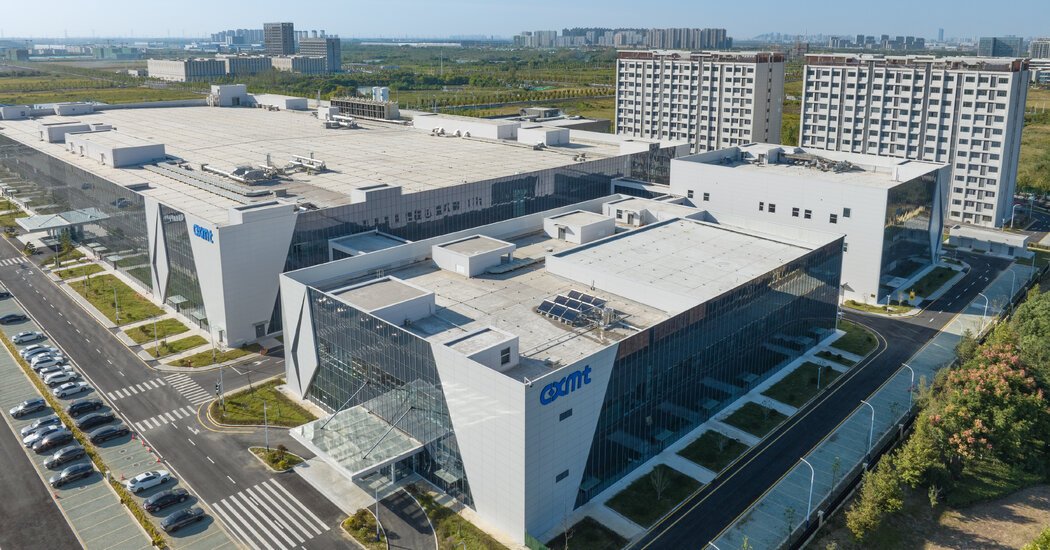
China’s largest maker of memory chips is raising billions of dollars in a blockbuster public offering to pursue the nation’s agenda of technological self-sufficiency and leadership in the global race to develop artificial intelligence.
ChangXin Memory Technologies, known as CXMT, said in a filing on Wednesday that it had roughly doubled the price of its offering on the Shanghai exchange from earlier guidance, based on strong investor demand. It is seeking to raise the equivalent of up to $9.8 billion.
That would be the largest initial public offering in Asia this year, and one of the biggest ever on an exchange in mainland China.
The Chinese chip maker is tapping sky-high investor enthusiasm. Last week, SK Hynix, a South Korean memory chip giant, raised $26.5 billion by selling shares in the United States, in the largest such offering on Wall Street by a non-U.S. company.
CXMT is riding the A.I.-led boom in demand for memory chips, which instantaneously shuttle data to and from the processing engines of computers. All computers rely on memory chips, but the demands of A.I. data centers being built in the United States and China seem all but limitless.
The 10-year-old firm cannot operate as freely as many of its rivals. It is prevented from acquiring some of the most advanced chip-making tools by export restrictions imposed on Chinese firms by the United States and other countries, bowing to American pressure.
These curbs have made the fast-growing company a linchpin in China’s drive to nurture homegrown suppliers to reduce its dependence on foreign technology. Chip manufacturing has been a bright spot for China’s economy, propping up activity that has otherwise been sluggish. Government data released on Wednesday showed that economic growth last quarter slowed to its weakest rate in years.
CXMT saw its revenue jump to nearly $7.5 billion in the first quarter, up more than 700 percent from a year earlier, according to its I.P.O. prospectus. It made a profit of more than $1 billion last year, a sharp turnaround from a loss of nearly $3 billion as recently as 2023.
CXMT is starting to make inroads in the global memory market, which is dominated by the South Korean duo of Samsung Electronics and SK Hynix, plus Micron Technology of the United States. CXMT held 8 percent of the global market share in the first quarter of 2026, up from 3 percent a year earlier, according to Counterpoint Research.
“CXMT encapsulates many of China’s technology ambitions in a single company,” said Kyle Chan, a fellow at the Brookings Institution, who is a China tech policy expert. “The company is hitting its stride at a pivotal moment for China’s A.I. push.”
The company is also a testament to returning Chinese talent and government largess.
CXMT’s founder and chairman, Zhu Yiming, is a product of the elite Tsinghua University, often considered akin to the M.I.T. of China. He departed for America for graduate studies at the State University of New York at Stony Brook.
Mr. Zhu stayed in the United States, the hub of cutting-edge chip design. In Silicon Valley, he founded GigaDevice, a semiconductor design start-up, in 2005. He returned to China and in 2016 worked with the regional government to begin the project that became CXMT, headquartered in Hefei, in eastern China.
Years of losses and billions of dollars in government subsidies followed. “The company has benefited from very generous government support, which is the sole reason it could enter the hugely capital intensive memory industry,” said Chris Miller, a professor at Tufts University and author of “Chip War,” which chronicles the global semiconductor race.
The shares CXMT plans to sell will represent about 10 percent of its stock, and could begin trading in the coming weeks. The sale also includes an option to sell extra shares after trading begins, depending on demand, worth about $1 billion.
Despite its recent success, CXMT is behind market leaders in the most advanced technology, known as high-bandwidth memory. The ultrafast data-transfer technology is especially in demand for developing larger, more capable A.I. models.
Trade restrictions that prevent CXMT from buying the most advanced chip-making tools are making it harder for the firm to catch up. The company is working with domestic Chinese suppliers to create alternatives, but the trade curbs, analysts say, are a major obstacle.
“It’s going to be a steep hill to climb for CXMT in the high-bandwidth memory market,” said Neil Shah, vice president of research for Counterpoint Research.
For an ascendant Chinese company like CXMT, geopolitics is part of doing business. The Pentagon has placed the state-backed company on a list of companies with alleged ties to China’s military, making it a potential national security concern.
In its prospectus for investors, CXMT addressed this political risk factor. The language was oblique, but the message was clear: It said that if “relevant countries” tighten restrictions further, the company “may face supply chain instability.”