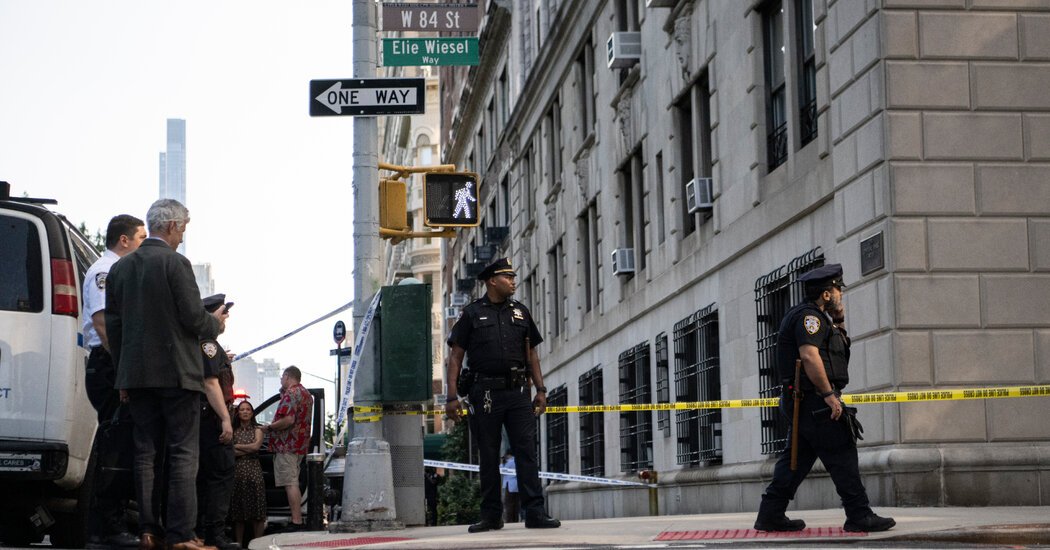
Moshe Grunhaus was leaving the Jewish Center in Manhattan when he was stabbed in broad daylight on Thursday, rattling a Jewish community already on edge and inflaming the debate about Israel and antisemitism.
The police arrested a man, Raul Morales, on Thursday, but prosecutors had not charged him by Friday evening. He first stabbed an Asian man, Chok Sung, 57, before attacking Mr. Grunhaus, who was wearing a yarmulke, while shouting “Allahu akbar,” a frequently used Islamic religious phrase, according to the police.
The assaults deepened the tension between many Jewish leaders and Mayor Zohran Mamdani, a longtime critic of Israel.
Pro-Israel groups had been warning for months that Mr. Mamdani’s rhetoric on Israel could worsen antisemitism, as the mayor said repeatedly that the city might enforce an arrest warrant for Prime Minister Benjamin Netanyahu if he visited New York.
In response to the outcry from many Jewish leaders, Mr. Mamdani on Tuesday posted an extraordinary direct-to-camera video in which he backed off from that threat, but called Mr. Netanyahu a war criminal and urged federal law enforcement to arrest him.
On Friday, the tensions erupted into the public, as some community leaders and pro-Israel groups made the striking accusation that the mayor’s public comments, including the video, were partly to blame for acts like the stabbing.
UJA-Federation of New York, a major Jewish philanthropy that has emerged as a forceful opponent of Mr. Mamdani, helped to organize a news conference where speakers lamented the toll that rising antisemitism had taken on the Jewish community.
Parents fear allowing their children to wear yarmulkes or Stars of David in public, and camp directors are fielding calls from anxious parents asking whether their children will be safe, said Mark Treyger, the chief executive of the Jewish Community Relations Council, and a longtime critic of the mayor.
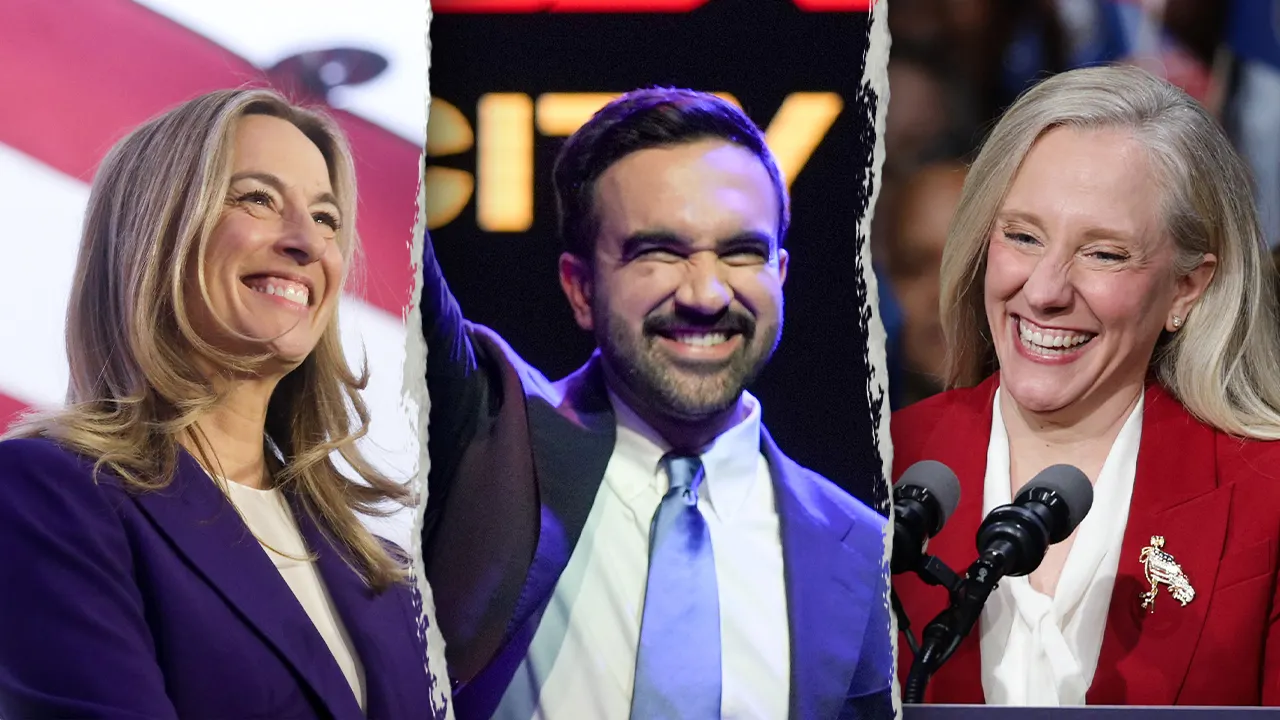
“I beseech all those in a position of power, including our mayor, to hear our cry from the heart,” said Micah Lasher, the Democratic congressional nominee in the district that includes the site of Thursday’s attack. “To please help take the temperature down and provide leadership that makes every New Yorker feel safe in this glorious city.”
Mr. Mamdani pushed back against the accusation he had made Jews unsafe on Friday, telling NY1 later in the day: “There’s no tolerance for antisemitism or hatred of any kind in this city.”
“If anyone is perpetrating this kind of bigotry, that kind of hatred, they will be held fully accountable,” the mayor said.
The exchanges marked a highly emotional week in New York, which is home to the largest Jewish population outside Israel, and highlighted the degree to which Middle East politics have become infused into Mr. Mamdani’s young mayoralty.
Speaking to NY1 on Friday, the mayor rejected the argument that his criticism of Israel or its leaders had anything to do with Jewish New Yorkers.
“They are critiques of a political leader, not of people of a specific faith or a religion or a background,” he said. “My responsibility as the mayor of this city is to keep every New Yorker safe, no matter where they come from, what they believe in or, frankly, even if they agree with my politics. My job is to keep them safe.”
Mr. Mamdani’s stance reflects the shifting public sentiment toward Israel, which has grown more negative in New York and across the United States.
Progressive Jewish groups echoed the mayor’s views. T’ruah, an organization of progressive rabbis, said it was “unhelpful to make assumptions” about the stabbing and noted that the Police Department had said “the suspect’s mental state may have been a factor.”
“We refuse to believe that Jewish safety requires silence about the Israeli government’s actions,” the group said in a statement. “A narrative that public criticism of Israel causes antisemitism and therefore must be censored is not only overly simplistic but dangerous to Jews, Palestinians and our democratic values.”
It’s not clear whether this week will be a passing flashpoint in Mr. Mamdani’s relationship with pro-Israel Jewish leaders or the start of a deeper deterioration or loss of trust.
At the news conference on Friday, notably, several elected officials typically aligned with the mayor, including the city public advocate, Jumaane Williams, and the state attorney general, Letitia James, made clear that the city had been shaken by antisemitism and urged New Yorkers to stand together against intolerance.
“It’s important that we reaffirm that hate and violence have no place in New York,” Ms. James said. “So let us commit ourselves to doing the good and necessary work of standing up together, shoulder to shoulder, arm in arm, with no space between us. Hate will not be tolerated.”
Susan Zhuang, a City Council member from Brooklyn, said anti-Asian bias had also continued to be a major problem that too often had “been simply ignored.”
“The violence, the harassment, the fear continue even when the cameras move on,” she said. “Our community is still living with consequences, and too many people suffering in silence.”
The stabbing on Thursday sent shock waves through the Upper West Side, a neighborhood known partly for its vibrant Jewish life and whose violent crime rate is typically one of the lowest in the city.
The police charged Mr. Morales on Friday afternoon with a hate crime in connection with the stabbing of Mr. Grunhaus, but not in the stabbing of Mr. Sung. It was not clear whether prosecutors would agree to the charges proposed by the police. Both victims are expected to survive and were being treated at a local hospital.
A spokesman for the mayor said his office had reached out to the Police Department to be connected to the victims. A spokesman for the Police Department said on Friday night that the department was not connecting elected officials, including the mayor, to either victim because detectives were still interviewing them.
At the start of July, more than half of all hate crimes in the city this year had targeted Jewish people, making antisemitic violence the largest share of hate crimes. About 10 percent of New York’s population is Jewish.
Several Jewish leaders pointed to Mr. Mamdani’s video, in particular, as creating potential danger for Jewish New Yorkers.
At the news conference on Friday, Eric Goldstein, the president of UJA-Federation of New York, took issue with his video about Mr. Netanyahu, whom the mayor described as “a war criminal” and the “architect of genocide” in Gaza.
“His video message about the prime minister was political grandstanding,” Mr. Goldstein said. “Shame on him for doing this for perceived political benefit when it has real-world consequence for the Jews of New York. He must stop.”
The Israeli government also criticized the mayor. In a statement, Israel’s foreign minister, Gideon Saar, said the violence “did not happen in a vacuum.”
“Months of incitement against the Jewish state from Mamdani have helped create a climate in which Jews are targeted,” he said. “Words have consequences.”
On Friday evening before the start of Shabbat, Rabbi Rick Jacobs, president of the Union for Reform Judaism, which represents the largest Jewish denomination in the United States, released a statement that criticized Mr. Mamdani for his “fiery video.”
He said the mayor had vilified Israel and Mr. Netanyahu and created “an atmosphere in New York City that makes Jewish people feel less safe and puts us at risk.”
The attack on Thursday happened on Tisha B’Av, on which observant Jews commemorate the destruction of the Temples in Jerusalem by the ancient Babylonians and Romans, and other tragedies throughout Jewish history.
Rabbi Yosie Levine of the Jewish Center said on Friday that the stabbing outside his synagogue on such a mournful holy day made it feel like “the evil we gathered to remember stopped belonging to the past.”
“Jewish life in America is starting to feel like Jewish life in Europe,” he said. “Armed guards, bulletproof glass and the constant fear that yesterday’s rhetoric will turn into today’s assault.”
Yair Rosenberg, Dana Rubinstein and Maia Coleman contributed reporting.