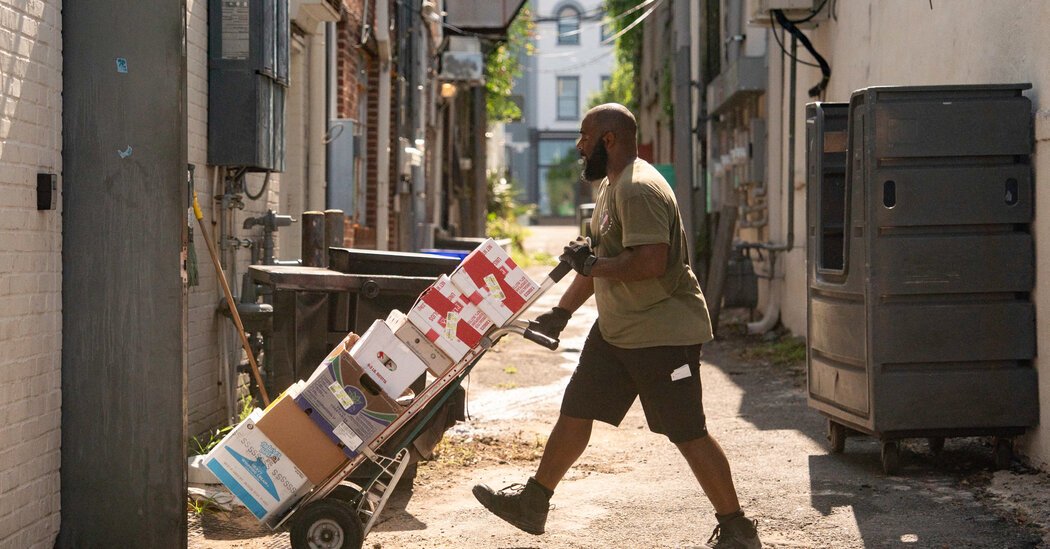
Republicans in Washington are taking steps to roll back federal workplace heat protections as summer temperatures surge.
The Trump administration is moving to rewrite Biden-era rules that would mandate breaks and access to water and shade for workers, in a step businesses lauded but that labor groups said could weaken already limited federal protections. Congress is considering legislation that would go a step further, prohibiting the Labor Department from adopting the Biden-era heat plan or similar rules.
At the same time, the Occupational Safety and Health Administration is curtailing workplace inspections that President Joseph R. Biden Jr.’s appointees had increased to raise awareness of heat-related illnesses.
OSHA officials did not respond to questions about enforcement activity.
The details of the proposed changes might not be known for months. Still the efforts highlight the divide between labor and industry about what steps to take as the dangers from rising temperatures become more apparent.
The proposed revisions would also reverse momentum toward codifying extreme heat as a workplace hazard. Stretches of record heat have persisted across the country this summer, punctuating decades of steadily climbing summer temperature highs and more frequent spells of dangerously hot conditions. Another “heat dome” is bringing extreme temperatures to the South and Midwest this week.
OSHA officials did not respond to questions about enforcing the mandate.
Business groups welcomed most of those steps, saying employers are already safeguarding workers from heat. But labor organizations say they fear job sites are becoming more dangerous as oversight declines and immigration enforcement creates an atmosphere of fear in the fields and warehouses where heat is most extreme, which could discourage some employees from raising alarm over conditions.
“They’re bringing the work force back to the 1800s,” said Trina David, a crew chief at Phoenix Sky Harbor International Airport who oversees baggage handling and other activity while planes are parked at gates. The temperature in the city often hits triple digits in the summer, and it can be even hotter on the tarmac.
Heat is linked to hundreds of workplace deaths each year, but labor groups say the true toll is unknown because heat-related illnesses are not properly tracked or reported. In 2024, the death toll was at least 530, according to data compiled by the A.F.L.-C.I.O.
On-the-job injuries and deaths typically trigger federal or state workplace safety investigations. But OSHA doesn’t have any rules specific to extreme heat, which can make holding employers accountable for dangerously hot working conditions difficult, former agency officials said.
OSHA oversees workplace safety in about half of states; in the others, it delegates those duties to state agencies under plans federal regulators approve. Some states and cities have their own workplace heat protections in place, including California, Oregon and Maryland.
But gaps in worker protections and rising global temperatures driven by climate change prompted the Biden administration to increase federal oversight of workplaces where extreme heat is common. In 2022, OSHA started a program that aimed to double inspections.
From April 2022 to December 2024, the agency conducted about 7,000 workplace inspections related to extreme heat, including 147 investigations into potentially heat-related deaths, according to the agency. OSHA sent nearly 1,400 warning letters to employers and issued 60 citations in that span. It was a significant step up: The agency reported about 200 heat-related inspections a year from 2015 through 2020.
As Mr. Biden’s term waned in the summer of 2024, OSHA proposed rules that would require employers to develop heat plans and provide rest areas and water any time the heat index reaches 80 degrees or higher. The Biden administration estimated the rules would cover about 35 million workers.
Many labor and business groups expected that proposal to disappear once President Trump returned to the White House. But the Trump administration carried out a scheduled public hearing on the Biden heat rule proposal in June 2025.
This month, the administration published plans to continue that rule-making process — but with significant revisions planned for release by the end of this year. The measure could become final in 2027.
Employers had raised concerns that the Biden proposal would disrupt their operations, potentially blocking them from designing more effective and tailored heat relief plans.
“The fact that they have something on the agenda is encouraging,” said Marc Freedman, vice president of workplace policy for the U.S. Chamber of Commerce.
But labor groups say an employer-friendly federal rule could not only endanger workers in the states OSHA directly oversees, but also weaken protections in the other states. That could prompt business groups to pressure regulators to scale back or rescind any stronger rules in place at the state or local level, said Debbie Berkowitz, who served as senior policy adviser at OSHA under President Barack Obama.
Separately, the Trump administration has also shifted the approach of the OSHA inspection program started under Mr. Biden. In April, OSHA renewed the initiative, but it stripped away any targets around inspection activity.
That was a significant change, Ms. Berkowitz said, because the program relied on the inspections and potential enforcement to keep employers accountable. And it was designed to provide a key legal framework for OSHA to target heat hazards in specific industries and workplaces, she added.
It is not clear how the change may be affecting OSHA inspection activity; the agency has not made any recent statistics public. But data released in February by Senator Elizabeth Warren, Democrat of Massachusetts, showed a 20 percent decline in OSHA inspections over a six-month period last year, compared with the same period in 2024. (The government has not publicly released data for the number of inspections for the entire 2025 fiscal year.)
OSHA has long been stretched thin, said Dennis Spencer, a Philadelphia-based airline worker who serves as a director of safety for the International Association of Machinists and Aerospace Workers. Under the Trump administration, its availability has not improved, he said.
“If you don’t call OSHA, they’re not coming in and just looking around,” Mr. Spencer said. “I haven’t gotten calls where they say, ‘OSHA’s here looking at the heat standard or the hydration plan.’ I don’t think they’re making random stops.”
That means workers have to carry much of the burden of flagging heat dangers, said Oscar Londoño, co-executive director of WeCount!, a human rights organization in South Florida focused on immigrant workers. Doing so is often risky because of fears of retaliation, and it’s especially fraught in agriculture and sectors where heat is most intense and where fears of deportation are highest, he said.
“In the industries where workers are getting sick or dying on the job due to extreme heat, these are largely low-wage immigrant workers,” Mr. Londoño said.
Business groups including the U.S. Chamber and Associated Builders and Contractors have said a vast majority of employers already monitor heat hazards and take steps to protect workers. The Biden administration’s proposal ignores that, Mr. Freedman said.
“There’s room for a sensible standard here, but not the one the Biden administration proposed,” he said.
Still, Mr. Freedman said even he had qualms about legislation that would block the Biden workplace heat proposal “or any substantially similar standard.” Mr. Freedman called the bill, which is awaiting a House floor vote, “well-intentioned” but said he thought it went “just one step too far.”
Labor groups say a strict workplace heat standard is needed to reflect the underappreciated and rising threat that heat poses.
Ms. David, the Phoenix airport worker, said that heat always posed some challenges in her 19-year career. But when she started working at Sky Harbor, the worst summer heat would last three months. In 2024, temperatures hit triple digits on a record 113 consecutive days — and were 20 to 40 degrees higher on the tarmac.
“I get that we signed up for this, but we didn’t sign up for the heat to become as severe as it is,” she said.
“Everyone’s asking workers to adapt to the heat,” she added. “Your organs can’t adapt that fast. The conditions changed.”