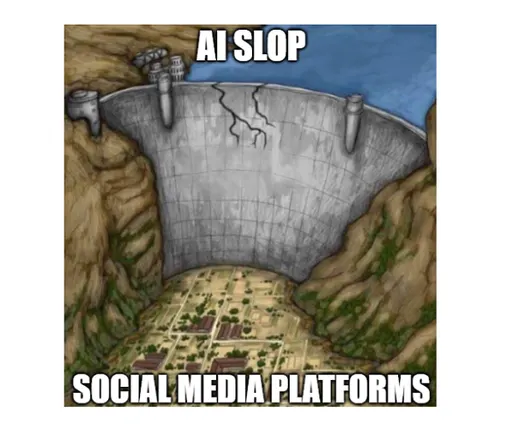
Artificial intelligence-generated content is steadily overwhelming human-created posts across social apps. As a result, almost every platform is looking at restrictions on AI-generated content in order to maintain more meaningful connections among users.
Thus far:
On balance, it seems pretty clear that social platforms have overestimated audience enthusiasm for AI options. In fact, it now seems inevitable that the next step will be a social platform fully banning AI-generated content.
Indeed, Mashable has reported that everyone’s former favorite social platform MySpace is considering a re-launch under that exact premise, as an antidote to social feeds that are increasingly inundated by AI.
The backlash against the AI influx on social media makes sense. Social media is, both in name and process, foundationally built around human social engagement.
Maybe the rise of AI chatbots has altered that definition somewhat, and what qualifies as social has moved beyond human-to-human interactions. But conceptually, social media apps have given people a means to connect and to celebrate the creativity of humanity.
What happens when the majority of that content is generated by bots?
Statistically, most social media users hate the presence of bots, and they have lamented the amount of bot activity on social apps. This makes the AI backlash all the more predictable, because platforms have been battling inauthentic engagement of varying kinds for decades, amid complaints about manipulation, spam and other forms of fake interaction.
Indeed, one of the core tenets of Elon Musk’s Twitter purchase was that he would “defeat the spam bots or die trying,” he said. That was reflective of broader community concerns around the rise of inauthentic engagement in the app.
Yet, with the arrival of the latest AI tools and systems, bots are now being re-framed as a positive, and the platforms are trying to showcase how smart and human-like their systems have become.
But bots are still bots, and this is still inauthentic engagement. It’s just been repackaged as creative assistance or expanded creativity through visual generation.
It’s the same junk that people have railed against for years, and as such, it’s no surprise that people are calling for more ways to ban AI-generated spam from their feeds.
The most surprising element here is that the platforms themselves seem to think that people want more bots, and that giving people more means to enhance or alter their output through AI is a positive.
While the nature of social media has veered further from social engagement and more towards entertainment, people are still keen to see human creativity, and to relate to moments of human connection and experience.
AI slop does nothing for this, and the backlash looks set to put a dent in the broader enthusiasm around AI development. As a result, this could impact broader take-up of these tools.