YouTube will be making a major update to the qualifying terms for its monetization programs. The changes announced Monday, will make it harder for creators to join its revenue share program, but will also provide expanded revenue opportunities that could help creators earn more money.
First, YouTube is doubling the entry requirements for the YouTube Partner Program, which is the platform’s core creator monetization creator payment scheme.
Right now, channel performance requirements for ad revenue share through YPP are:
- 1,000 subscribers with 4,000 qualified watch hours in the last 12 months
or
- 1,000 subscribers with 10 million qualified Shorts views in the last 90 days
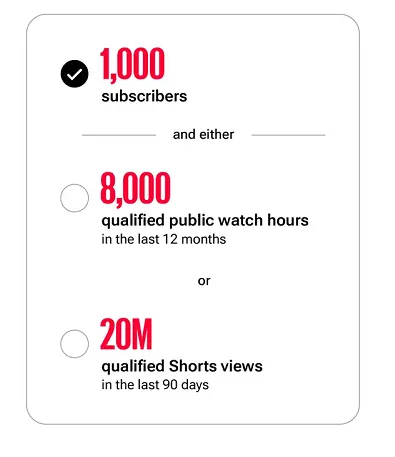
As of February 1 2027, YouTube is increasing the watch time requirement to:
- 8,000 watch hours in the last 365 days or 20 million qualified Shorts views in the last 90 days
YouTube VP of Creator Product Amjad Hanif said that higher watch time will mean higher payouts. By increasing these thresholds, he said, the platform is trying to ensure that creators are able to earn meaningful income from their YouTube efforts, as opposed to only earning “a few cents for that month.”
Hanif said that creators currently signed up to YPP will remain eligible for ad revenue share even if they don’t meet the new requirements. However, new channels will have to reach these new performance levels as of February 2027.
Hanif added that there will be no change to the eligibility requirements that govern access to fan funding features, including Super Chat, channel memberships and creator partnership programs. Hanif said the fan funding tier “still takes 500 subs and 3,000 watch hours, or 3 million views in the last 90 days.”
The main impetus of the update is Shorts. YouTube said that it’s now serving more than 200 billion daily Shorts views every day, and the updated view thresholds will drive more creators to build their Shorts presence.
At the same time, YouTube wants to expand the revenue opportunities linked to Shorts in order to provide more earnings potential for its highest-performing creators.
On that front, YouTube is also updating its terms to support new Shorts ad formats.
As per YouTube: “With these new ad formats, if an advertiser runs Shorts ads to specifically target 5 or fewer channels, creators will earn 45% of that ad’s revenue in addition to regular earnings from the Shorts Creator Pool.”
The Shorts Creator Pool combines all the revenue from Shorts ads that run between clips in the feed each month and then redistributes that among eligible creators. This update will provide more revenue opportunities for popular Shorts creators, giving them more incentives to keep posting.
In addition, YouTube said Shorts creators will also be able to earn revenue from new bonus programs linked to YouTube Shopping, incentives for brand deals and “earnings boosts for cultural trend activations.”
YouTube added that it will share more details on these additional options soon.
So while entry requirements for the YouTube Partner Program will be increased, that will ensure higher payouts for each participant and YouTube will expand monetization pathways for short-form creators.
YouTube expects to keep paying out significant amounts to its creator community, and Hanif predicted that it may even exceed its current levels of creator revenue share.
“Today, YPP remains the only program that pays creators consistently, transparently and at scale,” YouTube said. “In fact, in the last four years alone, we’re incredibly proud to have paid over $100 billion to creators, artists, and media companies.”
Clearly, YouTube sees its TikTok-inspired Shorts feed as a key component of future growth, so it’s restructuring creator payouts to better align with this.
On another front, YouTube is also expanding its Premium Lite program to all countries where YouTube Premium is available.
The main value proposition of YouTube Lite is ad-free viewing, although it also provides offline viewing options.
Creators are able to earn revenue from YouTube Lite subscriptions via a system similar to the Shorts creator pool, with a proportion of the revenue from these subscriptions shared into a group fund that’s redistributed to eligible creators.
YouTube said the expansion of YouTube Lite availability will grow this revenue pool, adding another way for creators to make money from their content.
So there will be higher entry requirements, but also higher payouts for those that meet them. YouTube is hoping this will prompt top creators to enhance their focus and keep pumping out more content.
Previous research conducted by the University of Applied Sciences in Offenburg, Germany found that 85% of all YouTube views are generated by the top 3% of YouTube channels, which means putting more focus on top-level creators makes sense.