Cubans are seasoned, involuntary experts at waiting — for the day’s bread ration, for overcrowded buses, for visas to leave home. Since the pandemic threw the island into a deep crisis and especially since the Trump administration instituted a de facto oil blockade of Cuba in January, that daily exercise has become a slow suffocation.
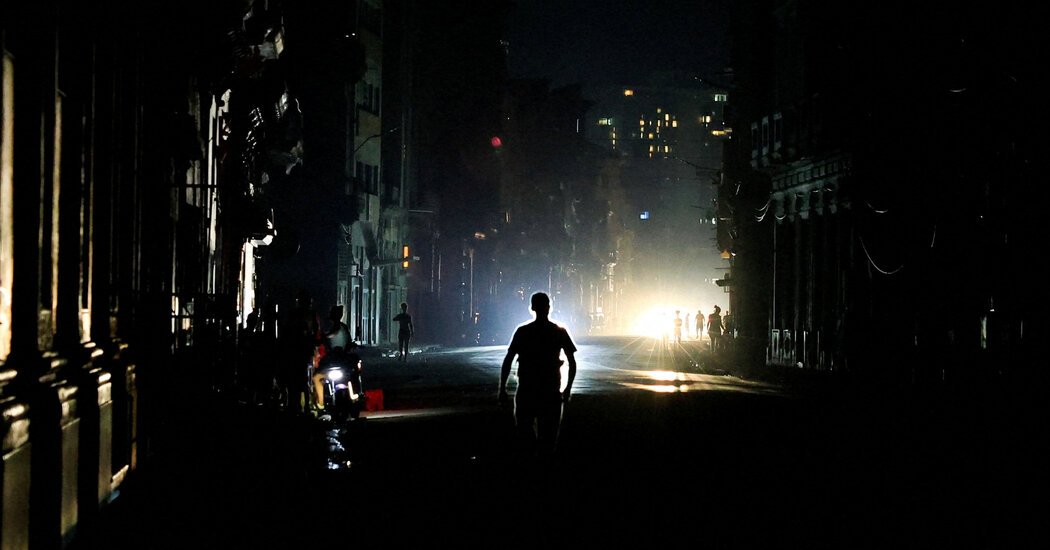
Now Cubans wait for everything. They wait for imported food and over-the-counter medicines sent by relatives abroad. They wait for electricity that returns for only an hour or two each day or for a feeble breeze in the oppressive summer heat that might allow their children a couple of hours of sleep.
Most of all, Cubans wait for signs that Washington or their own government will land on a way out of their current immiseration — that they might finally live in a normal country, no longer trapped by decades of authoritarian politics, economic mismanagement, U.S. sanctions and an extended Cold War. Regardless of whether the island is heading toward a true political breaking point, no amount of jury-rigged power supplies or what President Miguel Díaz-Canel calls “creative resistance” can hide that Cuba’s people are being pushed to the limits of what they can endure.
The uncertainty has driven different players to stake their hopes on a range of possible futures: the fall of Cuba’s Communist regime, a negotiated U.S.-backed transition to democracy or military action leading to a kind of U.S. protectorate in the style, most recently, of Venezuela. But the most likely one is that the waiting will continue — an extended stalemate with ordinary Cubans paying the price.
Some, particularly in the Cuban diaspora, are expecting Cuba’s equivalent of Eastern Europe in 1989, when Communist regimes fell across the region. Rosa María Payá, the exiled daughter of the slain pro-democracy activist Oswaldo Payá, has described the Cuban government as the “Berlin Wall of our time.” Accordingly, though with negligible coordination with Cubans on the island, Cuban American community leaders have dusted off, updated or drafted new plans for a democratic transition.
For much of this spring, however, it was not clear that 1989 was the historical parallel the Trump administration had in mind. In direct communications with Raúl Castro’s grandson and members of Cuba’s security establishment, Secretary of State Marco Rubio and the C.I.A. director, John Ratcliffe, signaled their openness to letting some of the island’s Communist authorities stay in power, provided that Havana loosen state control over the economy, release political prisoners and eliminate security ties to U.S. adversaries.
Since May, though, the possibility of such a deal has receded. As Cuba has refused to accept Washington’s demands for significant leadership change, the U.S. government has deployed secondary sanctions that have forced many foreign companies to withdraw from the island. Neither an economic liberalization package announced in June nor the July release of the country’s highest-profile political prisoner, the artist Luis Manuel Otero Alcántara, has compelled the administration to budge.
This impasse has reinforced suspicions that the Trump administration intended to inflict economic hardship all along — not to induce concessions but to create the conditions for widespread social unrest.
Summer has often been Cuba’s season of political upheaval, from the 1994 Maleconazo amid Cuba’s post-Soviet economic depression to the nationwide marches on July 11, 2021, at the depth of the pandemic. Recent energy grid collapses have brought fresh signs of public anger. Neighborhood cacerolazos — loud pot-banging sessions — and street blockades made of burning trash are almost nightly occurrences. A slide inadvertently shown during a televised government briefing revealed officials are concerned about an “estallido social,” or a social explosion.
Yet growing instability does not another 1989 make. The collapse of Communist rule in most of Eastern Europe depended not only on popular discontent but also on divisions within the ruling elite and oppositions with significant popular bases. So far, Cuba’s coercive apparatus remains intact, the threat of repression has weakened any opposition’s reach, and mass emigration continues to substitute for mass mobilization, with as many as two million Cubans leaving the island since 2020. The effective closure of the U.S. border to Cuban entries since 2025 has simply redirected hundreds of thousands of migrants to other destinations.
If internal hardship does not automatically portend regime collapse, it might be tempting to conclude that change can come only from without. For weeks the Trump administration has been dropping hints of coming military action by framing Cuba as a national security threat, citing Havana’s intelligence ties to China and Russia, its purported acquisition of drones from Iran and its alleged role in what the State Department calls hemispheric “subversion” past and present. The May indictment of Mr. Castro, charging him with involvement in the 1996 shooting down of two Cuban American civilian aircraft, also provides a pretext for some kind of Maduro-style law enforcement extraction.
Any American intervention, though, would call to mind a different historical parallel: 1898, the beginning of a four-year U.S. military occupation that led to the birth of a Cuban republic subservient to U.S. economic and political interests.
Few observers seriously expect another full American occupation of Cuba. But history need not repeat itself so literally to rhyme with the imperial refrains of old. President Trump has publicly floated a “friendly takeover” of the island. By forcing the exit of major hotel operators and other Cuban state partners, the administration’s secondary sanctions have devalued Cuban assets and potentially cleared the deck for acquisitions by U.S. companies at bargain basement prices.
Meanwhile, Mr. Castro’s grandson, who holds no formal leadership position in Cuba, has effectively declared Cuba open for business and expressed his eagerness to negotiate directly with Mr. Trump. Embracing a Castro family member as Cuba’s analogue to Delcy Rodríguez, Venezuela’s interim leader, may prove unacceptable to many in the White House, not least Mr. Rubio. But Venezuela’s example offers a sobering precedent: Military action in Cuba may not guarantee democracy so much as a new order in which the secretary of state operates as an economic viceroy, working with a close circle to hand out the spoils.
For now, all these scenarios seem more imaginary than imminent. Even absent other foreign lifelines, Cuban officials have shown scant willingness to do Washington’s bidding. Nor has the government in Havana been offered a consistent offramp. Meeting Washington’s demands would amount to negotiating the regime’s own demise.
Washington’s room for maneuvering is also constrained. Despite recent reports of a new Cuba task force at the C.I.A., military escalation risks embroiling the United States in an even greater national reconstruction project than in Venezuela at a moment when the administration is again consumed by the conflict in Iran. The domestic political costs of a new entanglement in Cuba could also weigh heavily ahead of this fall’s midterm elections.
That leaves both sides locked in a pattern of tira y afloja, a push and pull, in which each looks for the other to make a truly consequential concession first. But time is not on the Cuban people’s side. They cannot indefinitely postpone meals, medical procedures or more consequential decisions about their personal and political futures.
Governments can afford to keep playing the waiting game. Ordinary Cubans cannot.
Michael J. Bustamante is a professor of Cuban and Cuban American studies at the University of Miami and the author of “Cuban Memory Wars: Retrospective Politics in Revolution and Exile.”
The Times is committed to publishing a diversity of letters to the editor. We’d like to hear what you think about this or any of our articles. Here are some tips. And here’s our email: letters@nytimes.com.
Follow the New York Times Opinion section on Facebook, Instagram, TikTok, Bluesky, WhatsApp and Threads.