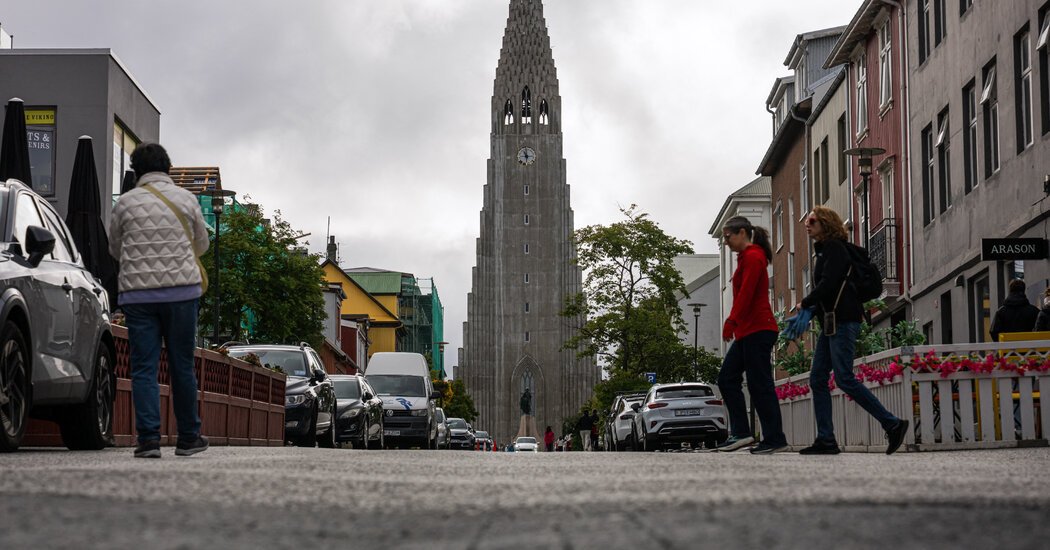
If Iceland votes on Saturday to restart talks to join the European Union, it will join a long list of hopefuls.
Ukraine sees membership as a security guarantee against Russia. Moldova wants in, as do Montenegro, Albania, Serbia and North Macedonia, among others. European officials even joke about adding Canada — which is, of course, not in Europe — to the mix.
Despite Britain’s not-so-silent exit in 2020, interest in boring, bureaucratic Brussels is strong thanks to Russian aggression, Chinese competition and Washington’s unpredictability.
“When the U.K. left the union, there was this moment where people were holding their breath: Would there be a domino effect?” said Almut Möller, the head of the program Europe in the World at the European Policy Center, a think tank.
Instead, becoming part of a like-minded group is now seen as “actually of great value,” she said, “if we are returning to a world of great power competition.”
Iceland’s vote will not be the final word on the European Union’s appeal — or lack thereof. Globally, critics continue to blast the sprawling system, its regulations and its rules. Icelanders remain split over whether they should throw themselves into talks.
What the European Union seems to offer prospective members is strength in numbers in a time of realpolitik.
Magnus Arni Skjold Magnusson, the chairman of the European Movement in Iceland, described the choice, in part, as a vote on values, as the United States pulls out of treaties, rolls back rights and courts corruption.
“Do we want to lean toward a nation, a country that doesn’t share our values on democracy, equality, gay rights?” Dr. Magnusson said. “Or do we want to align ourselves with like-minded nations?”
Iceland’s referendum will not determine whether it joins the European Union — that would take another vote. It will allow the Nordic nation to resume negotiations with the union on potential membership after more than a decade-long pause. Iceland tried to join the European Union after the mid-2000s global financial crisis but stopped the process amid industry opposition and grinding negotiations.
Iceland is already closely linked to the union and is a member of the free-movement Schengen area, allowing travelers to move between the island and other members without border checks. Joining the bloc could enable Iceland to opt into the euro, which appears to many in the country to be an enticingly stable currency.
Saturday’s vote comes as Russia has stepped up its activity in Arctic seas and after President Trump this year threatened to forcibly annex Greenland — and repeatedly mixed up “Iceland” and “Greenland” in a speech about that push.
“It feels like our neighborhood is being threatened,” said Edda Kentish, a 42-year-old Icelandic copywriter, who plans to vote yes on restarting the talks.
Joining the European Union could have costs for Iceland. The fishing industry has warned of increased competition. Others worry that Iceland will cede some of its sovereignty — or have its voice drowned out — if it joins the bloc.
“As the saying goes, if it’s not broken, don’t mess with it,” Kolbeinn Helgi Kristjansson, 33, who works in tourism, wrote in an email.
With fewer than 400,000 people, Iceland would be the smallest E.U. country. Germany’s population, for instance, is about 200 times larger.
Haraldur Olafsson, one of Iceland’s most vocal opponents of E.U. membership, said the bloc’s laws were made to fit Germany and France, and would expand regulations in his country. “You will be forced to use your money on all sorts of stupid things,” he said.
And adding new E.U. members is not easy — or fast. Brussels has been moving through negotiations with candidate countries slowly, to avoid allowing nations in too quickly or without sufficient guardrails.
Ukraine has been pushing for rapid membership, and E.U. officials often talk about the importance of bringing it in, but its candidacy is in fairly early stages. Montenegro has been trying to join since 2008, Albania since 2009. Turkey has formally been a candidate for membership in the union for decades, though its lack of progress toward E.U. standards has stalled its bid.
Adding poorer members can be expensive for member states, which end up funneling money toward integrating those economies. Beyond that, new members can bring added economic competition once they are more integrated into Europe’s shared market.
Nations that go on to elect governments with different goals and values than those that prevail in Brussels can slow joint decision-making.
Even with those concerns, Iceland might join relatively easily, given its close existing ties, high income and relatively stable political system. Marta Kos, the E.U. commissioner for enlargement, said this week that it could finalize negotiations in “one to two years.”
“I think this is a great time for Iceland to join because of the geopolitical situation we’re in,” Kristrun Frostadottir, Iceland’s prime minister, recently said on the podcast “The Rest Is Politics: Leading.” She said the union’s push to tighten alliances could give her nation a stronger negotiating position.
“They’re looking strategically around,” she added of the bloc. “They’re aware the world is changing.”