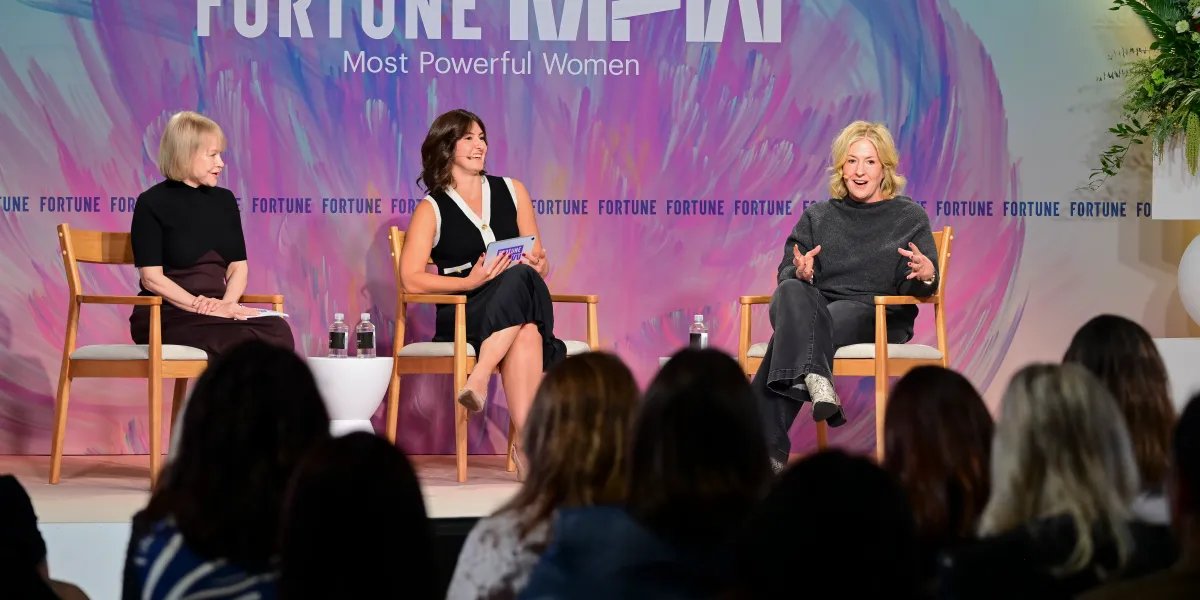
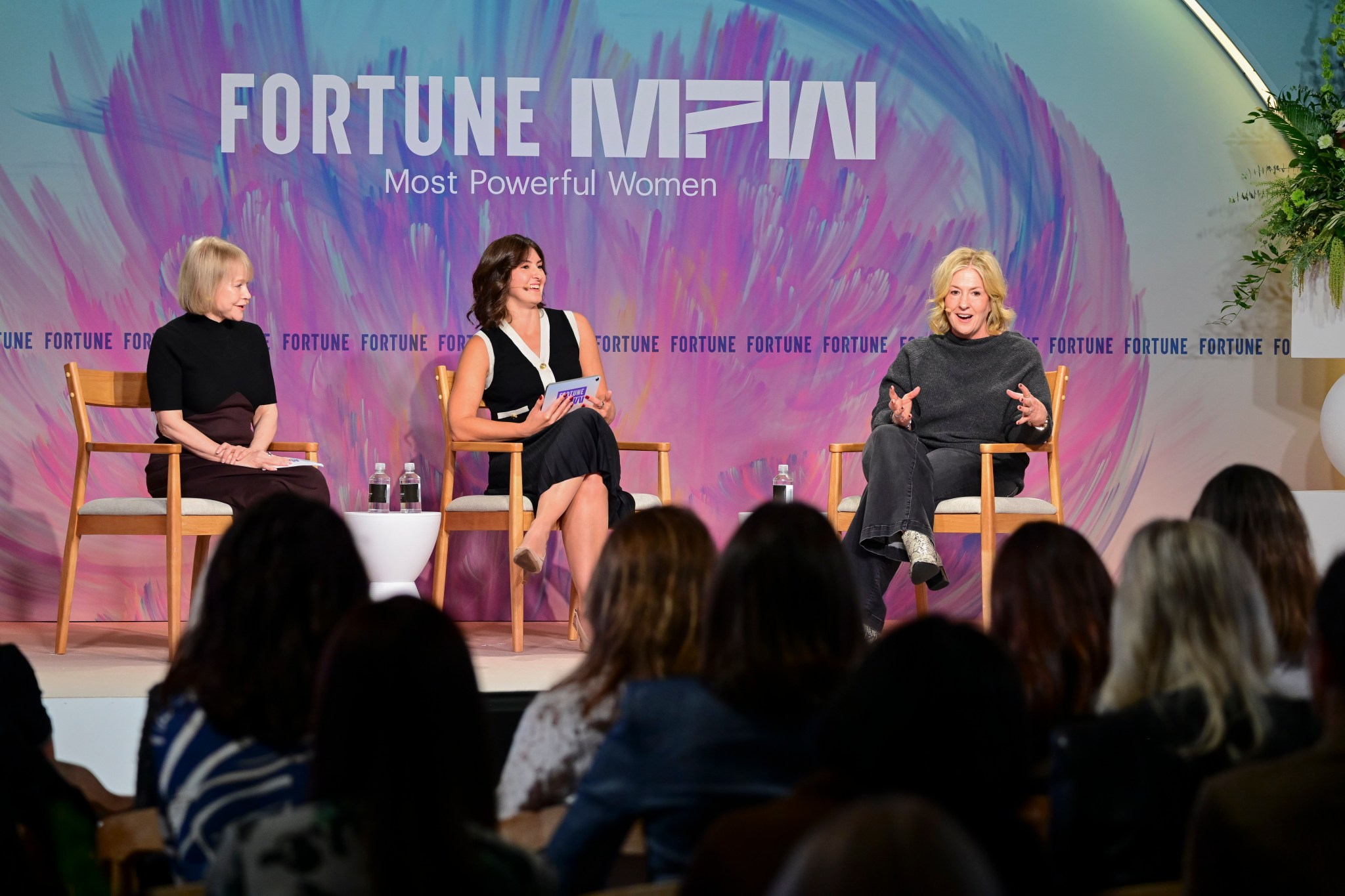
Our nervous systems aren’t ready for the level of uncertainty we’re facing right now. That’s according to Brené Brown, author, researcher, and professor, who spoke at the Fortune Most Powerful Women Summit in Washington, D.C., last fall.
“It is extraordinarily difficult to be brave right now, for a lot of different reasons,” Brown said in October 2025. “Politics is one, but [also] radically changing markets. A workforce that is—I’m going to tell you right now, people are not okay. If you’re leading people, you probably know people are not okay.”
People are neurologically wired for certainty, not for a high level of stress, fear, and uncertainty, Brown said. Successful leadership at work today requires self-awareness, managing one’s nervous system, metacognition (or thinking about how we think), and the ability to slow down decision-making to stay aligned with one’s mission and values.
Brown said while she’s a tech optimist, there are still many skills that are deeply human and aren’t replicable with AI—but we’re not doing a very good job at being humans right now.
“We’re s–t at being deeply human right now,” Brown said. “We can’t stand each other.”
And Brown said we’re not good at this for a “very serious reason”: We’re too attuned to the leadership principles of Jack Welch. The late General Electric chairman and CEO taught that human qualities are liabilities to performance. Brown argued this advice, which was adopted by many Fortune 500 companies, no longer holds true in today’s complex and uncertain world.
What is Brené Brown’s advice for the modern workplace?
The tough-minded, rigid leadership style that worked during Welch’s era doesn’t fit the needs of modern leadership, especially for younger generations who value vulnerability, authenticity, and emotional intelligence.
Those traits are often lacking in a Welch-style leadership model. Instead, Welch advocated for a “vitality curve” that ranks employees as top 20%, middle 70%, and bottom 10%, with the bottom group being removed annually. Critics like Brown argue this “rank and yank” approach fosters fear, undermines collaboration authenticity, and has shown limited effectiveness in long-term performance and culture.
“Fear has a short shelf life. You cannot keep us afraid for long periods of time,” Brown said. “It’s not how our biology works. If we’re afraid, one of two things will happen: We’ll either kind of become numb to it, or we’ll hyper-normalize the feeling. There has to be a periodic reminder of capacity cruelty in order to maintain power over [other people].”
Brown is a bestselling author, renowned researcher, and professor who gained global prominence from her 2010 TEDx Talk, “The Power of Vulnerability,” which remains one of the most-watched TED Talks of all time. Her work focuses on vulnerability, shame, empathy, and courageous leadership, which she has spent more than two decades studying.
She has authored six No. 1 New York Times bestsellers, including The Gifts of Imperfection, Daring Greatly, and Dare to Lead, each selling millions of copies worldwide. Brown has also hosted two award-winning podcasts, Unlocking Us and Dare to Lead, which consistently rank among the most popular self-help and leadership shows. Her work has also inspired popular Netflix documentaries The Call to Courage and Atlas of the Heart. Last year, she published a new title, Strong Ground: The Lessons of Daring Leadership, the Tenacity of Paradox, and the Wisdom of the Human Spirit.
She is also a research professor at the University of Houston, where she holds the Huffington Foundation Endowed Chair at the Graduate College of Social Work, and is a professor of practice in management at the top-ranked University of Texas at Austin McCombs School of Business. The core messaging from her research is that vulnerability is essential for courage, creativity, and meaningful connection—and confronting uncomfortable feelings is necessary in developing resilience and authentic leadership.
A version of this story was originally published on Fortune.com on October 13, 2025.