OpenAI launched over 20 new products at its annual DevDay event on Tuesday in San Francisco, with the headliner coming in the form of new desktop agents called “dots.” The new offering is a competitor to Meta’s Muse agent and the Instinct assistant.
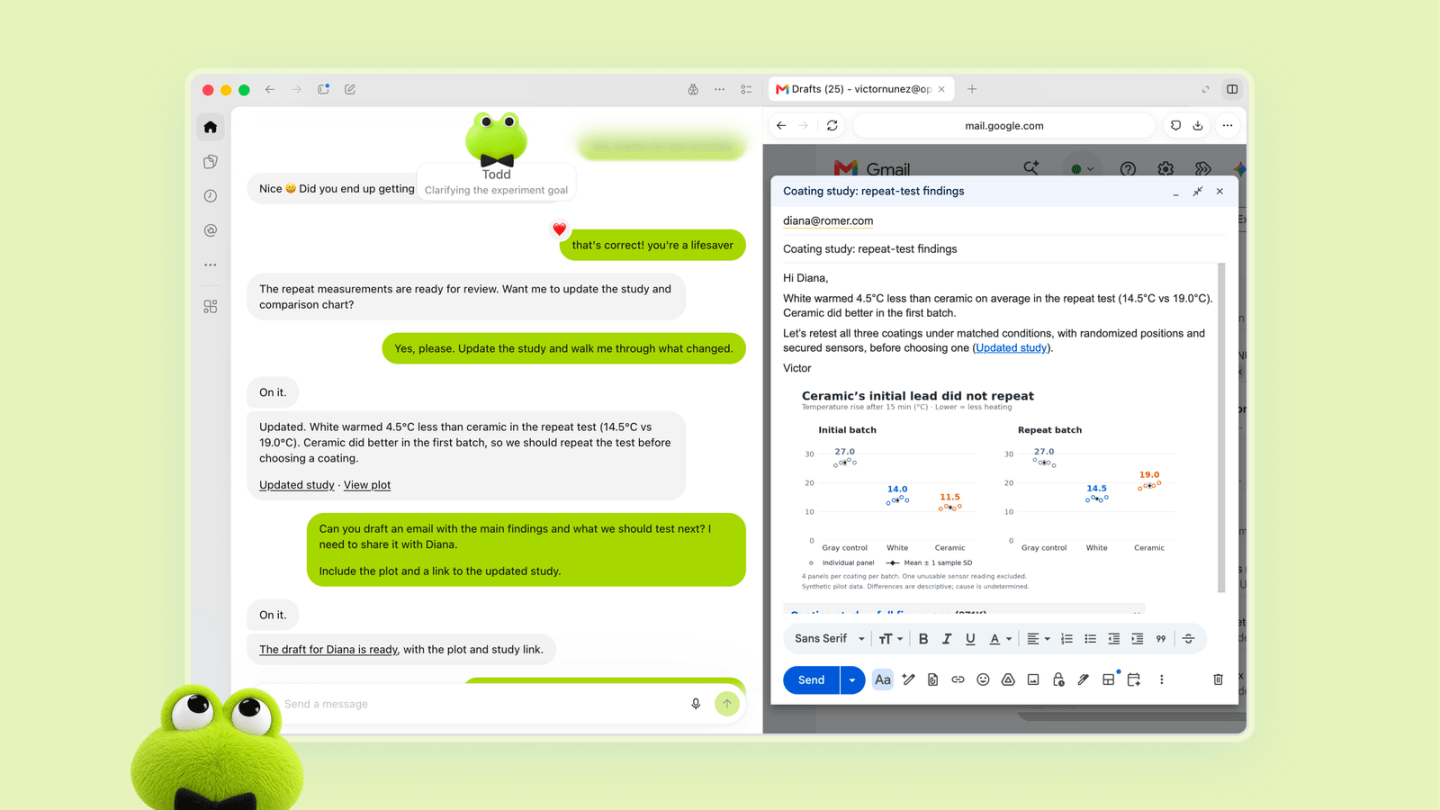
Dots are always-available assistants you can assign work to by chatting through text, Slack, and Microsoft Teams. They can complete multi-step tasks, OpenAI said, such as keeping track of a project, preparing for an appointment, or following up on a to-do list. The agent proactively completes the work, leveraging any apps the user has granted it access to, and only reaches out to the human when something requires their review or attention.
The teams at OpenAI have been working long hours in recent weeks to prepare for the huge number of launches, one source at the company tells Fortune, something another employee publicly alluded to in an X post. OpenAI also put a freeze on any major launches in the past 2 weeks, save for its affordability-focused GPT-6 Sol and Luna models, so it could ship them all at DevDay, the source said.
OpenAI
As the graphic above shows, users can name their dots for a bit of personalization, and choose their shape. The company shared examples of green dots that look like a frog, as well as yellow, pink, and blue dots of varying cutesy forms. The dots learn their creator’s preferences over time, and remember past conversations and decisions—a process the likely results in them collecting immense amounts of data along the way, as Meta’s Muse does, ZDNet reports. That could be why dots are not available in regions with strict data privacy law like the European Economic Area, Switzerland, and the UK.
To make sure dots don’t go rogue—especially in light of OpenAI’s agents continuing to hack websites and act in unintended ways during training—OpenAI built them to ask the human before performing sensitive actions, such as changing a password, permanently deleting data, or installing software. Users can also set customer rules to explicitly tell their dots what they can and cannot do, and when they need permission.
All Pro and Business Premium users get one free dot included in their plans, although OpenAI says it will later offer paid options for more dots at an unnamed price. Over time, OpenAI plans to make it possible to assign work to teams of dots that can collaborate.
Users can work alongside their dot in ChatGPT Space, a dedicated area within ChatGPT where they can build upon what they create in ChatGPT rather than exporting it. OpenAI calls this a “shared surface where humans and agents can collaborate.” Users can also upload files, and share them with others—a move that could lay groundwork for OpenAI to one day challenge rival Google Docs or the wider Google Workspace suite of applications.
You can create documents, spreadsheets, and slide decks in ChatGPT Space, and assign humans and agents tasks. For example, “multiple teammates and agents can edit the deck at the same time and leave comments,” OpenAI said.
A $500 monthly plan, while the $200 monthly plan takes a hit
OpenAI also unveiled a new $500/month plan, which offers the highest usage allowance and makes Codex eight-times faster. It’s also available in ChatGPT Work.
OpenAI seems to be pushing power users toward this pricey new plan by decreasing the included usage on its $200/month Pro plan. It’s now less of a step up from the $20/month Plus plan, with a lower usage allowance and message limit, with no corresponding drop in price. (Conversations with dots do not count toward ChatGPT usage limits.)
The $200/month plan, however, is getting a welcome update: it will no longer have a five hour usage limit, said Thibault Sottiaux, Head of Core Products and Platform, on X. He also mentioned that the model quality will keep increasing, so subscribers can get more done with their fewer tokens.
Amid an ongoing price war with Anthropic, OpenAI debuted a more affordable new model, called GPT-6.1 Sol, for developers and builders through the API. It aims to offer nearly the same level of intelligence as its flagship GPT-6 Astra model “at a fifth of the price.” It particularly excels at agentic coding, computer use, and professional work, OpenAI said. It’s the same cost as GPT-6 Sol, released just last week, at $2/million input tokens and $10/million output tokens.
OpenAI also shared new statistics on its user numbers: Over 1.2 billion people now use ChatGPT per week, along with 2.5 million businesses. The company is focused on courting more businesses to sign up for its Enterprise plans. Today, it launched a more secure version of Zero Data Retention with Private Safety Processing, which “enables offline, automated safety review” without sharing data with OpenAI.
OpenAI also debuted a new marketplace where enterprise customers can re-allocate part of their committed money for ChatGPT toward other tools, if desired. This is tied to their enterprise agreement, and is negotiated direclty with their OpenAI account team. The program is starting with 32 partners: Adobe, Figma, Sierra, and Harvey, to name a few.
There are more launches to come soon from OpenAI. In the next few weeks, it plans to unveil a cybersecurity-focused model, GPT-6 Cyber, in the coming weeks, geared toward enterprises as well, as Fortune first reported. By the end of 2026, it’s also committed to debuting its consumer-focused device.
The teams at OpenAI have been working long hours in recent weeks to prepare for the huge number of launches, one source at the company tells Fortune, something another employee publicly alluded to in an X post. OpenAI also put a freeze on any major launches in the past 2 weeks, save for its affordability-focused GPT-6 Sol and Luna models, so it could ship them all at DevDay, the source said.