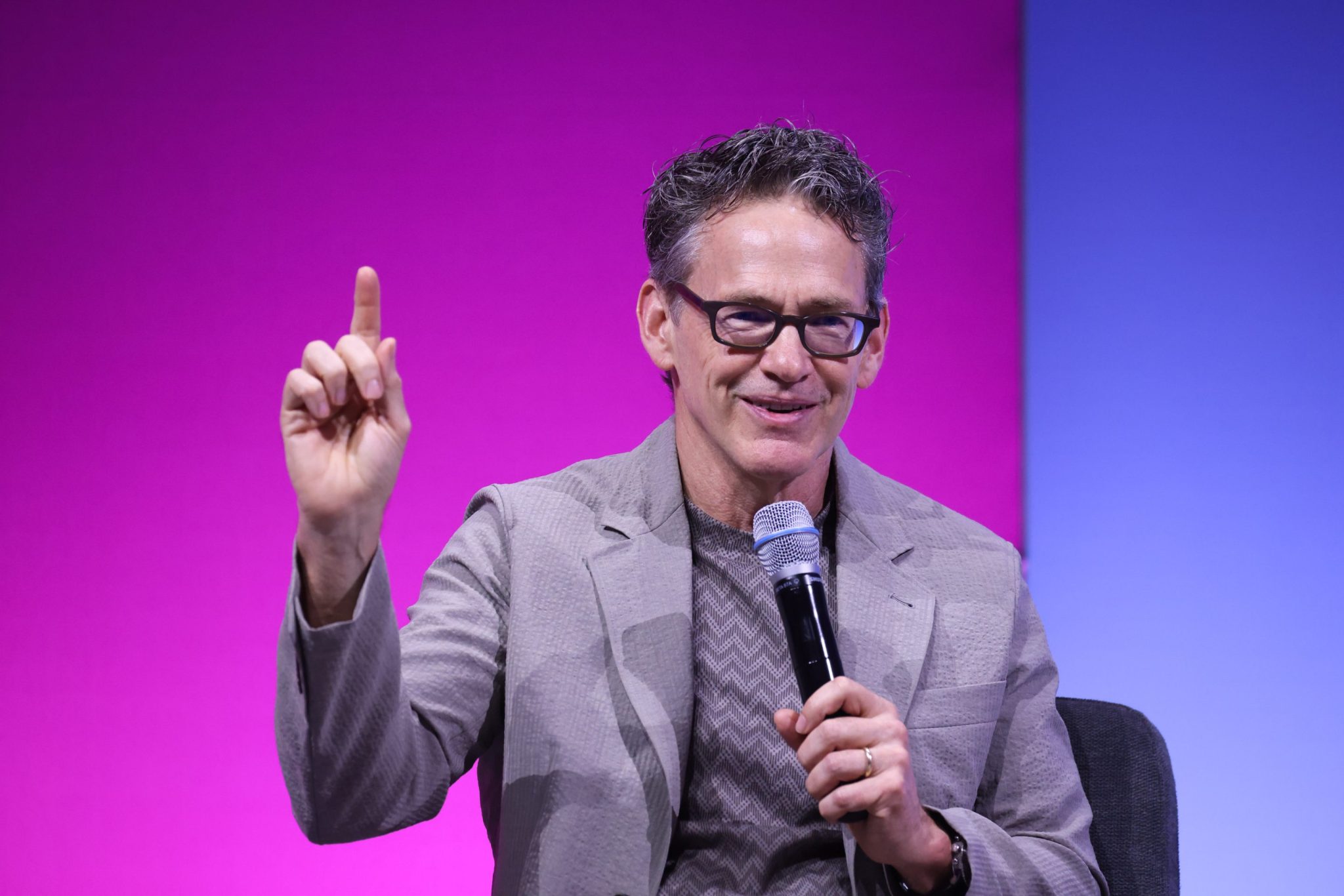
Good morning. After you’ve streamlined and transformed and flattened your company, how do you get it to grow again? I recently asked that question to Bayer CEO Bill Anderson, who’s done all of the above at the 163-year-old health science giant. He’s reduced the number of managers from about 16,000 to 4,500 (in a company of 88,000) and replaced hierarchy and annual budgets with 5,000 small teams working on 90-day cycles. So what’s next?
“Our ambition, for the last three years, basically, was to survive,” he told me, as we sipped takeout coffee in an empty corner of New York’s Javits Center last month. “How much are we willing to stretch ourselves now and put out a bold ambition for what this company can be and fight for that?”
Good question. Bayer announced plans to invest $2.2 billion in a new Ohio manufacturing site last week. Global COO Sebastian Guth recently wrote in Fortune that the company stopped assigning sales targets. Investors are newly enthusiastic as Bayer’s stock is up 57% over the past year (versus about 21% for BASF and 14% for Novartis) but flat over the past three years (versus 43% and 47% growth, respectively). Anderson has improved profitability and won a Supreme Court ruling that addresses liability claims predating his arrival, but the real test will be whether he can continue to drive revenue and profit growth.
Anderson has found that giving people more authority doesn’t necessarily increase their willingness to make tough decisions. “We have a nice culture” that’s “a little softer” on things like “courageous authenticity and decisiveness.”
To address that, he started at the top: “The job of the leaders is not to manage people, and it’s not to decide the goals, and then, you know, cascade them. No, forget that. The job of the leaders is to set the vision. That’s very different than telling everyone what to do,” he said. “We are putting 95% of decision making at the bottom, not delegating it down in the hierarchy.” He ranks his priorities in descending order: Mission first, employees second, shareholders third, senior management last.
What’s oddly heartening is the realization that Anderson doesn’t have all the answers. It shows that transformation is ongoing and hard. “This is not a culture program or a communication program,” said Anderson. “Ninety-nine percent of all corporate transformations are not transformations. They’re just shuffling the boxes around.”
Contact CEO Daily via Diane Brady at diane.brady@fortune.com
Top leadership news
Why Oura really pulled its IPO
Oura blamed “uncertainty in the IPO market” for scrapping its offering hours before pricing, but experts suspect other causes: a steep $40-$44 per share price for a hardware-heavy company, the fact that only 27% of shares would be newly issued by the company, and the threat of an Apple ring. Oura says it has the “luxury of choosing our moment” to go public.
McDonald’s looks beyond meal deals
Discounts haven’t reversed slowing U.S. growth for McDonald’s. Rising beef costs and a crowded schedule of menu launches have added pressure on restaurants. CEO Chris Kempczinski is now offering franchisees $8.5 billion in support over 10 years as he pushes for restaurant upgrades and better service.
Why Mikel Arteta had his DNA mapped
Arsenal manager Mikel Arteta had his genome sequenced to better understand his health risks, prompting changes to his diet and sleep routines. He explains why looking after his own health is part of leading his team—and why he decided to talk about it publicly.
The markets
S&P 500 futures are flat this morning. The last session closed up 0.58%. The STOXX Europe 600 was down 0.13% in early trading. The U.K.’s FTSE 100 was down 0.14% in early trading. Japan’s Nikkei 225 was down 0.92%. South Korea’s KOSPI was down 1.98%. China’s markets are closed. Hong Kong’s Hang Seng was down 0.62%. India’s NIFTY 50 is down 0.84%. Bitcoin is down at $84k.
Around the watercooler
Former CIA official with Top Secret clearance admits to $194 million fraud, including 298 gold bars and four luxury South Florida properties by Catherina Gioino
OpenAI’s human rights lead: What the military could do with AI ‘keeps me up at night’ by Emily Forlini
‘AI Snake Oil’ author sees chatbots evolving into a ‘truth oracle’—and journalism heading somewhere it hasn’t been in 200 years by Nick Lichtenberg
Elon Musk is a trillionaire again—and he’d still be the richest person on the planet even if he gave everyone $90 by Emma Burleigh
CEO Daily is curated and edited by Joseph Abrams, Jason Ma, Claire Zillman, and Lee Clifford.