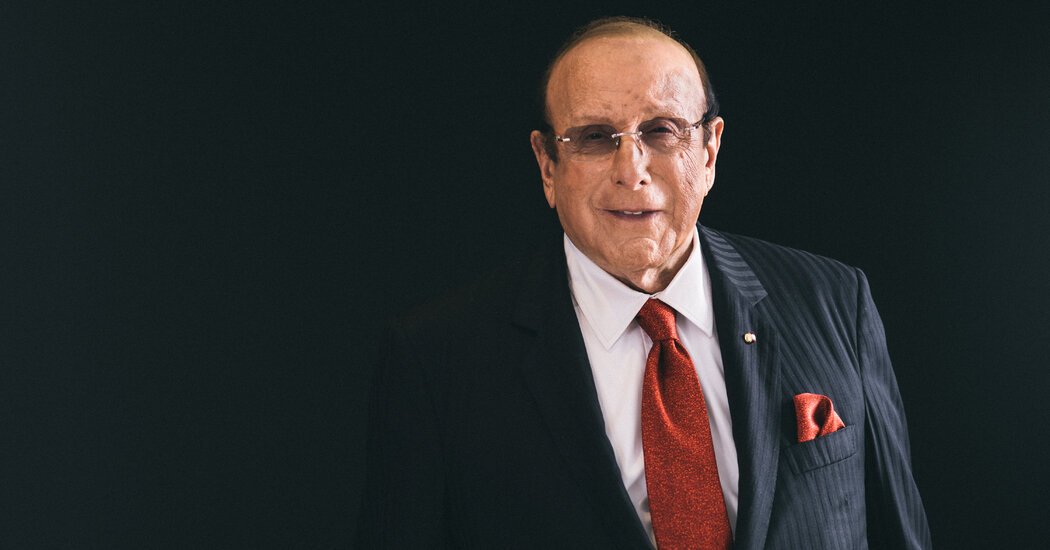
Clive Davis, the music executive who rose from a midlevel legal position at Columbia Records to become one of the industry’s most powerful and longest-reigning dons, guiding the careers of Whitney Houston, Aretha Franklin, Barry Manilow and dozens of other stars, died on Monday at his home in Manhattan. He was 94.
His family confirmed the death. Mr. Davis had recently been hospitalized with respiratory problems.
One of the few nonperformers in music to become a household name, Mr. Davis maintained a visible role as a starmaker for half a century. In the late 1960s he propelled a reluctant Columbia headlong into the rock era with acts like Janis Joplin and Blood, Sweat & Tears. He also encouraged the jazz trumpeter Miles Davis to connect with the Woodstock generation.
Later, at the Arista and J labels, he championed R&B-leaning pop divas like Ms. Houston, Alicia Keys and Jennifer Hudson; seized on the commercial potential for hip-hop; and orchestrated major career revivals for Carlos Santana and Rod Stewart, with albums selling in the millions.
For the public that saw him on television or in magazines, Mr. Davis was a mellow, dandyish eminence, seldom pictured in anything but a brightly accessorized suit. He spoke with an accent that hinted at European refinement, although his middle-class Brooklyn origins shone through when he referred, with affection, to “Arether.”
In the music industry, Mr. Davis, whose last position was chief creative officer of Sony Music Entertainment, was known as a relentless pursuer of hits, and as a symbol of continuity whose career survived numerous setbacks and corporate leadership sweeps.
Sometimes Mr. Davis even turned up in the lyrics of his artists’ songs. In Aerosmith’s 1979 track “No Surprize,” Steven Tyler sang about being greenlighted by the Columbia boss at an early gig at Max’s Kansas City in Manhattan: “And then old Clive Davis said he’s surely gonna make us a star.”
Many of the industry’s A-list executives cultivated their leadership skills through years as producers or talent wranglers. When Mr. Davis started in the Columbia legal department in 1960, at age 28, he had no relevant background; he later described himself as a garden-variety striver who was most proud of getting full scholarships to New York University and Harvard Law School.
“I knew nothing about music,” he said in a 2017 documentary, “Clive Davis: The Soundtrack of Our Lives.”
Mr. Davis worked to develop his business instincts — and his ear — by studying the Billboard charts and analyzing what made a song a hit. He came to believe in the power of what he called contemporary music: the unabashedly commercial pop that results when a record executive plays matchmaker in the studio, connecting the right singers with the right material.
That process could take a while. For Ms. Houston’s first album, Mr. Davis and his lieutenants hunted for producers and songs for nearly two years. When “Whitney Houston” was finally released, in 1985, it had three No. 1 singles — “Saving All My Love for You,” “How Will I Know” and “Greatest Love of All” — and became one of the most successful debut albums in history, selling more than 25 million copies around the world, according to Sony.
“What I learned from Clive is that the only thing that matters at the end of the day when you’re making a record is the three and a half minutes of magic,” Jimmy Iovine, the producer and record executive, told The Los Angeles Times in 1996. “Everyone says they keep the music first, but from my experience, Clive is one of the few who truly practices this.”
Mr. Davis’s longevity in the music world — embodied by his glamorous annual Grammy Awards parties, which he hosted starting in 1976 — made him an institution in the business. Well past the point when most of his contemporaries had retired, Mr. Davis continued to hunt for talent. He could also draw headlines, as when he revealed, at age 80, that he was bisexual and had been in serious relationships with men in addition to his two marriages to women.
“What is patently clear,” he wrote in a memoir, “The Soundtrack of My Life” (2013), “is that openness in all areas of life is an important component of happiness and success.”
A Kid Called Clive
Clive Jay Davis was born in Brooklyn on April 4, 1932, and grew up in the Crown Heights neighborhood. His father, Herman, was an electrician and traveling tie salesman. His mother, Florence (Brooks) Davis, had family connections to the Russeks department store in Manhattan; despite their modest circumstances, she carried herself with a “regal air,” Mr. Davis later recalled.
They named their son after Clive Brook, the suave English movie star who played opposite Marlene Dietrich in the 1932 film “Shanghai Express.”
“Believe me, there were not many kids named Clive in Crown Heights,” Mr. Davis said in his memoir, written with Anthony DeCurtis.
In the book, he described a youth of rigorous schoolwork and passion for the Brooklyn Dodgers but no special attachment to music. He graduated from Erasmus Hall High School in Brooklyn and attended N.Y.U., where he was president of his freshman class, on a scholarship.
While he was in college, his parents died within 11 months of each other, and he went to live with his sister, Seena, in Queens. In his book, he described the loss of his parents as a devastating blow: “It made me feel that anything, however cherished and secure, might be taken away from me at any time.”
He threw himself into his studies and, after completing his bachelor’s degree in 1953, gained another scholarship, to Harvard Law School. Within a few years of graduating in 1956, he was a moderately paid associate at a white-shoe firm in New York, but the job bored him. When a position for an in-house lawyer opened at Columbia — then a division of CBS, one of the firm’s clients — he eagerly took it.
Early on, Mr. Davis demonstrated a shrewdness in negotiation. He helped defeat a federal antitrust suit over Columbia’s mail-order record club and handled delicate contract talks with young stars like Bob Dylan and Barbra Streisand.
Rising quickly through Columbia’s corporate ranks, Mr. Davis became president in 1967 and began to reshape the label to compete in changing times.
Under his predecessor, Goddard Lieberson, a trained composer and an inspiration for Mr. Davis’s debonair style, Columbia had dominated the market for Broadway cast albums and built an extraordinary roster of jazz, classical and traditional pop acts.
Yet the label had made only minimal steps toward rock. Mitch Miller, the powerful head of artists and repertoire, had dismissed rock in the 1950s as juvenile garbage. “It’s not music,” he once said. “It’s a disease.”
As rock came to dominate pop culture, that stance became a liability.
Mr. Davis’s epiphany in both music and business came at the Monterey International Pop Festival in June 1967, where the lineup included Jimi Hendrix, the Who and the Grateful Dead. Mr. Davis was particularly smitten with Ms. Joplin and her band, Big Brother and the Holding Company. The affectionate antics of the flower-child generation charmed him, but the mass commercial potential of rock made an even stronger impression.
“I felt my spine tingle and my arms vibrate,” he recalled in the 2017 documentary. “I realized this was going to be the future. I could feel it in my bones.”
In the years after Monterey, he brought Big Brother, Billy Joel, Bruce Springsteen, Neil Diamond, Santana, Chicago, Laura Nyro, Aerosmith and many others to the label.
To shake up Columbia’s button-down corporate culture, he had his salesmen read Rolling Stone magazine — an act of “heresy” at the label of “My Fair Lady” and the piano virtuoso Vladimir Horowitz, a former colleague, Dick Asher, later recalled, according to Fredric Dannen’s book “Hit Men: Power Brokers and Fast Money Inside the Music Business” (1990).
Within a few years, Columbia’s profits skyrocketed, validating his approach.
But Mr. Davis’s fast-moving career had a painful setback on May 29, 1973, when Columbia fired him and filed a lawsuit accusing him of using $94,000 in company funds (about $700,000 today) to pay for personal expenses, including apartment renovations and the bar mitzvah of one his sons. Mr. Davis said an underling had forged invoices without his knowledge.
Dragged Into ‘Drugola’
His dismissal from Columbia came as federal authorities announced a string of arrests as part of an investigation into payola and drugs in the music industry, and for months Mr. Davis’s name was attached to sensational news reports of “drugola.” He and his lawyers said then — and Mr. Davis contended ever since — that he had been made a scapegoat to protect CBS and its all-important broadcast licenses.
Mr. Davis was never charged with payola but, in 1975, he was indicted on six counts of filing false income tax reports. He pleaded guilty to one count — failing to pay taxes on $8,800 in vacation expenses (about $55,000 today) — and paid a $10,000 fine. At his sentencing hearing, the judge scolded the news media for smearing his name.
By then, Mr. Davis was already rebounding.
In 1974, he took over the foundering Bell label and renamed it Arista, after the New York branches of the National Honor Society, of which Mr. Davis had been a proud member as a high school student. He quickly scored a No. 1 hit with “Mandy,” by one of the few Bell acts that he kept on the label: Mr. Manilow.
Arista built a diverse roster in the 1970s, including Patti Smith, the Kinks, Lou Reed, Gil Scott-Heron and Melissa Manchester, and Mr. Davis developed a specialty of reviving the careers of faded female vocalists. The first was Dionne Warwick, in 1979, with “I’ll Never Love This Way Again,” which became her first Top Five solo single in a decade. Then came Ms. Franklin, whose 1985 album, “Who’s Zoomin’ Who?,” became her first million-seller.
Mr. Davis found even greater success with Ms. Houston, Ms. Warwick’s cousin, who signed with Arista in 1983, when she was 19, and remained associated with Mr. Davis throughout her career. (She died on Feb. 11, 2012, at the Beverly Hilton in Beverly Hills, Calif., hours before Mr. Davis’s pre-Grammys gala was to begin a few floors below.)
He promoted his acts lavishly and involved himself in the creative process. Artists and producers under his watch frequently found themselves directed back to the studio for the umpteenth new mix or vocal tweak.
Very often, his participation proved worthwhile. When Ms. Houston recorded “I Will Always Love You” for the soundtrack to her 1992 film “The Bodyguard,” she sang the first 40 seconds or so a cappella, at the suggestion of Kevin Costner, her co-star.
When Mr. Davis heard the track, he insisted on keeping it that way, over the objections of the song’s producer, David Foster, and others at the record company, who feared that such a long, bare introduction would hurt the song’s chances at radio.
Mr. Davis prevailed, and “I Will Always Love You” held the No. 1 spot for 14 weeks.
His single-mindedness, and his habit for self-promotion, made Mr. Davis a lightning rod in the industry. In response to a New York Times review of Mr. Davis’s book that said he had “discovered” various artists, Rubén Blades, the Panamanian musician and political figure, wrote, “Record executives do not discover artists: they stumble upon them.”
In some cases, Mr. Davis clashed with his talent. In 1969, Tony Bennett gave in to his pressure to record more contemporary songs. The resulting album, “Tony Sings the Great Hits of Today!” — which included a melodramatic, partly spoken version of the Beatles’ “Eleanor Rigby” — was widely mocked, and Mr. Bennett later said the experience had made him vomit.
In his 2013 book, Mr. Davis described a growing tension during the 1970s with Mr. Manilow, who saw himself primarily as a songwriter but whose biggest numbers — even “I Write the Songs,” a No. 1 hit in 1976 — were mostly written by other people. Mr. Davis said he told Mr. Manilow, “If you were Irving Berlin, we would know it by now!”
After Ms. Houston’s death, Mr. Davis came under criticism when Arista insiders said that the label, under Mr. Davis’s direction, had pushed her to adopt an image that would appeal to white audiences. In recording her albums, “anything that was too Black-sounding was sent back to the studio,” one former executive said in a 2017 documentary, “Whitney: Can I Be Me.”
Enduring Instincts
Episodes like those were few in a career filled with long-lasting relationships with artists and commercial instincts that, decade after decade, remained uncannily intact. In the 1980s and ’90s, Mr. Davis made lucrative joint-venture deals for Arista with young impresarios like L.A. Reid and Sean Combs, who were at the cutting edge of Black pop, and Mr. Davis plotted successful career turnarounds for some of his old stars.
Santana’s 1999 comeback album, “Supernatural,” with guest spots by Dave Matthews, Eric Clapton, Rob Thomas of Matchbox Twenty and others, sold more than 12 million copies and won nine Grammy Awards.
Among the stars Mr. Davis nurtured later in his career was Ms. Keys, whose debut album, “Songs in A Minor,” was released in 2001 on Mr. Davis’s next label, J, which he started after a battle with BMG Entertainment, then Arista’s parent company.
At the end of 1999, as Arista was celebrating a record sales year, BMG executives tried to force Mr. Davis into retirement. Artists rallied loudly to his defense — “If Clive leaves, I leave,” Ms. Franklin told The Los Angeles Times — and a chastened BMG agreed to finance a new label, J, with $150 million. Mr. Davis would own 50 percent.
J got its name from Mr. Davis’s middle initial, which he shares with his three sons, Fred, Mitchell and Doug. They survive him, along with a daughter, Lauren Davis; eight grandchildren; two great-grandchildren; and his partner, Greg Schriefer. Mr. Davis’s marriages to Helen Cohen and Janet Adelberg ended in divorce.
In 2000, Mr. Davis was inducted into the Rock & Roll Hall of Fame as a nonperformer and, in his later years, he began to tend to his legacy. In 2002, he donated $5 million to endow the Clive Davis Department of Recorded Music, an undergraduate program at N.Y.U.’s Tisch School of the Arts that prepares students for careers in the music industry; in 2011, he gave another $5 million, and the program was renamed the Clive Davis Institute.
His Grammy parties remained highlights of each awards season, attended by music stars and boldface names from business and politics. (Nancy Pelosi, the former speaker of the House, and Tim Cook, the former chief executive of Apple, were frequent guests.)
At the most recent party, on Jan. 31, Mr. Davis was introduced by a video message from former President Barack Obama, who said, “Most people don’t realize how much the music they love was shaped by one man.”
In 2017, just before the documentary about him was released, Mr. Davis, then 85, said in an interview with The New York Times that he was still hunting for hits for his artists.
“I still love it,” he said. “Whether it’s doing those albums, or doing my Grammy party every year, it’s a great feeling. I got into this totally by luck, and it’s just wonderfully fulfilling.”