

Ethereum is pushing against resistance just below $2,400, trying to extend a recovery that has brought it back from the lows near $1,750 set during February’s sharp capitulation. The market remains uncertain, and every attempt at higher levels has been met with selling pressure that reflects the broader caution defining crypto right now. But a CryptoOnchain report has surfaced a supply-side data point that reframes the current price level in a way that is worth sitting with.
Ethereum reserves on Binance have fallen to approximately 3.31 million ETH — their lowest point since early 2021. That number alone carries weight, but what makes it genuinely striking is the comparison it invites. The last time Binance held this little ETH in reserve, Ethereum was trading at around $590. The asset has since risen nearly fourfold from that baseline. The supply available to sell on one of the world’s largest exchanges has not recovered to match that price appreciation — it has kept falling.
What that means in structural terms is that the market is attempting to push above $2,400 with a dramatically thinner sell-side cushion than has existed at any comparable price level in years. The resistance is real. But the supply available to sustain it may be less abundant than the chart suggests.
57% Less ETH to Sell — and Holders Are Not Coming Back
The trend behind the current reserve level is as significant as the number itself. Ethereum reserves on Binance have not simply dipped — they have been in sustained, continuous decline, falling from approximately 7.7 million ETH at their peak to the current 3.31 million.
That is not rotation or temporary withdrawal. It is a structural migration of assets away from liquid trading venues and into cold storage, DeFi smart contracts, and staking platforms — destinations where ETH is committed rather than available.

In on-chain analysis, that kind of persistent exchange outflow is one of the clearest signals of long-term holder conviction. When investors move assets off exchanges, they are making an active decision to remove them from the pool of immediately sellable supply. They are not watching for an exit. They are positioning for what comes next.
What makes the current situation particularly striking is the price context. In 2021, when reserves were last at this level, Ethereum was worth around $590. Today it is trading near $2,400 — and yet holders are keeping even less on exchanges than they did then. That behavior at a dramatically higher price reflects a market that has matured, with participants who understand the asset well enough to hold through volatility rather than sell into it.
If new demand enters this market — driven by macro tailwinds, institutional adoption, or network developments — it will meet a sell side that has never been thinner relative to current price levels. That is the setup the reserve data is describing.
Ethereum’s weekly structure shows a market transitioning from a sharp corrective phase into a tentative recovery, but still operating within a broader range rather than a confirmed trend reversal. After peaking near $4,800 in 2025, ETH entered a sustained downtrend that culminated in a capitulation event around the $1,500–$1,700 region. That move was accompanied by a clear spike in volume, signaling forced selling and a reset in positioning.
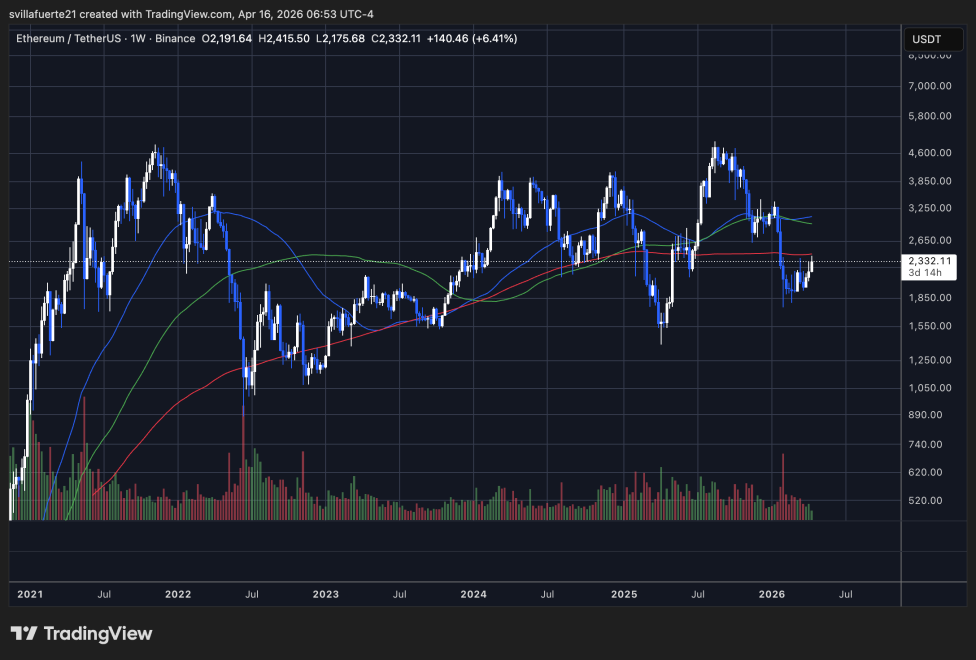
Since that low, price has staged a recovery back toward the $2,300–$2,400 region, which now acts as a key resistance zone. This level aligns closely with the 100-week moving average, while the 50-week average is attempting to flatten just above the current price. The 200-week moving average, still trending upward near the $2,000 area, continues to act as long-term structural support.
The current setup is defined by compression between these moving averages. ETH is holding above its long-term trend support but remains capped below mid-cycle resistance. This creates a neutral-to-transitional structure rather than a directional one.
Volume has normalized following the capitulation spike, suggesting reduced urgency from both buyers and sellers. A decisive break above $2,400 would likely shift momentum toward a broader recovery, while rejection at this level could reinforce continued range-bound behavior within the current cycle structure.
Featured image from ChatGPT, chart from TradingView.com
Editorial Process for bitcoinist is centered on delivering thoroughly researched, accurate, and unbiased content. We uphold strict sourcing standards, and each page undergoes diligent review by our team of top technology experts and seasoned editors. This process ensures the integrity, relevance, and value of our content for our readers.