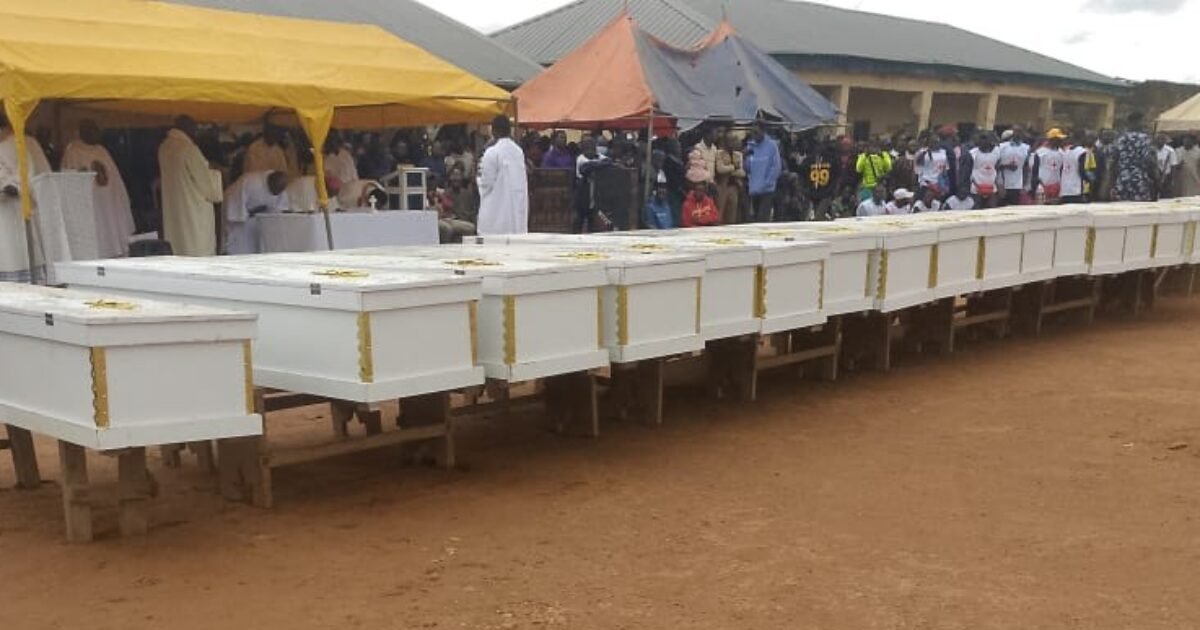

For more than a decade, Christian communities across Nigeria’s Middle Belt, Plateu State, and southern Kaduna have gathered repeatedly to bury victims of a genocide carried out by Fulani militants, with some burials themselves coming under fire. In just the last six months, Nigerian security monitors have reported thousands of nationwide killings.
In May, armed militias attacked Ngbra-Zongo village in Plateau State’s Kwall District shortly after midnight, killing 11 people. Days later, mourners gathered in Nding Sesut community, Barkin Ladi Local Government Area, to bury seven relatives killed the night before when gunmen attacked mourners during the burial itself, killing three more. Later that month, attackers returned to Bokkos County on consecutive days; by the second day, the local government chairman had confirmed over 40 killed, and a mass burial in Kopmur village came under fire when gunmen returned to shoot at mourners at the graveside.
On June 2, residents of Gwon-Ajang village in Barkin Ladi held a mass burial for eight people killed on May 31, when more than 100 armed attackers stormed the village at night and shot residents in their homes.
In mid-July, weekend attacks on Kum and Wereng-Comp communities in Ryom County left at least 25 Christians dead, including a two-month-old infant; nine members of one family were killed and buried in a single mass grave.
The most recent mass-casualty attack occurred July 26–27 in Naridon village, Kauru Local Government Area of Kaduna State, on the border with Plateau State. Gunmen opened fire on residents, set houses ablaze, and killed at least 30 people, including eight children. On August 1, the Catholic Diocese of Kafanchan held a mass burial for 27 of the 30 victims; the diocese’s bishop said the community had been failed by those responsible for protecting it.
Comrade Joshua Raphael, speaking by phone the morning after the attack, said gunfire began around 11:45 p.m. and continued for close to three hours before any security response arrived, despite repeated efforts to alert authorities by phone. He said clergy and a doctor came to assist afterward, and that community members helped convey the dead to the mortuary while burial preparations were made. Raphael put the toll at that point at 29 dead, seven injured, and four shops burnt. Asked who he believed was responsible, he said, “Yes, sir, Islam. Confirmed,” and described Naridon as “a pure Christian community” with no Muslim residents nearby.
Community leaders in Naridon report that state and local government personnel remained absent from the day of the attack through the day of the burial. Survivors also face hunger, since their homes and food barns were burnt in the attack, and are calling on the government to provide food aid. In an open letter to Kaduna State Governor Uba Sani, the people of Chawai Chiefdom said survivors and families of the injured are grappling with “loss, trauma, displacement,” and that many feel forgotten, since “no meaningful intervention or support has been extended to them to date.” The letter requested relief materials for affected families and medical care for the injured, while praising the governor’s “commitment to inclusivity and fairness” and expressing hope for his “swift intervention and support.”
Sunday Abo, youth leader of the Kamaru district where Naridon sits, said he visited the scene and went through the affected houses himself, finding that residents had been attacked inside their homes; he counted eight houses directly attacked and four shops burnt to ashes. He said the district is roughly 95 percent Christian, with a small Muslim minority living among them, some of whom are relatives who converted to Islam, and that neighboring Muslim or religiously mixed communities have not experienced similar attacks.
Abo said the district has faced repeated attacks since 2015 or 2016, including a nine-person killing in nearby Olangamaji less than a month earlier, and that residents live alongside Fulani herders who graze cattle nearby but could not confirm who was responsible for the latest attack. He said the community has concluded it cannot wait on government protection, stating “we are supposed to do the needful in order to protect their own self before government comes in,” and called for unity among neighboring communities and support to form local vigilante groups.
Irigwe community leader Ayuba Lauyer, asked what advice he has for Naridon and neighboring Christian communities facing the threat of genocide, called on the area’s two tribes, the Chawe and the Irigwe, to set aside rivalries and unite, saying residents “must first have to defend ourselves” before government protection arrives and that doing so would make further attacks “less severe and less frequent.”
He said residents have identified Fulani settlers living among them as responsible for the killings and for destroying farmland despite posing as interested in peaceful coexistence. Lauyer said the community has “reached the limits of our patience” and warned “there will be all out war” if another attack occurs, while appealing to government to stop Fulani grazing incursions into their villages.

At the mass burial, Kafanchan Diocese Bishop Julius Yakubu Kundi said in his homily that the community had been failed by those responsible for protecting it and that he had come to stand with mourning mothers whose pain “cannot be imagined by anyone who has not felt” it.
He said the killings were “criminality,” not a reprisal attack or a boundary dispute, stating “this has nothing to do with revenge, this has nothing to do with reprisal attacks.” He said government was aware of the community’s plight before the attack, and that international condemnation of such killings typically produces no further action, adding that “even though the coffins are white, the problem that brought about the coffins is dark.”
Nationwide figures compiled by Nigerian security analysts show the scale behind these individual attacks. SBM Intelligence reported 5,091 killings across Nigeria between April and June 2026, of which 2,644 victims were unarmed civilians. Separately, Nextier’s Violent Conflicts Database recorded 156 violent incidents in May 2026 alone, resulting in 842 deaths and 279 kidnappings, a 51.5 percent rise in incidents and a 90.1 percent rise in fatalities compared with May 2025.
According to Open Doors’ 2026 World Watch List, 3,490 Christians were killed for their faith in Nigeria between October 2024 and September 2025, 72 percent of the 4,849 Christians killed worldwide during that period, and an increase from 3,100 the year before. Human Rights Watch’s 2026 World Report noted that no confirmed arrests or prosecutions have followed the April killings in Bokkos, and that court proceedings tied to the 2025 Yelwata attack remain unclear.
Ad block users: Some site features may not work correctly while an ad blocker is enabled, because they break scripts and content this website depends on. If you can’t see comments below, for example, please disable your ad blocker.