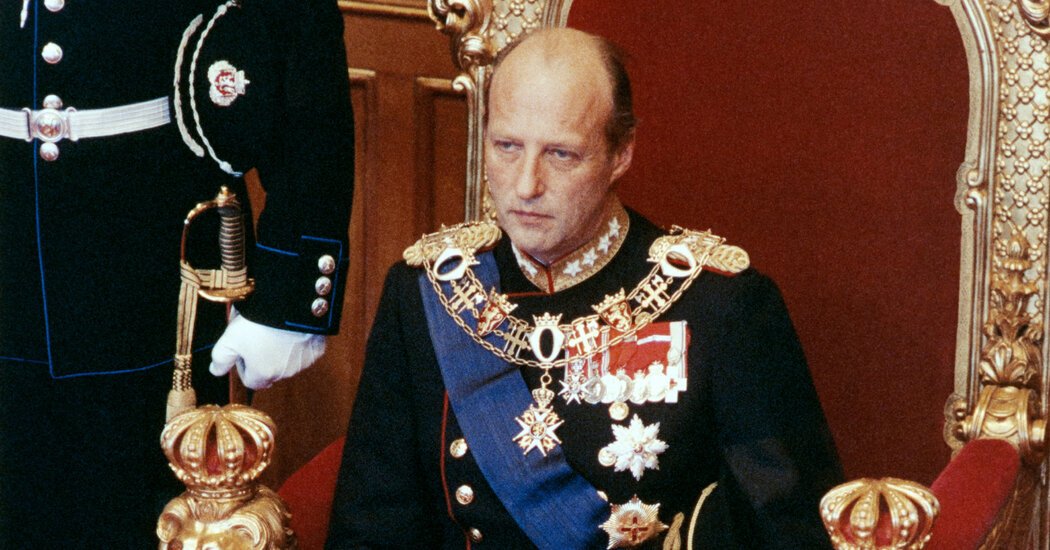
King Harald V of Norway, whose 35-year reign opened an ancient monarchy to a contentious cast of family connections, including a draper’s daughter; a celebrity shaman; and Jeffrey Epstein, the disgraced financier, died on Friday. He was 89.
The king died at University Hospital Rikshospitalet in Oslo, the Royal Court said in a statement. He had been receiving treatment for a bacterial infection of his blood and members of the royal family had gathered at the hospital on Thursday as his condition deteriorated.
The king was born into a centuries-old lineage that shared part of its heritage with the British monarchy, anchoring him in a network of inherited privilege in an era when Europe was moving toward replacing all-powerful rulers with more ceremonial constitutional monarchs like Harald. He was a distant cousin of King Charles III of Britain.
Of his reign’s many collisions between tradition and modernity, perhaps the most perilous came recently.
This year, the United States Department of Justice released a huge trove of documents related to Mr. Epstein, including emails linking Crown Princess Mette-Marit, the king’s daughter-in-law, to the sex offender.
In the emails, the relationship between the crown princess and Mr. Epstein — unfolding several years after Mr. Epstein was convicted in 2008 on charges of soliciting a minor for prostitution — came across as intimate and teasing, and showed that she was closer to him than the palace had previously acknowledged. The disclosures prompted questioning of Mette-Marit’s suitability as a future queen and emboldened some Norwegians to call for the abolition of the monarchy.
There had already been some public questioning in 2001, when Crown Prince Haakon, the heir to the throne, married Mette-Marit Tjessem Hoiby, a former waitress, divorcée and single mother. But Harald himself had already begun the process of change that brought so-called commoners — people with no royal ancestors — into the regal House of Glücksburg created by his forebears. Risking a rift with his father, King Olav V, and threatening not to wed at all if his plans were frustrated, Harald had in 1968 married Sonja Haraldsen, the daughter of a clothing merchant and an undergraduate at the University of Oslo when they met.
Their secret on-again-off-again courtship lasted for nine years before Olav dropped his opposition and consented to their wedding.
The marriage was the start of a family tradition: Both of their children followed Harald’s example by choosing commoners as spouses.
The disclosures this year about Mette-Marit’s friendship with Mr. Epstein forced her to issue a statement saying that she regretted “having had any contact with Epstein.” But the royal family refused to comment further, opening it to accusations of evasiveness and more. “Can Mette-Marit become queen after this?” a leading newspaper editor asked.
The scandal was all the more incendiary because it emerged just days before Mette-Marit’s son, Marius Borg Hoiby, the stepson of Crown Prince Haakon, went on trial on multiple charges of rape as well as other crimes. In June, he was found guilty of many of the charges and sentenced to four years in prison, and has been under house arrest as he appeals the verdict. Also in June, the crown princess, who was diagnosed with pulmonary fibrosis in 2018, underwent a successful lung transplant.
The crisis this year eclipsed other moments when Harald’s family had inspired public scrutiny. In 2002, his daughter, Princess Martha Louise, married an author, Ari Behn; they divorced in 2017, and he died by suicide in 2019. In 2022, the princess announced her engagement to Durek Verrett, an American and a self-proclaimed shaman who counted Gwyneth Paltrow among his celebrity clients and friends. They married in 2024.
Their relationship brought hostile attention to some of Mr. Verrett’s past utterances, including his claim that he had used an amulet — which he sold for $222 on his website — to combat Covid-19, and his assertion that cancer is a choice. The princess had also been criticized for many years for claiming to be clairvoyant and for urging others to contact “the angels and the divine universe.”
Disapproval of their relationship inspired media comparisons to the turmoil in the British royal family provoked by Prince Harry’s 2018 marriage to Meghan Markle. There were indeed parallels: In 2022, the Norwegian royal family announced that, like Prince Harry and his wife, Martha Louise and her partner would step back from royal duties; and, like Harry and Meghan, the princess and Mr. Verrett, who is Black, ascribed public criticism of their bond to racism.
But unlike the acrimonious rift in Britain between King Charles III and Harry, his younger son, Martha Louise characterized her separation from the royal family as friendly. For the Norwegian king’s part, he said that he and Mr. Verrett “agree to disagree.”
Harald was born on Feb. 21, 1937, on the royal Skaugum estate outside Oslo, the third child — after Princess Ragnhild and Princess Astrid — of Princess Martha of Sweden and the future King Olav V of Norway, who ruled from 1957 until his death in 1991.
Harald and Queen Sonja had two children, Martha Louise, born in 1971, and Haakon, in 1973. He is survived by them, his wife and six grandchildren.
The king’s early years were shaped by World War II, which began in September 1939. Six months later, German troops invaded Norway and the royal family fled. Harald’s grandfather, King Haakon VII — who had refused to surrender to the Germans — and his father, then called Prince Olav, took up residence in London, where a Norwegian government in exile had been established to oppose the German-backed administration of Vidkun Quisling, a Nazi collaborator who was in office for much of the occupation.
Along with his mother and sisters, Harald traveled to Washington, where he spent most of the war and where the family befriended President Franklin D. Roosevelt. At 7, he stood behind the president at his fourth inauguration in January 1945.
After the end of the war later that year, the royal family returned to Norway. Harald attended the University of Oslo, the Norwegian Military Academy (from which he graduated in 1959) and the University of Oxford in Britain, where he studied history, economics and politics at Balliol College in the early 1960s. He was known as an athlete, and as a yachtsman he was part of the Norwegian team at three Summer Olympics from 1964 to 1972, in Tokyo, Mexico City and Munich.
He became Norway’s king following the death of his father on Jan. 17, 1991, a new reign that was credited with greater openness toward the public than his predecessors had allowed. Beyond his acceptance of commoners into the royal family, he ordered the renovation of royal buildings, including the Royal Palace in Oslo, so that they could be opened to the public.
Harald was the country’s first Norwegian-born monarch since the 14th century. (After long political unions with Denmark and Sweden, Norway became independent in 1905.) Like other European monarchs, his powers as head of state were circumscribed by the Constitution and parliamentary convention to ensure that his political role was limited and largely formal. Much of his reign was underpinned by an economic boom that brought prosperity to Norwegians from offshore oil and gas deposits.
But in July 2011, he faced a brutal challenge to the nation’s self-image and self-esteem when Anders Behring Breivik, a far-right extremist, killed 77 people in attacks on government buildings in Oslo and on the island of Utoya. Some Norwegians compared the shock to the trauma of the Sept. 11, 2001, attacks in the United States.
With an address to Norwegians, meetings with bereaved families and a public display of grief when he wept at a national memorial service, Harald was credited with emerging as a symbol of patriotic resolve and unity.
“Now it’s important that we stand together and support each other, and that we don’t let fear take over,” he told his compatriots on the night of the attacks.
In a rare interview with The New York Times a few months later, the king said: “I’ve always had the feeling that in times of crisis, that’s what we’re here for, really. That showed in 1940, and we’ll see if this will come out the same way. You do what comes natural to you, and if that’s correct, all the better for that.”
Lynsey Chutel and Henrik Pryser Libell contributed reporting.