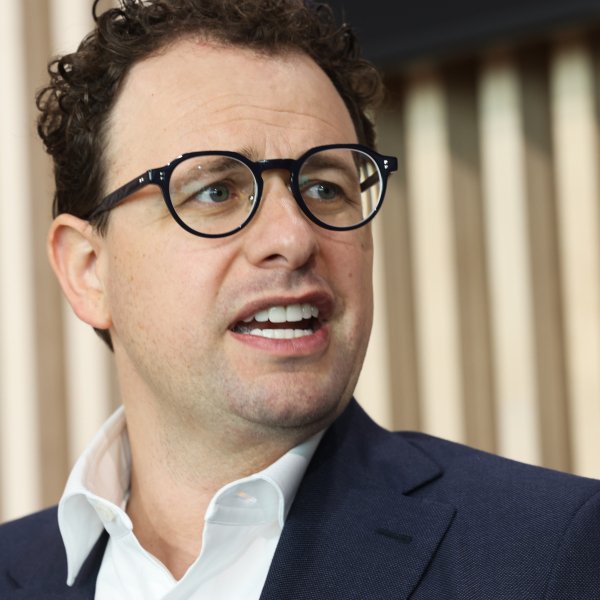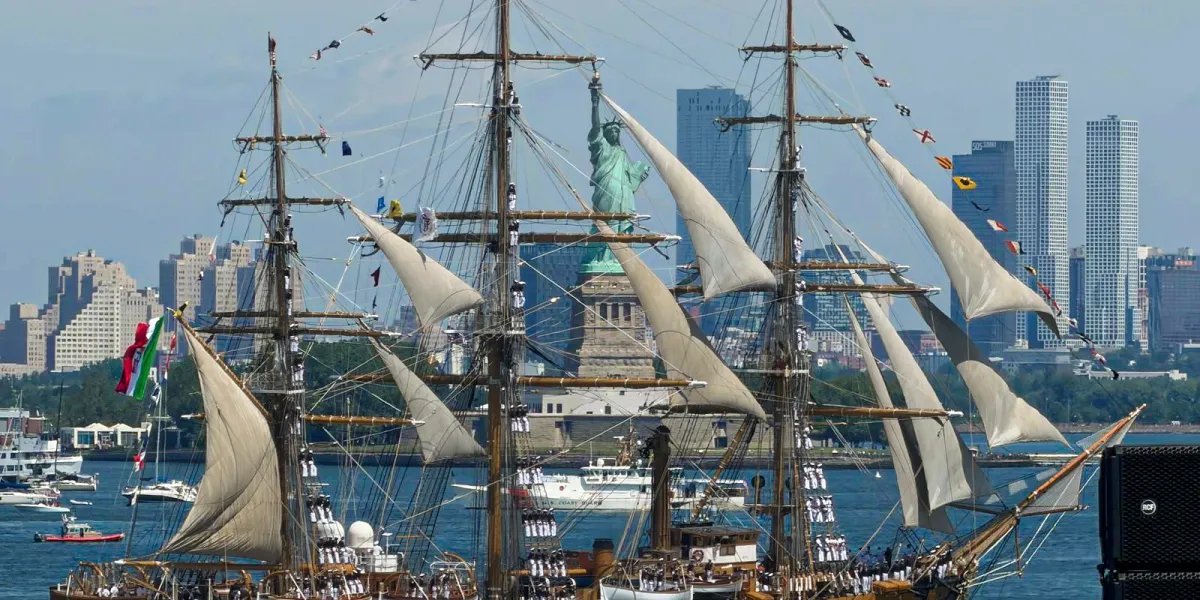
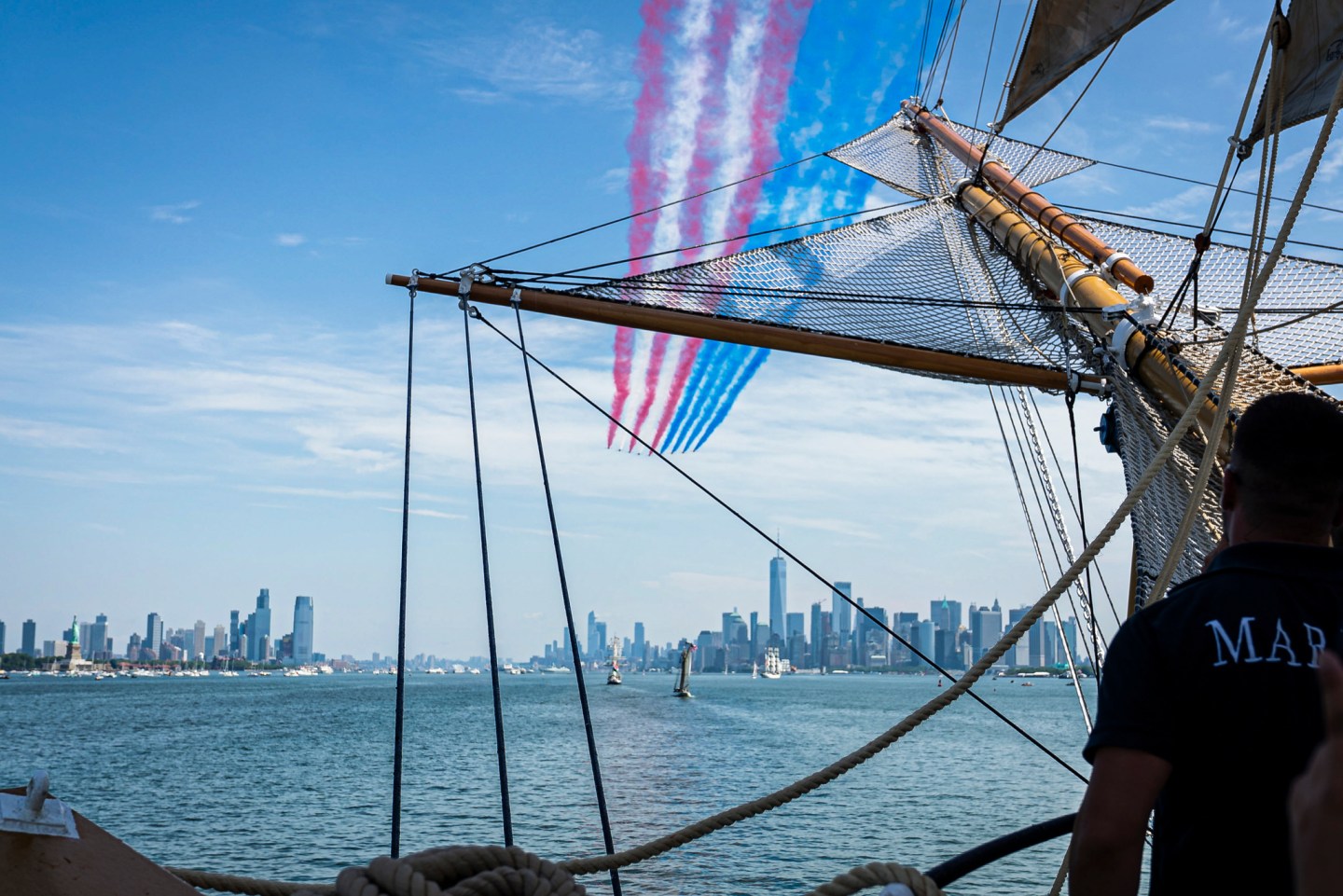
On July 4th weekend, the America’s Cup—sailing’s oldest trophy, first won by a New York yacht in 1851—returned to the Hudson River for the first time in nearly two centuries. The Italian Navy’s historic 1931 tall ship, the Amerigo Vespucci, known internationally as “the most beautiful ship in the world,” carried the Cup to New York’s harbor as part of the 250th-anniversary Sail4th naval review. Standing beside it was Marzio Perrelli, a year into the job as the first-ever CEO of the America’s Cup Partnership, and a man who spent 25 years actively avoiding sports for a living.
“I’m here because there was this big event for the 250th anniversary, and the Amerigo Vespucci was here, so we brought the Cup on it,” Perrelli told Fortune in the equally ornate teak woodwork and hand-carved ornamented lobby of New York’s Algonquin Hotel, just days after the storied ship entered New York’s harbor. “That was an opportunity to bring the Cup back to New York, where everything started almost two centuries ago.”
Copyright by Amerigo Vespucci, Courtesy of the America’s Cup Partnership
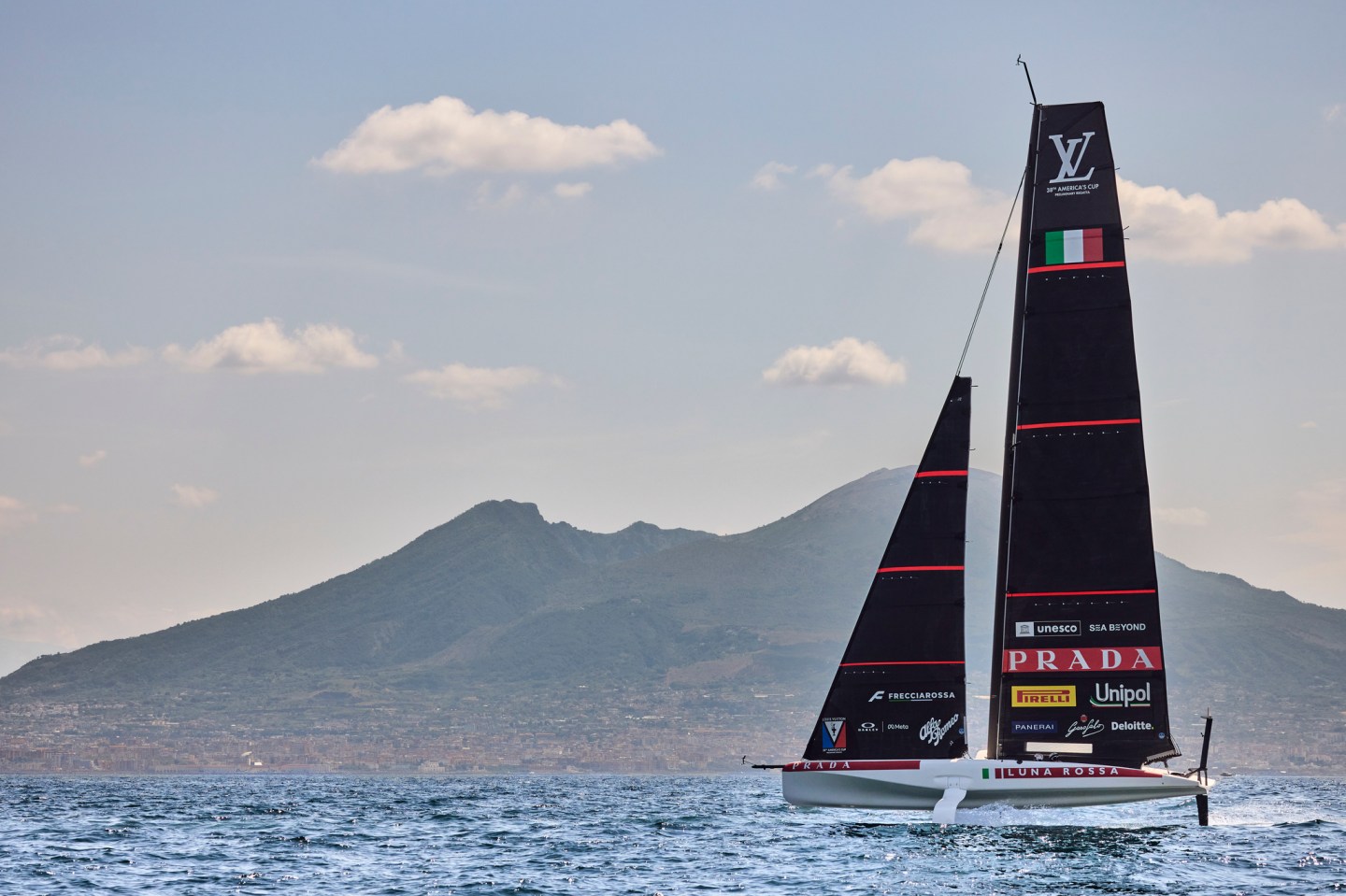
That symbolism is present all throughout the weekend’s naval festivities, and even like the Cup itself. Much like the Algonquin’s Beaux-Arts facade, the Vespucci’s gun-deck styling and figurehead carvings are more about signaling tradition than serving a practical purpose. And that symbolism runs even deeper with the America’s Cup: Nearly a century after she was built in Naples’ own Castellammare di Stabia shipyard, the ship will carry the Cup back to where it was created in Naples, where the America’s Cup is set to take place this time next year.
For Perrelli, it’s precisely that kind of symbolism that attracted him to the job in the first place, and is how he’s coming to handle a sporting event—complete with 175 years of maritime heritage—while stepping in as the first CEO in its history.
“I understand how important the heritage is,” Perrelli told Fortune as he and the authored switched between Italian and English throughout the chat. “At the same time, it’s the oldest competition in the world, but it’s also start-up, because it’s a new government, it’s a new era.”

Courtesy of the America’s Cup Partnership
From Goldman’s training class to Sky Sport
Perrelli’s path to the Cup runs through three decades in finance and media. He joined Goldman Sachs’ New York training program in 1993, spent time in London, then opened the firm’s Milan office. He spent 11 years at Goldman in total before moving to run HSBC’s Italian business.
His pivot to sports came almost by accident: At a dinner in Paris tied to the Ryder Cup’s Italian organizing committee, he ran into an old London contact who then ran Sky Italia, Italy’s satellite TV platform that’s now owned by Comcast. Two weeks later, Sky’s chief called and asked him to run Sky Sport Italia. It was an immediate yes from Perrelli, who stayed on for eight years before the America’s Cup Partnership came calling.
“Sports: It’s a sector of finance,” he said. “You have banks, private equity, family offices, all these kinds of people involved in the sports industry. And the media side is really relevant as well. I guess it’s a perfect mix. Today’s sports is very much related to both the financial industry and the media sector.”
For 175 years, the Cup’s reigning champion, known as the Defender, unilaterally ran the event, from the boats to the venue and even the rules. But that all ended in December 2025, when five founding teams—Emirates Team New Zealand, Britain’s Athena Racing, Italy’s Luna Rossa, Switzerland’s Tudor Team Alinghi, and France’s K-Challenge—formed the America’s Cup Partnership, a shared governance structure. Perrelli was interviewed and selected by all five founding teams collectively.
“It was the decision of moving from the Defender to the America’s Cup Partnership,” Perrelli said. “That was the key element. I ended up interviewing with all the the challengers, who were founders. And after a few interviews, I was asked to join the partnership.”

Courtesy of the America’s Cup Partnership
A 175-year-old winner-take-all sporting monarchy, for the first time in its history, installed an independent, outside operator that was chosen by its rivals, not its champion. (Currently, the Royal New Zealand Yacht Squadron is the defender).
“The mindset of the teams has to change, because now they need to think as a whole, not just as individuals. Before, it was very egoistic: You focus on you, you don’t care about the other guys. Now they need to start thinking about the overall platform. If the platform grows, each team benefits economically.”
A big bet on Naples
The Partnership’s first full cycle under the new structure culminates in Naples in 2027, the first America’s Cup ever held in Italy. It’s also a bet that pairs the regatta with the long-stalled redevelopment of Bagnoli, the former industrial waterfront outside the city. Independent estimates from Italy’s Unimpresa Research Center put the immediate economic return at roughly €700 million, with €1–2 billion in impact over the following five to ten years. By comparison, Barcelona’s 2024 edition of the regatta generated a reported €1 billion-plus in regional GDP impact.
Perrelli thinks Naples should outperform Spain’s results.
“I don’t have the numbers from Barcelona in front of me, but I guess the economic impact will be bigger in Naples, just because Barcelona already had a lot of events,” he said, “not only the Olympics—but plenty of other things, while for Naples, this is one big event.”

Copyright Luna Rossa | Studio Borlenghi, Courtesy of the America’s Cup Partnership
He’s watched the buildup already reshape the city’s posture toward the race: “Napoli is waiting for the event and receiving the teams as they land. It will be almost a one-year stay for these guys and their families. The investment from the government is huge, because the legacy will be extremely important. I’s not a couple of interventions here and there, it’s one big side of the city being reborn.”
Naples 2027 will also mark a first in the Cup’s history: all four nations that have ever held the trophy—the U.S., New Zealand, Switzerland, and Australia—competing in the same edition.
But that fourth nation’s presence was not guaranteed. American Magic’s exit and a second US bid’s collapse briefly left the 2027 field on track to be the first America’s Cup in history without a U.S. entry. That’s until Czech billionaire Karel Komárek and British entrepreneur Chris Welch backed a new campaign, the American Racing Challenger, led by Ken Read.
“That was crucial,” Perrelli said of the U.S.’ entry. “You can’t have an America’s Cup without an American team. Doesn’t make sense.”
Copyright Luna Rossa | Studio Borlenghi, Courtesy of the America’s Cup Partnership
Putting the oldest trophy in sport on the calendar
Perrelli’s broader pitch for the Cup’s future sounds less like sailing heritage and more like league-commissioner logic: fixed scheduling, predictable venues, a biennial cycle.
“You can’t disappear for too much time. It has to be calendarized, like all other serious sports,” he said. “You know when the next Ryder Cup is, the next Formula One Grand Prix, the next Olympics, the next World Cup. We should know when the next America’s Cup is happening.”
“If you think about the Monaco Grand Prix, you go there not only for the race but for everything else around it. I think the America’s Cup should become a bit more like that: the place to go, the place to be. It doesn’t last one day, it lasts three months,” he continued. “Room for rivalries, parties, sports events, social events. That’s the way I see the America’s Cup transforming.”
Naples 2027 will carry a few firsts meant to signal that shift: two fleet races for the first time in Cup history, a mandatory female sailor on each five-person AC75 crew, and a rotating “guest racer” seat that Perrelli likens to sitting beside Lewis Hamilton mid-race in a Ferrari.