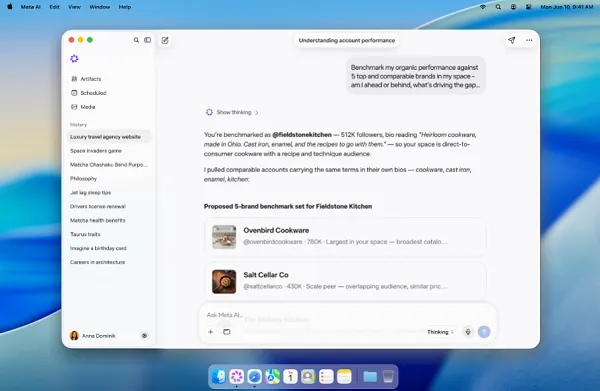
Meta released a Mac version of its Meta AI app, providing another access point to its evolving artificial intelligence assistant tools.
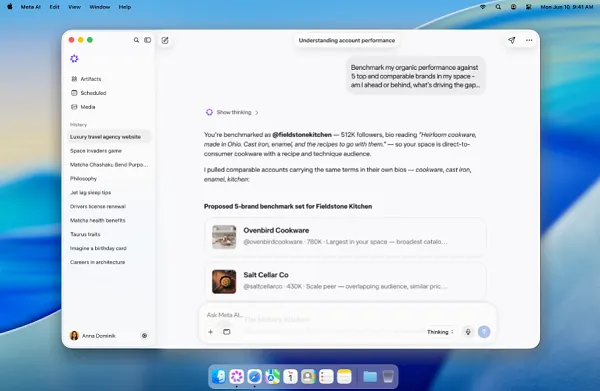
The new Mac-specific iteration of Meta AI includes all the features of the mobile app, giving desktop users an option to directly integrate its AI assistant chatbot into their workflow.
As explained by Meta: “With the new Mac app, you can share a window during a session to show what you’re working on, and it responds with tailored advice to the work in front of you. You can also use built-in dictation that works across all apps on your Mac.”
The app will work with the functionality of Macs to deliver a more organic AI experience, feeding Meta’s AI-powered responses into the system flow.
Meta said that the app will enable business owners to ask Meta AI questions about their business, “and get answers drawn from the context only Meta has, like your account engagement and ad performance.”
The system will also integrate publicly available insights about comparable brands, and show how they are building their presence on Meta, providing direct comparison and benchmarking insights.
“You can also prompt Meta AI to use information from your business info and the web to create decks, docs, and spreadsheets you need to keep your business growing,” Meta said. “And, you can let Meta AI handle work you’ve been doing manually by setting up recurring tasks and reminders to stay up to date on how your business is doing.”
It’s another step towards monetization of Meta’s AI offerings, with the company now working to build more business-specific use cases and tools for Meta AI, in order to help brands get started with its assistant tools.
Eventually, Meta will guide business users away from its free AI tools to its paid subscription offerings, and the company hopes that the utility of its AI systems will prove so valuable to business managers that paying for access will be a logical step.
Indeed, Meta said in its launch post that while the Meta AI mobile and desktop app are free to get started with, “businesses that want to use them even more will be able to subscribe to Meta One.”
In line with Meta’s now familiar business approach, the company wants to build tools that users find increasingly valuable, then charge for access once they’ve come to rely on them.