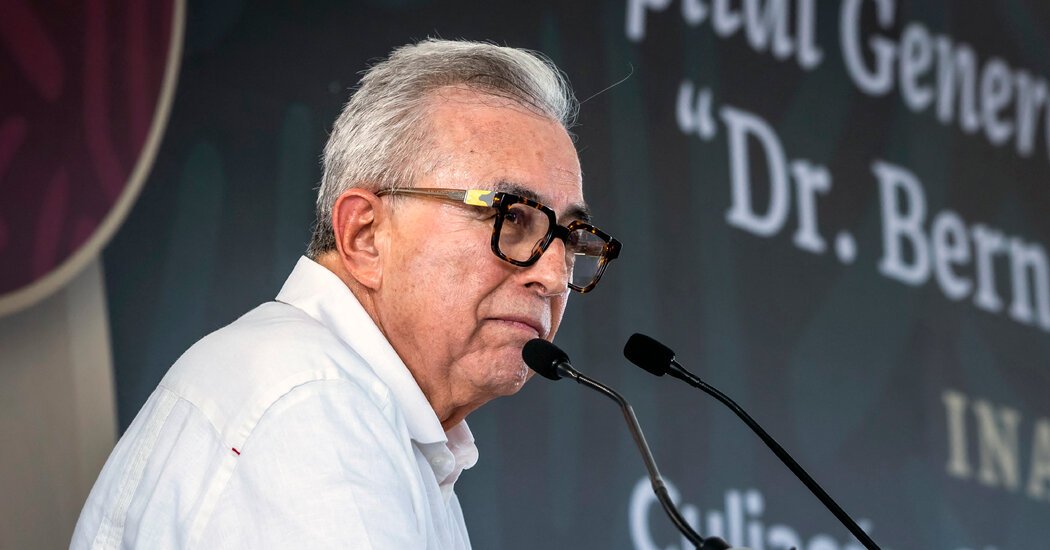
The governor of the Mexican state of Sinaloa — who returned to office on Friday despite accusations by U.S. prosecutors that he had conspired with a cartel — reversed course on Saturday after widespread criticism, particularly from members of his own party.
The governor, Rubén Rocha Moya, said in a social media post on Saturday night, about a day and a half after returning to office, that he had requested an indefinite leave of absence.
In April, U.S. prosecutors unsealed an indictment accusing Mr. Rocha and nine other current and former Mexican officials, including a sitting senator, of taking part in a broad conspiracy to help the powerful Sinaloa cartel traffic drugs into the United States. A few days later, he stepped down — the first time.
The indictment set off a scandal in Mexico and drove a new wedge between the U.S. and Mexican governments.
Mr. Rocha has denied wrongdoing and called himself the victim of a political attack. But his return drew opposition within his own party, Morena, including from Mexico’s president, Claudia Sheinbaum. Hours before Mr. Rocha’s announcement on Saturday, Ms. Sheinbaum, a leader of Morena, wrote on social media that public servants should not place personal ambition above the well-being of the people. She criticized what she called “the naked ambition of power for power’s sake.”
“Mexico deserves public servants who understand that positions are temporary,” she wrote, “but responsibility to the nation is eternal.” Although she did not mention Mr. Rocha by name, it was widely interpreted in Mexico as a criticism of his return to office.
Others in Mr. Rocha’s party were more pointed. Governors and senators from Morena released statements saying that he had acted alone and stressing the importance of respecting an active investigation. Ricardo Monreal, an influential Morena politician who had supported Mr. Rocha, called on him to go back on leave.
In the U.S. indictment, prosecutors accused Mr. Rocha of accepting bribes and help in getting elected in exchange for protecting the cartel, which has terrorized his state and Mexico for years. Ms. Sheinbaum has repeatedly said that her government is not protecting the governor, but has also called for more evidence from U.S. officials and supported Mexican’s investigation into the accusations. Mexican officials said in April that the United States had not provided sufficient evidence to support its request for Mr. Rocha’s extradition.
Mr. Rocha, 77, is the highest-ranking member of Morena, Mexico’s dominant left-wing political party, to be indicted by the United States. The case against him is the Trump administration’s most significant public step in cracking down on the corruption that it says is at the heart of Mexico’s cartel problem.
When he took leave after the indictment, Mr. Rocha said he wanted to participate in the Mexican government’s investigation as an “ordinary citizen,” without the immunity afforded to his office Experts said on Friday that returning to office restored his constitutional immunity.
With his departure one day later, he has presumably lost it again.