

primeimages/E+ via Getty Images
Dear clients and fellow shareholders:
The S&P 500 gained approximately 2.3% during the third quarter, bringing its year-to-date return to approximately 12%. Beneath the headline numbers, however, the advance has been far narrower than the index suggests. Almost half of the stocks in the S&P 500 have actually declined in the first nine months of the year, while the median stock gained only about 4%.
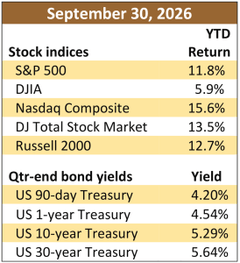
The stocks in our equity portfolio increased approximately 4% in the first nine months of the year. Your equity return may differ from these figures due to legacy positions, liquidity needs/constraints, and/or rounding.
Artificial intelligence continues to be the defining story of 2026, driving market gains while raising growing questions about the risks and potential returns of the enormous investment behind it.
Given that AI remains the market’s central preoccupation, much of this letter is devoted to questions surrounding its growth and implementation.
Even with its early-stage applications still rapidly evolving, the value of AI is already obvious in any tasks that benefit from the assimilation and manipulation of massive amounts of information. The productivity gains and benefits it ultimately delivers will almost certainly make the first 35 years of the Internet age seem downright sluggish in comparison, which helps explain the race to spend as much on AI infrastructure as possible, as quickly as possible. But at some point, investors will demand evidence that these expenditures can generate returns that justify their massive cost. And given the sums involved, those returns will need to be enormous.
The major hyperscalers (including Amazon, Microsoft, Alphabet, Meta, and Oracle) are now expected to collectively spend approximately $1.2 trillion on capital expenditures in 2027 and another $1.4 trillion in 2028. By some estimates, AI-related investment accounts for roughly 30% of U.S. GDP growth and nearly half of S&P 500 earnings growth this year. The scale of the investment is extraordinary, but whether the eventual returns will justify the capital committed remains to be seen.
The risks associated with financing this expansion are becoming more apparent. CoreWeave (CRWV), an AI cloud computing provider that rents computing power to companies such as Microsoft (MSFT) and OpenAI (OPENAI), has financed much of its rapid buildout through borrowing. In mid-October, yields on some of its bonds surged above 15%, reflecting growing investor concern about the debt required to fund a massive data center buildout well before the profitability of those investments has been established. According to Barclays, $37 billion of the $80 billion of data center bonds issued this year have been rated junk, or below BBB, roughly twice the percentage of total issuance that was rated junk in 2025.
The semiconductor industry has been a particularly powerful driver of equity returns, with the S&P Global Semiconductor Index rising approximately 95% through the first three quarters of the year. Stripping out semiconductors reduces the S&P 500’s year-to-date return from 12% to a modest 2-3%.
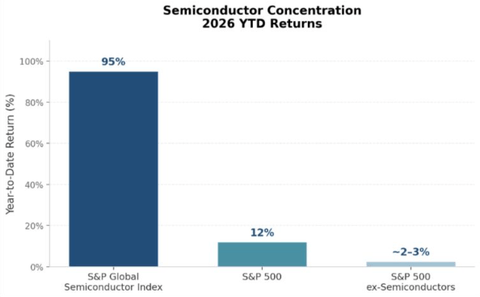
Demand for AI infrastructure has strained the supply of memory chips, pushing prices, margins, and earnings sharply higher. Gross margins across the semiconductor industry are near their highest levels in decades, while S&P 500 memory companies are generating gross margins of roughly 80%, more than twice their historical average.
There is, however, a significant difference in the economics (and accounting) between the companies supplying memory chips and other critical components for the current AI investment boom and the companies purchasing that equipment to operate their data centers. Memory producers have already benefited from skyrocketing prices and improved margins as supply has tightened. Their customers, however, the hyperscalers, have committed enormous sums to data centers, servers, networking equipment, and other infrastructure without yet knowing what returns those investments will generate.
The true economic costs of these expenditures aren’t evident in the companies’ earnings data. (This explains why Meta, a highly profitable company on a GAAP basis, recently disclosed that its long-term forecast showed it needed to “raise hundreds of billions of dollars over the next several years beginning as early as fall 2026.”)
Because much of this hyperscaler spending is capitalized and depreciated over the useful lives of the assets, its full effect on reported earnings is delayed. Memory producers report surging profits today while their customers recognize the associated costs over years. This helps explain the enthusiasm for memory stocks, but it also makes extrapolating current profits dangerous. Today’s exceptional margins may simply reflect a temporary imbalance between supply and demand rather than a sustainable level of profitability.
The same uncertainty applies to the economics of the underlying AI models. Open-source AI models are improving rapidly and gaining market share, putting pressure on leading providers such as OpenAI and Anthropic (ANT) that charge premium prices for proprietary models. Businesses may increasingly have access to capable models at little or no licensing cost, making it harder for AI model providers to maintain pricing power and earn attractive returns on the enormous sums invested in training and computing infrastructure. (Anthropic’s recent draft IPO prospectus disclosed more than $600 billion in future computing and infrastructure commitments, a staggering sum compared to the $16.3 billion in revenue it generated in the first half of 2026.) Cheaper models could accelerate AI adoption, but the benefits may accrue primarily to customers through lower prices rather than to the companies developing the technology. (There is already a model for this: the Internet Bubble. The first stocks to enjoy massive price increases in the late 1990s were companies providing basic Internet infrastructure and backbone, but businesses that utilized the Internet ultimately garnered the bulk of the operating benefits from the technology.)
Falling token prices create a related challenge. Tokens measure the text and other data processed or generated by AI models, and many services charge customers based on their consumption. Industry data show that token prices have recently come under pressure as lower-cost models gain share and competition intensifies. Lower prices encourage greater usage, but they also reduce revenue generated from each unit of usage. Model providers must generate enough additional demand to offset this pricing pressure, while infrastructure providers must earn sufficient returns on the chips, data centers, electricity, and networking equipment needed to serve that demand. We have little doubt that AI adoption will continue to accelerate, but that alone does not guarantee attractive returns for the companies currently investing heavily to support it.
The uncertainty about who will ultimately capture the value created by AI is one reason we have continued to avoid direct investments in the space, although we own businesses that stand to benefit from its development and adoption. The technology will certainly prove transformative, but which businesses will capture the most value, how long their competitive advantages will last, and whether the returns will justify the enormous amounts of capital invested to date remain open questions.
Our process is built around investing in businesses whose future economics we can assess with a high degree of confidence – and then buying their shares when the price offers a meaningful discount to our estimate of value. Applying that discipline has led us to avoid direct investments in AI, not because we doubt the technology’s potential, but because we have yet to find opportunities where we can confidently underwrite the economics and justify the price. We do not need to predict every technological winner or participate in every market trend. Our job is to invest when the underlying business economics and the price offer a compelling opportunity, and to remain patient when they do not.
Portfolio addition: Tencent Music (TME)
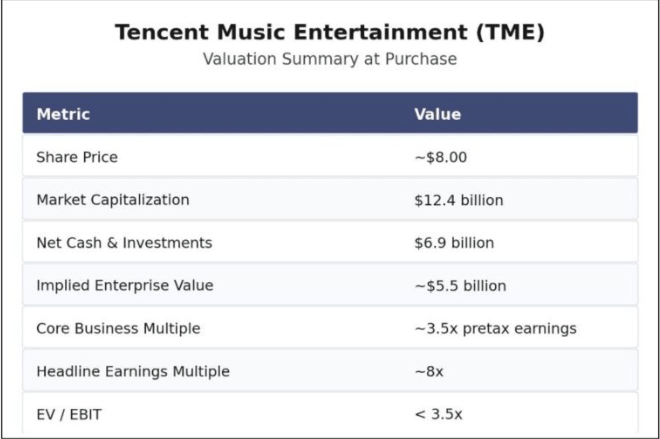
In addition to our August purchase of Inter & Co (INTR) (which we discussed in our full report), our other portfolio addition during the quarter was Tencent Music Entertainment (TME). TME develops and operates music streaming services, primarily for the Chinese market. (Tencent Music is separate from the more well-known Chinese Internet giant, Tencent Holdings (TCEHY), although Tencent Holdings owns roughly 53% of Tencent Music.) At approximately $8.00 per share, TME has a market capitalization of $12.4 billion and trades at roughly 8 times earnings. That headline multiple, however, fails to reflect the substantial amount of excess cash the company carries on its balance sheet. After subtracting its $6.9 billion of net cash and investments, we paid roughly 3.5 times pretax earnings for the core operating business.
We believe the market is valuing TME as a declining music-streaming application when, in reality, it is a high-margin, subscription-driven entertainment platform with a dominant ecosystem, substantial financial assets, and a long runway for growth. The market’s pessimism is understandable. Total monthly active users (MAUs) have declined, the company’s legacy Social Entertainment business has contracted, and competitor Soda Music has grown rapidly. But we believe investors are focusing on the wrong metrics. A shrinking user base does not necessarily mean a declining business when the users who remain are becoming substantially more valuable. TME is shedding its least profitable users – casual listeners whose unit economics are vastly inferior to paying subscribers.
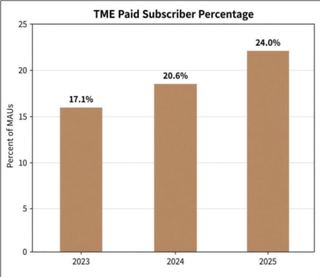
The platform’s user base can loosely be divided between those who pay for a subscription and those who do not. (Consider Spotify, for example: only 39% of its user base pays for a subscription.) Since its December 2018 IPO, TME’s actual paying music subscribers have increased from approximately 34 million to 127 million, and the percentage of users paying for a subscription has risen from 6% to 24%. Not only has the subscriber count expanded rapidly, the average revenue per paying user has increased 5% annually.
Music Related Services revenue has grown roughly 25% annually and now represents more than 80% of TME’s business, with significantly better economics than the Social Entertainment division.
In fact, Music Related revenue has grown faster than Spotify’s in recent years, despite TME trading at a fraction of Spotify’s multiple. TME also operates with much higher margins than Spotify. In 2025, TME reported a 44.2% gross margin, compared with 32% for Spotify, a difference of more than 1,200 basis points. Spotify sits largely at the end of a value chain dominated by Universal, Sony, and Warner, which accounted for 72% of its label-delivered music streams in 2025. TME benefits from a more fragmented domestic copyright market: China’s five largest record companies accounted for less than 30% of music-copyright sales in 2025, giving TME greater negotiating leverage and more flexibility in how it acquires and monetizes music.
This bargaining power shows up in TME’s financial statements. Music-related revenue grew 22.9% in 2025, while Service costs, which include royalties and revenue-sharing fees, actually fell 5.2%, demonstrating the operating leverage available in a business with growing subscription revenue and improving content economics.
TME also benefits from advantages beyond its music catalog. As part of the broader Tencent Holdings enterprise, it can leverage distribution across platforms serving more than one billion WeChat users, reaching new users while reducing reliance on expensive customer acquisition. And TME isn’t just a distributor paying royalties to record labels. Through the Tencent Musician Platform, self-produced music now accounts for more than 30% of streams. The company develops artists, organizes live performances, and partners with major labels through joint ventures, creating monetization opportunities beyond subscriptions. (Non-subscription music revenue grew 39.2% in 2025 and live performance revenue continues to grow rapidly.) These initiatives give TME greater control over its ecosystem and help it capture more of the value generated by the artists and content it develops.
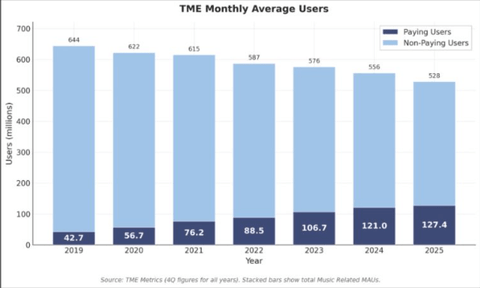
Tencent Music’s biggest competitive concern is Soda Music, ByteDance’s free music app, which recently reached 160 million MAUs. The market is treating Soda’s growth as a major threat to TME’s economics, but the platforms target different cohorts. Soda skews toward younger users and monetizes free listening through advertising, while TME offers a deeper catalog, including many top-charting tracks unavailable on Soda, plus membership perks like spatial audio, exclusive artist experiences, and priority access to live concerts. Soda’s growth may look threatening, but free listeners aren’t the same as paying customers, and TME’s premium business remains healthy. Paid music subscriptions in China also have a long runway for growth, leaving room for the industry to expand even as competition intensifies. (Chinese online music paying penetration is 24% compared to well over 50% in mature Western markets.)
TME’s recent acquisition of Ximalaya, China’s leading long-form audio platform, also expands the company’s addressable market and creates another opportunity to improve profitability. TME paid approximately $2.4 billion for Ximalaya, adding audiobooks, podcasts, and other spoken-word content to its ecosystem. Although Ximalaya currently operates at low-single-digit operating margins, its gross margins exceed those of TME’s legacy business, leaving substantial room to meaningfully increase operating margins through the integration of distribution and monetization.
TME is controlled by Tencent Holdings, an experienced technology operator, and management’s historical repurchases suggest an appreciation for the gap between price and value. TME bought shares at approximately $6.90 in 2023 and $10.80 in 2024, then paused repurchases for five quarters as the stock doubled. In Q2 2026, it resumed buying aggressively, repurchasing $400 million of stock (more than 100% of quarterly earnings) at an average price of $9.20. Management expects to use the remaining $600 million under its existing $1 billion repurchase authorization and is “already considering what comes next.” TME has also issued $1 billion of debt, with repurchases identified as a potential use of proceeds. At today’s valuation, buybacks are an especially attractive use of capital.
Tencent Music’s investment portfolio includes stakes in Spotify and Universal Music worth $2.8 billion, representing more than 20% of its current market cap. With TME’s relationships with Spotify and Universal Music well established, these holdings are no longer strategically necessary. UMG’s recently announced plans to sell part of its Spotify stake provide a precedent for monetization. TME holds these investments through entities in jurisdictions with favorable capital-gains treatment, allowing monetization with minimal tax leakage. Selling the stakes to fund buybacks at current prices would be highly accretive.
For a dominant, asset-light platform with growing recurring revenue and increasing returns to scale, Tencent Music is absurdly cheap. At approximately 8 times expected 2026 earnings and less than 3.5 times enterprise value-to-EBIT, the market is currently pricing in a substantial deterioration to the business.
Our valuation does not assume a return to peak growth or a premium multiple. Even if Music Related Services growth slows to the mid-single digits, TME can approach $2 billion in annual earnings by 2029 with only 250 basis points of margin expansion. Applying a 12x multiple to that earnings power implies a value of approximately $15 per share, nearly 90% above our purchase price, before assigning any incremental value to the company’s excess cash and investments. Share buybacks could drive further upside. If TME retires approximately 5% of its shares annually, 2029 EPS could reach roughly $1.47. At 12 times earnings, that equates to approximately $17.60 per share, an annualized return of roughly 31% over three years.
Editor’s Note: The summary bullets for this article were chosen by Seeking Alpha editors.