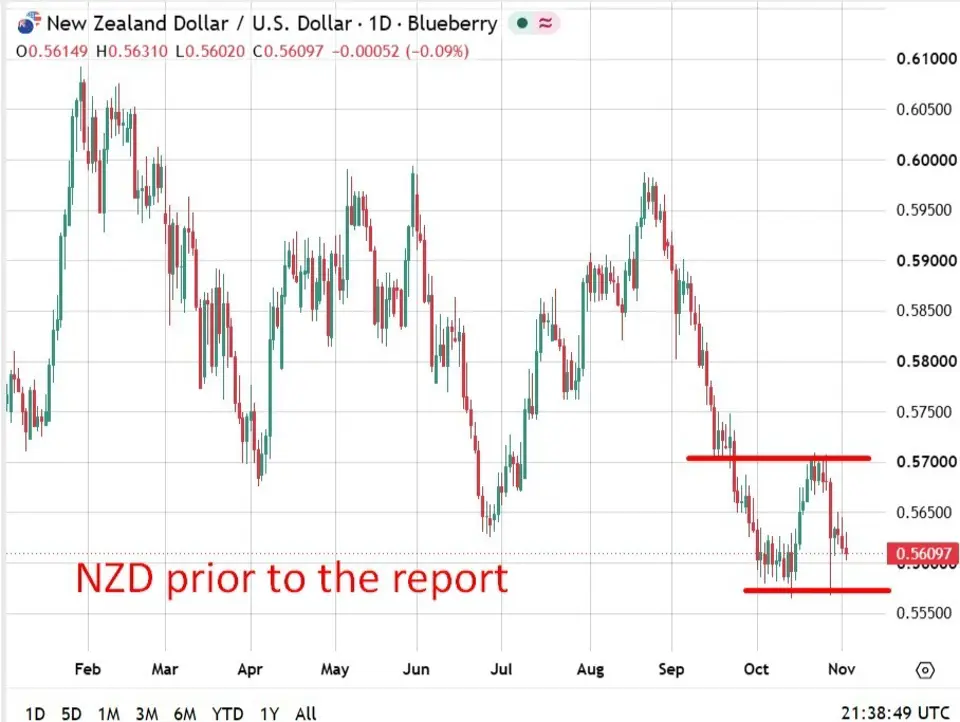
The miss on every major measure is likely to weigh on the New Zealand dollar and trim pricing for a December rate hike. The kiwi was already near a cycle low against the Australian dollar after last week’s RBNZ hold, and the gap with a more hawkish RBA now looks set to widen. The weak jobs figures argue against tightening, but the RBNZ’s hawks have focused on core inflation and fuel costs. A labour market miss alone may not settle the debate, so inflation expectations surveys later this month carry extra weight. Front-end swap rates are the market to watch for how far hike bets are pared.
—
Banks called the peak in New Zealand unemployment, but the labour market went the other way, and the RBNZ’s December hike now looks a harder sell.
Summary:
- Unemployment rose to 5.7% in Q3 from 5.6%, against a Reuters poll forecast of 5.5%
- Employment fell 0.1% on the quarter, against expectations of a 0.4% gain, and Q2 growth was revised down to 0.3%
- The participation rate dropped to 70.4% from 70.6%, below the 70.7% forecast
- Private sector wages excluding overtime rose 0.4% on the quarter and 2.0% on the year, both slightly below forecasts
- The RBNZ held rates at 2.75% last week on a 4:3 vote, with the next decision on 9 December
- New Zealand holds a general election on Saturday
New Zealand’s unemployment rate rose to 5.7% in the third quarter, above expectations of 5.5%, as employment unexpectedly fell and wage growth slowed, data from Statistics New Zealand showed on Wednesday.
Employment declined 0.1% from the previous quarter, against a Reuters poll forecast of a 0.4% gain. The participation rate dropped to 70.4% from 70.6%, below the 70.7% expected. Unemployment rose even though fewer people were looking for work, which points to weak hiring rather than a growing labour force. Earlier figures were also revised lower, with second-quarter employment growth cut to 0.3% from 0.5%.
The result runs against bank forecasts that had pointed to a peak in joblessness. Westpac had expected the rate to ease to 5.5%, while ANZ had forecast no change at 5.6%. The June quarter reading of 5.6% was already the highest since 2015.
Wage pressures also eased. Private sector wages excluding overtime rose 0.4% in the quarter, below the 0.5% expected, taking annual growth to 2.0% from 2.1%.
The data lands at a sensitive moment for the Reserve Bank of New Zealand. On 28 October it held the official cash rate at 2.75% in a 4:3 vote, surprising markets that had largely priced a hike. The majority cited weaker than expected inflation, stable inflation expectations and subdued wage growth, and argued that two earlier rate increases needed time to work. Wednesday’s figures support that case on both jobs and pay.
Westpac had described today’s release as the first key input before the RBNZ’s next decision on 9 December, while still forecasting a hike at that meeting. The bank cautioned that the move was not a done deal, and a weaker labour market makes that case harder to argue.
New Zealand holds a general election on Saturday, adding further uncertainty to the policy outlook ahead of the December meeting.