How did you meet your closest friends?
I just spent a weekend in Orange Beach, Ala., with the same group of friends that I met in August 1987, on my first day of college.
And what bound us together? It wasn’t politics. We fight about that. It wasn’t religion. We fight about that, too. We’ve been friends for a more powerful, more elemental reason — most of us lived on the same dormitory floor our first year of college.
In a few weeks, I’ll host another gathering of close friends, people I text with every day. What do we have in common? Not a lot, except for the fact that we served together for almost a year in Iraq.
I’m a Southern evangelical conservative and a recovering Republican. One of my closest friends from those months downrange is a progressive Mexican American immigrant who’s a former Mormon, former Catholic and present agnostic who says he worships the Hubble Space Telescope because “it sees farther than any man.”
We haven’t explored whether he’s switched his allegiance to the James Webb Space Telescope since it sees farther still, but I suppose he doesn’t want to switch religions again.
Rather than spend paragraphs waxing on about the power of these friendships, citing the considerable social science showing that close friendships enhance our lives in measurable ways, I thought I’d simply quote a Swedish proverb that I love to mention: Shared joy is double joy. Shared sorrow is half sorrow.
I’m thinking about all this because I just finished watching one of the best shows about friendship that I’ve ever seen.
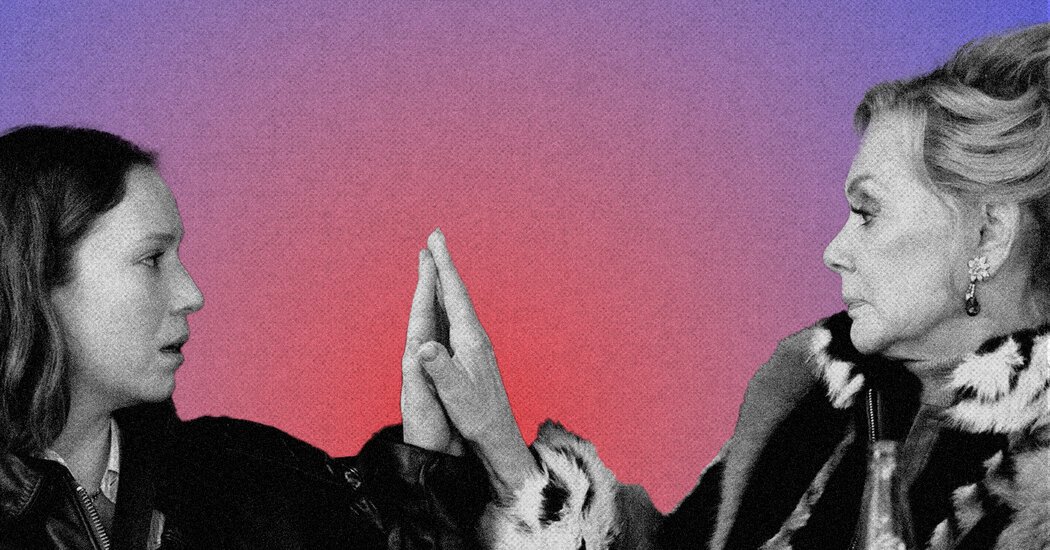
It’s called “Hacks,” and its final episode aired last week on HBO Max. It stars Jean Smart as Deborah Vance, an aging comedian with a residency in Las Vegas who is forced to update her fading act, and Hannah Einbinder as Ava Daniels, a young comedy writer who’s struggling to find work.
In the first episode this unlikely pair decides to work together, and the rest of the series hinges on their relationship.
Deborah is decades older than Ava, she’s extremely wealthy, and if she has any particular ideology, it’s summed up in the phrase, “Offend everyone.” Ava, by contrast, is very much younger and very much poorer, and her politics are so comically progressive that she was once delighted to find out that a guy she liked was also a prostitute.
Sex work is real work, she argued, though she pulled away when she found out he was also an aspiring magician — her tolerance had limits.
At first, I took the series as little more than escapism. It was funny, the stakes were low, and it was a nice way to lighten the evening after living through days that could feel very heavy.
But then, as the series progressed, I realized that I was watching something much better than a classic odd-couple comedy (though that is a tried-and-true formula). You might even call it socially subversive. It defies the spirit of our atomized, individualized age.
Deborah and Ava are both ambitious. They’re both conniving, and the story starts as a kind of workplace rivalry. Both women are in the relationship for their own purposes. These two mismatched people fight, separate, reunite, fight again, and then, yes, fight some more.
At first, the show seems dead-set on putting their conflicts at the center, and you’re not sure if the emerging grudging respect is real. At the end of Season 3, Deborah lands her dream job as the host of a late-night comedy show, and Ava blackmails her way into the head writer’s job.
But by that time, the conflict started to seem forced. It was clear that the two women liked each other too much to sustain their hatreds, and by the end of the show the dynamic had shifted entirely. The story line wasn’t Deborah versus Ava, but rather the two of them against the world.
My news-side colleague Catherine Pearson wrote an insightful piece focusing on that element of the show alone, rightly noting that the very structure of American life is making those relationships difficult to form and sustain.
As my friends and I watch our parents age, we’re noticing that older people are often treated as invisible. This is not a news flash, but age is no longer a marker of wisdom; for some, in this “OK boomer” age, it’s an object of contempt: You are the ones who wrecked our world. You are the ones who refuse to get out of the way.
One thing that makes the show so powerful is that the friendship blossoms without either woman becoming like the other. You’re not compromising your values when you love a person different from yourself.
In fact, it’s easy to become a worse person when you live in a carefully cultivated ideological or theological cocoon. In “Hacks,” however, the opposite happens. Deborah softens some of her hard edges. Ava becomes less arrogant and more aware of her own self-righteousness.
They still maintain their essences, however. They’re still Deborah and Ava, and the real change they made is they decided that they loved each other. They were no longer focused only on themselves.
They started to treasure their quirks. They made sacrifices for each other (in Season 4 Deborah even quit her late-night show rather than fire Ava). And, above all, they decided to be, well, present — to be together even when (as the finale showed) they had deep differences on matters of life and death.
In fact, as the show illustrates, concentrating on differences and even mutual interests is a bit beside the point. The question isn’t “How much are we alike?” Rather, it’s “Can I appreciate and even love the person you are?”
At the beginning, they had one thing in common — they were both funny. At the end that was still the only thing they truly shared, other than a life together, and their unbreakable bond.
Twenty years ago, I had a conversation that changed how I saw friendship.
I was at a meeting of pastors and other evangelical leaders in Manhattan, and Tim Keller, who was then the pastor of Redeemer Presbyterian Church in Manhattan, said something that predicted much of our current social malaise.
“I’m noticing a change in the young people in my church,” he said. “They once could disagree about important things and remain friends. Now they can’t.”
Political disagreements pulled them apart. So did theological disagreements. Where differences were once a source of curiosity and even enjoyment, they were now deal-breakers. Their disagreement with you was proof of their low character, and who wants to be friends with bad people?
The last two decades have proven Keller right. Friendships are fracturing over politics. Last month, a study by Mertcan Güngör and Peter Ditto, two psychologists at the University of California, Irvine, found that 37 percent of Americans report having lost relationships over political differences.
A 2024 American Enterprise Institute study found that friendship itself is on the decline, with the decline reaching crisis status for Americans without a college degree. A stunning 24 percent of Americans who have a high school diploma or less report having zero close friends. Zero.
That same year, the American Immigration Council and Over Zero, a group dedicated to combating identity-based violence, released a revised version of their Belonging Barometer, which measures whether Americans feel “emotionally connected, welcomed, included and satisfied in their relationships.”
It found that most Americans feel a sense of exclusion or ambiguity (non-belonging) in their workplaces, communities and in the nation. It found that a distressingly high percentage felt a sense of non-belonging even in their families (40 percent) and friend groups (44 percent).
Human connection isn’t just a matter of personal enjoyment; it’s critical to our health and sense of well-being. As the Belonging Barometer notes, a lower level of belonging “was associated with the more frequent experience of physical and emotional pain, stress and loneliness. Conversely, experiencing greater levels of belonging was associated with reporting greater life satisfaction and better general health.”
In other words, shared joy is double joy. Shared sorrow is half sorrow.
In May, I appeared on HBO’s “Real Time With Bill Maher,” and I had the chance to talk about the sense of non-belonging, of exclusion and loneliness, that is plaguing this nation. “I’m going to sound like a kindergarten teacher,” I told Maher. “You want to know how to help heal our country? Make a friend.”
“But specifically,” I said, “try to make friends in the communities that don’t feel like they belong in this country.”
That advice was applauded by the studio audience, but it went over like a lead balloon online. I understand. When it feels as if the Constitution is hanging by a thread, a conversation about friendship and belonging can feel like a distraction at best and misdirection at worst.
But we can do two things at once — we can fight through the emergencies of the moment, and we can try to understand and address the deep pain and alienation that helped bring us to this terrible moment.
One of the most encouraging things in contemporary pop culture is the emergence of shows centered on deep friendship, profound connection and the value in persisting in relationships even in the face of serious differences and sometimes even deep pain.
Not just “Hacks” but “Shrinking,” “The Bear” and “Ted Lasso,” to name a few. In many ways they all tell the same story.
We’ve been worrying about polarization for years, and now we’re experiencing its bitter fruit — to the point where even close friendships can fracture beyond repair. But that’s precisely what makes shows like “Hacks” so crucial. Treat them as comedic refresher courses in relationships. The kinds of friendships that once emerged naturally can still be cultivated intentionally.
And if you don’t know how that can happen, or hold the idea in contempt, I’d suggest watching two fictional comedians demonstrate a profound truth about relationships — odd couples can still survive and even thrive, so long as you decide to love others at least as much as you love yourself.
Some other things I did
My Sunday column was about a cheery topic: Why are we repeating so many mistakes from the recent past? From a land war in Europe to tariffs, to Gilded Age-style corruption, to flirtations with communism and fascism, to rising antisemitism, it’s as if we’re running a repeat of the last century’s worst ideas. What is going on?
The answer lies in part in the interplay between two political sayings that are so oft-repeated that they have become clichés. When they should be top of mind, though, they seem to have lost their impact.
Here’s the first (and you can probably say it along with me), from George Santayana in 1905: “Those who cannot remember the past are condemned to repeat it.” We can argue about the precise historical parallels, but the echoes of the past are everywhere.
Here’s the second, from Winston Churchill in 1947: “It has been said that democracy is the worst form of government except all those other forms that have been tried.”
It is no coincidence that authoritarianism is once again appealing to people at a time when two things are happening at once. Liberal democracies are struggling to meet the needs of a substantial portion of their citizens, and entire generations have come of age with no living memory of the totalitarian horrors of the 20th century.
In other words, millions upon millions of people are enduring democracy as “the worst form of government” without the necessary balanced understanding (that citizens in the mid-20th century had gained through firsthand observation) of “except all those other forms that have been tried.”
Thanks for reading. You will soon start to get my columns emailed to you too.
If you’re enjoying what you’re reading, please consider recommending it to others. They can sign up here.