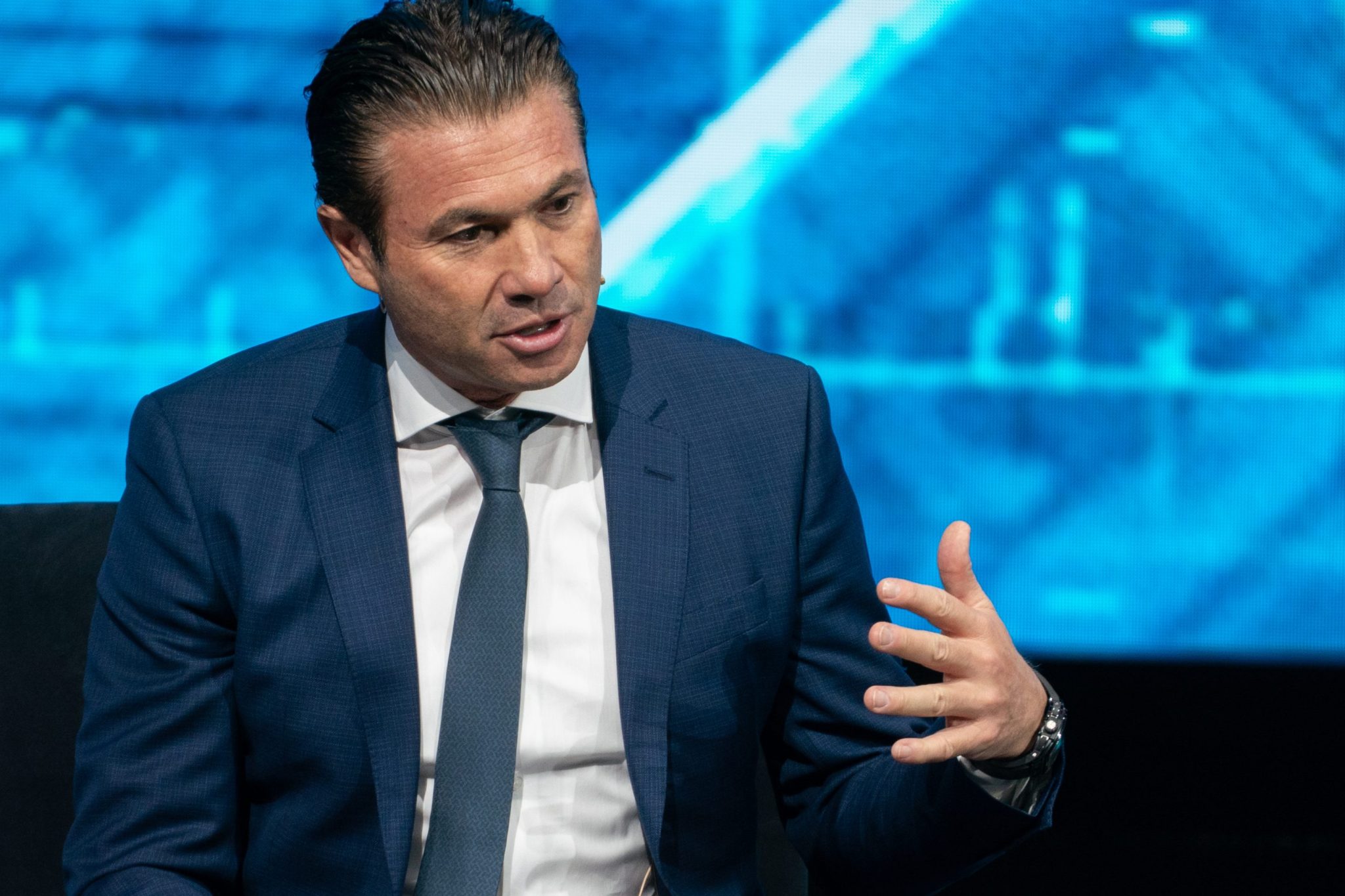
Following the event, Humain’s CEO Tareq Amin posted on LinkedIn to say that he was “looking for a few exceptional individuals” to join the company as it prepares to launch an IPO.
Top-tier management consulting experience, strong financial and strategic depth, and experience in investor-facing strategy and IPO preparation are among the key areas of expertise Amin is searching for.
Amin first mooted the IPO plan last October, saying he hoped to do a dual listing in both Saudi Arabia and New York by 2029.
Meanwhile, Amin announced last week that the company is also looking to tap global and local investors to raise a $2.5 billion fund to finance a new wave of data center expansion across the kingdom, Bloomberg reported.
The fund will help finance data center capacity of 250 megawatts (MW) that Humain is developing in partnership with Al Moammar Information Systems, one of the largest IT companies in Saudi Arabia. The project could eventually be expanded to up to 1 gigawatt (GW).
The moves come amid an ongoing drive by the $900 billion Public Investment Fund (PIF) to rein in capital spending among its portfolio companies and scale back its giga projects.
In August last year, PIF disclosed an $8 billion writedown on its flagship giga projects, reducing their share of the fund’s total assets from 8% to 6%.
Humain’s IPO plans come as Saudi companies have pulled planned listings amid concerns over market volatility and expectations of weak demand due to the ongoing U.S.-Iran war.
In June, Mutlaq Al Ghowairi Contracting announced it was postponing its offering of a 30% stake, which could have raised up to $800 million and made it among the largest IPO in the region this year.
The road to listing may also prove challenging for Humain, given that companies that have pursued dual listings historically face higher compliance costs and more demanding reporting obligations.
However, the wave of deals signed at LEAP last week showed growing confidence amongst investors that Riyadh will become the region’s AI capital.
You can read my article here on the opportunities and challenges facing the future development of Saudi’s AI industry.
Melissa Hancock
As ever, thanks for reading, and do keep in touch with your thoughts and ideas.
melissa.hancock@fortune.com
UAE drives MENA’s August startup funding rebound
MENA startup funding more than doubled in August, reaching $375 million across 27 deals—a 117% increase from July and an 11% rise year on year.
But the uptick was highly concentrated, with Moove’s $250 million Series C funding round alone accounting for two-thirds of total funding, according to tech accelerator Wamda.
Moove, a mobility fintech company founded in Nigeria, officially achieved unicorn status last month following the funding round, which was led by Abu Dhabi sovereign wealth fund, Mubadala Investment Company.
The total deal count fell 40% month on month, underscoring the extent to which August’s funding performance was driven by a handful of large transactions.
The UAE reclaimed its lead as MENA’s most richly funded startup ecosystem, surpassing Saudi Arabia, which topped the regional rankings in July.
UAE startups raised $362 million across 13 deals, capturing nearly 97% of the region’s total capital deployed during the month.
Saudi Arabia came a distant second, with just six startups raising a combined $10.25 million.
However, the overall composition of MENA funding last month was encouraging, with debt accounting for around 2% of total capital in August, compared with 56% the previous month.
“August offers evidence that investors remain willing to deploy substantial equity into select MENA companies,” noted Wamda.
“But it does not yet indicate a broad-based recovery. September’s deal flow will show whether the rebound can extend beyond megadeals and translate into wider investor participation.”
The gender funding gap remains stark, with male-founded startups accounting for more than 96% of total capital deployed, raising $361 million across 22 deals.
Female-founded startups secured just $8.5 million across two transactions, while mixed-gender teams attracted $5.5 million through three deals.
Qatar posts widest budget deficit in almost a decade
Qatar’s budget deficit hit a decade-high of QAR21.2 billion ($5.8 billion) in the second quarter as the Gulf state’s LNG exports plummeted amid the ongoing blockade on the Strait of Hormuz.
According to the finance ministry’s latest budget report, the deficit has almost doubled since the first quarter, when it stood at QAR10.3 billion ($2.82 billion).
Before the onset of the U.S.-Iran war in February, Qatar supplied around one-fifth of the world’s LNG, but the war has knocked a sizeable hole in its export capacity, which plummeted from around 20 million tons a quarter last year to less than 2 million in the second quarter, according to Bloomberg.
Qatar has largely halted LNG shipments through Hormuz since one of its tankers was struck near the strait in July.
Unlike its Gulf neighbors, Saudi Arabia and the UAE, Qatar has no alternative shipping routes to bypass the strait, thereby preventing its vessels from reaching international buyers.
At the end of August, state-owned Qatar Energy was forced to extend force majeure into October for its Asian buyers, and into November for European buyers, which includes Italian energy company Edison Spa.
However, on Tuesday, a Qatari LNG tanker transited the Strait of Hormuz and reached the Gulf of Oman, marking the first visible movement of Qatar’s LNG through the strategic waterway since July, according to ship-tracking data compiled by Bloomberg.
A resumption of exports would offer much-needed relief to buyers in Asia and Europe. Benchmark European gas prices climbed to €75 ($87) per megawatt hour (MWh) last week, more than double their level a year ago.
Global investment giants fuel 54% AUM surge for Abu Dhabi’s financial center ADGM
Assets under management at Abu Dhabi’s ADGM financial center increased by 54% in the first half of 2026, compared with the same period last year, underscoring the center’s growing appeal to key players.
Asset managers that established operations in ADGM during the first half of 2026 collectively oversee more than $2.1 trillion in assets globally.
The number of fund and asset managers increased 23% to 190 by the end of June, while funds managed rose 32% to 276.
During that time, ADGM has attracted a number of high-profile firms, including tech-focused U.S. private equity company Vista Equity Partners, Man Group, Barings, Bain Capital, and Cantor.
In late August, crypto exchange Coinbase announced it had chosen ADGM as its “international tokenization hub” as it looks to bring more traditional financial assets onto the blockchain.
Last week, Swiss derivative investment company Adapt Investment Managers, which manages $2 billion in client assets, opened an office at ADGM, as it looks to expand its global footprint.
It joins fellow alternative investment manager, Blue Owl, which set up shop in ADGM in June. The $315 billion private credit provider has attracted considerable controversy this year after investors rushed to withdraw roughly $5.4 billion from two of its flagship funds—ultimately forcing it to cap withdrawals at 5% of shares.
Ahmed Al Zaabi, chairman of ADGM, commented that the scale of growth was “advancing our ambition to become among the world’s top-five leading international financial centers”.
The Big Number
$3.25 billion
The total value of five and 10-year international sukuk that Saudi issued last week, marking its first external debt sale during the war. The sukuk attracted roughly $16.5 billion of orders.
The 3 things we enjoyed reading this week
- Last month, the Trump administration launched “Operation Economic Outcast”, a package of sanctions aimed at forcing countries around the world to sever any remaining financial ties to Iran. Yet, billions of dollars of Iranian funds are flowing through clearing accounts at American banks each year, according to Western officials and researchers. The Trump administration has reportedly encouraged U.S. institutions in private meetings with bank compliance officials to better monitor Iranian money flows. But such flows are difficult to detect and cut off given that Iran uses an intricate web of correspondent banks, front companies and other means to disguise the transactions.
- On Tuesday, Qatar’s PM Sheikh Mohammed bin Abdulrahman Al Thani wrapped up a two-day China visit that officials said marked the start of a “golden decade” between the two countries. Beijing pledged to coordinate more closely with Qatar to help de-escalate the Iran war, and Qatar committed to prioritizing China’s energy supply, despite regional disruptions. Qatar supplied 19.4 million tonnes of LNG in 2025, making it China’s second-largest supplier. The visit also expanded cooperation in AI, advanced manufacturing and renewable energy, reflecting Doha’s push toward “broader horizons” with Beijing even as it maintains its security partnership with Washington.
- The 35th edition of the Abu Dhabi International Book Fair kicked off on Sunday this week and promises a packed program, with around 1,500 events spanning literature, poetry, music, art, history, and space diplomacy. Highlights will include a discussion on Miguel de Cervantes’ influence on the modern novel and a talk from International Prize for Arabic Fiction winner Said Khatibi on his novel Swimming Against the Tide. Other sessions cover the late Egyptian artist Inji Efflatoun, Bahraini musical legacy through singer Salman Ziman, the ninth-century Blue Quran, and the UAE’s use of space diplomacy. The fair runs until September 18.