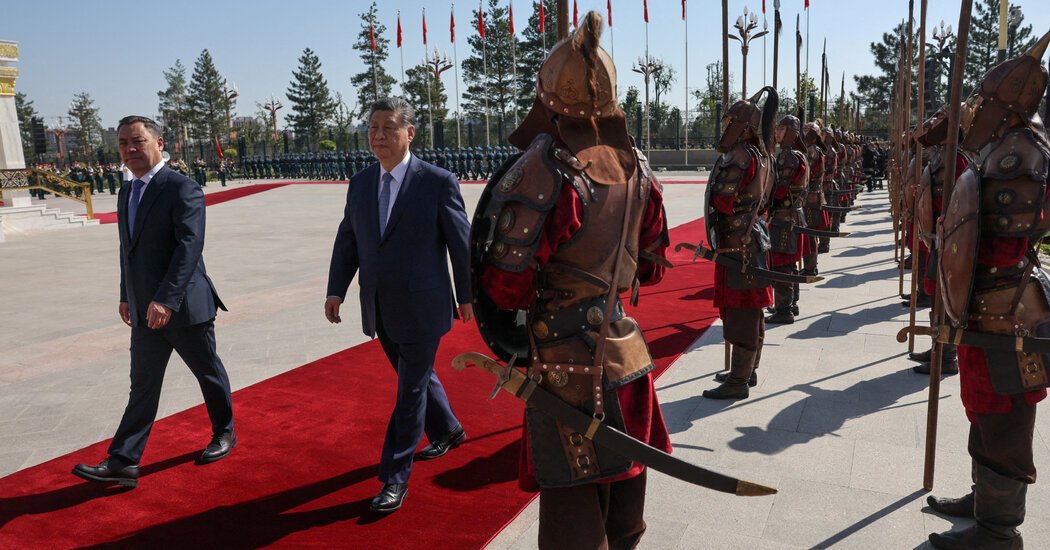
As the leaders of China, Russia, India, Iran and other nations converged on Central Asia for a two-day summit beginning on Monday, one thing was clear from the outset. Even as President Trump tries to bend the world to revolve around Washington, Xi Jinping of China has his own powerful orbit.
The Chinese leader’s arrival in Bishkek, the capital of Kyrgyzstan, for a meeting of the 10-nation political and security grouping known as the Shanghai Cooperation Organization underscored Mr. Xi’s broad ability to sustain Washington’s foes, both in peacetime and in war.
The talks come against the backdrop of two wars that have pushed the globe into a period of intense geopolitical instability, suppressing economic growth and driving up inflation. Those challenges were at the heart of discussions taking place simultaneously on the other side of the globe in Asheville, N.C., at a gathering of finance ministers from the Group of 20 countries.
The meeting in Bishkek, in contrast, was a showcase for the incredible leverage that the wars have given Mr. Xi.
No nation has been more critical to Russia and Iran in sustaining their economies and war efforts than China. Mr. Xi has undermined efforts by the United States and its allies to pressure Russia and Iran economically, employing Beijing’s vast geopolitical and economic clout as the world’s largest importer of crude oil and exporter of consumer goods.
Mr. Xi’s biggest rival, the United States, has been distracted by the war in Iran and has pulled some of its military forces from Asia and Europe. Last month, the Chinese leader was able to brush off threats by President Trump that the United States would inflict an “economic D-Day” on countries that provided Tehran with a lifeline. Mr. Trump once made similar threats about purchasers of Russian oil, but did not follow through with any actions against Beijing.
“After the past year, Trump has a fundamental credibility problem with Xi,” said Julian Gewirtz, who served as the senior director for China and Taiwan Affairs at the National Security Council during the Biden administration. “Both his threats and his assurances appear to Beijing, as another world leader put it, to be written in pencil.”
In Bishkek, Mr. Xi’s priority is to burnish his image as the leader of non-Western nations and to push back against what he calls U.S. hegemony. Despite that, he will most likely be cautious about how much support he publicly offers Iran.
The Chinese leader cannot afford to provoke Mr. Trump less than a month before he is scheduled to travel to Washington to attempt to extend a fragile economic truce between the United States and China. Before heading to the United States, Mr. Xi will travel to Egypt and India for state visits.
The series of trips leading up to his summit with Mr. Trump is aimed at casting Mr. Xi as a powerful statesman at a time when Mr. Trump has frayed U.S. relations globally, analysts said.
“Xi appears to see an opportunity to show that China has friends and options around the world at precisely the moment Washington is alienating many of its allies,” Mr. Gewirtz said.
This week’s summit in Bishkek is a reminder of the limits of U.S.-led economic warfare. President Vladimir V. Putin of Russia and President Masoud Pezeshkian of Iran, both critically reliant on China, arrived in the Kyrgyz capital on Monday as they work to defy Western efforts to isolate them and persevere with their own wartime goals.
Beijing has largely obliged, extending economic lifelines to both Moscow and Tehran and leveraging its economic clout to the frustration of Washington.
While Mr. Xi’s power is on the rise, there are limits to it. Though the Shanghai Cooperation Organization is partly a security grouping, Beijing has been unwilling to deploy its military to defend members such as Iran, which joined the organization in 2023, or Russia, instead formally calling for dialogue and an end to the conflicts.
Mr. Xi does not want to be entangled in foreign wars, analysts have said, viewing them as one of the primary reasons the United States has seen its power wane over the decades. But Beijing is willing to increase trade and provide technologies that can be used on the battlefield.
The Chinese leader met with Mr. Putin for bilateral talks in Bishkek on Monday, praising what he called ever-brighter prospects for relations between China and Russia.
Mr. Putin, in turn, highlighted the success of visa-free travel between the two nations and said he was ready to make the arrangement permanent. The Russian leader noted that the first scheduled voyage of a Chinese container ship passed through what is known as the Northern Sea Route in mid-August, presaging broader cooperation in the Arctic.
Whether Mr. Xi meets with the Iranian leader separately from the summit will indicate how much the Chinese leader is willing to push the line ahead of the scheduled visit to the United States.
Though it once counted only Russia, China and four Central Asian nations as members, the Shanghai Cooperation Organization expanded in 2017 to include India and Pakistan and more recently added Belarus and Iran. In the process, it has become a growing counterpoint to Western-led political and security groupings.
Some of the leaders gathering for the summit in Bishkek have helped Mr. Putin continue his war against Ukraine, which is now in its fifth year, and aided Iran in its attempt to weather a monthslong onslaught by the United States.
Not long after Mr. Putin launched the all-out invasion in 2022, Iran supplied Russia with Shahed drones and helped Moscow establish domestic production facilities for the weapons.
Central Asian nations have become critical import and payment routes for Russia, as Moscow works its way around Western restrictions. Iran has turned to Central Asia as an alternative import route amid a U.S. blockade.
India, Kazakhstan and Belarus are among the countries that have stepped in to ship gasoline to Russia in recent weeks as Ukrainian long-range strikes have decimated Russian oil refineries.
India emerged as one of the biggest purchasers of Russian oil in the aftermath of Mr. Putin’s invasion. Though its imports dropped following pressure from Mr. Trump and new U.S. sanctions on Russian oil giants, the U.S. war against Iran roiled oil markets and pushed Indian suppliers to turn once again to imports from Russia. China is the biggest importer of Russian and Iranian crude.
Mr. Xi’s relationship with Mr. Putin is increasingly one-sided in Beijing’s favor. Western sanctions related to Russia’s war with Ukraine have enabled China to stockpile discounted Russian oil, cushioning the blow of a blockade in the Strait of Hormuz.
Even the site of this week’s summit highlights China’s growing hand over Russia. Once a Soviet republic, Kyrgyzstan had been firmly within Moscow’s sphere of influence. But China’s influence in the Central Asian nation has grown, and the five nations of Central Asia have banded closer together in response to Russia’s war against Ukraine.
In opening remarks before a meeting with President Sadyr Japarov of Kyrgyzstan on Monday, Mr. Xi said relations between Beijing and Bishkek had “made a leap forward” and that cooperation was “flourishing across all areas.”
On Monday evening, the leaders attended a lavish opening ceremony for the World Nomad Games, held in a newly built stadium in Bishkek and hosted by Mr. Japarov. Dancers and singers in traditional costume performed, as riders on horseback traversed a stage area ringed by bursts of fire.
When Mr. Xi arrives in the United States, Mr. Trump is likely to seek the Chinese leader’s cooperation on both Iran and North Korea, but it is not clear that China will oblige, Mr. Gewirtz said.
“Trump has painted himself into a corner,” he said. “The administration is struggling to square two seemingly irreconcilable goals: tightening pressure on Iran and maintaining its truce with China.”