
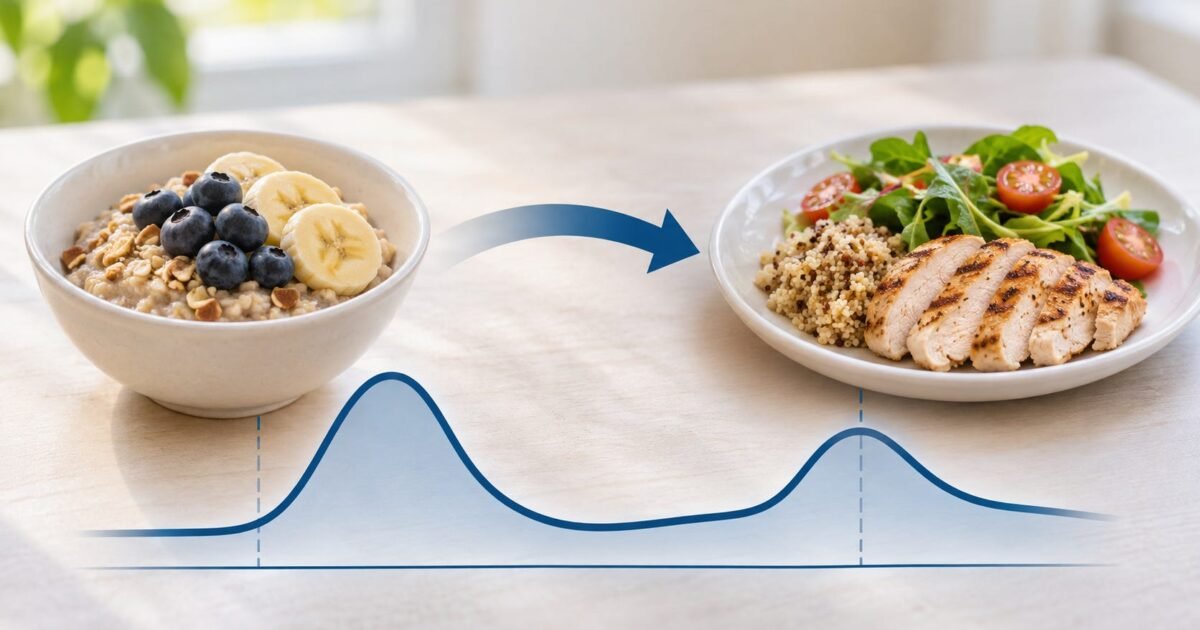
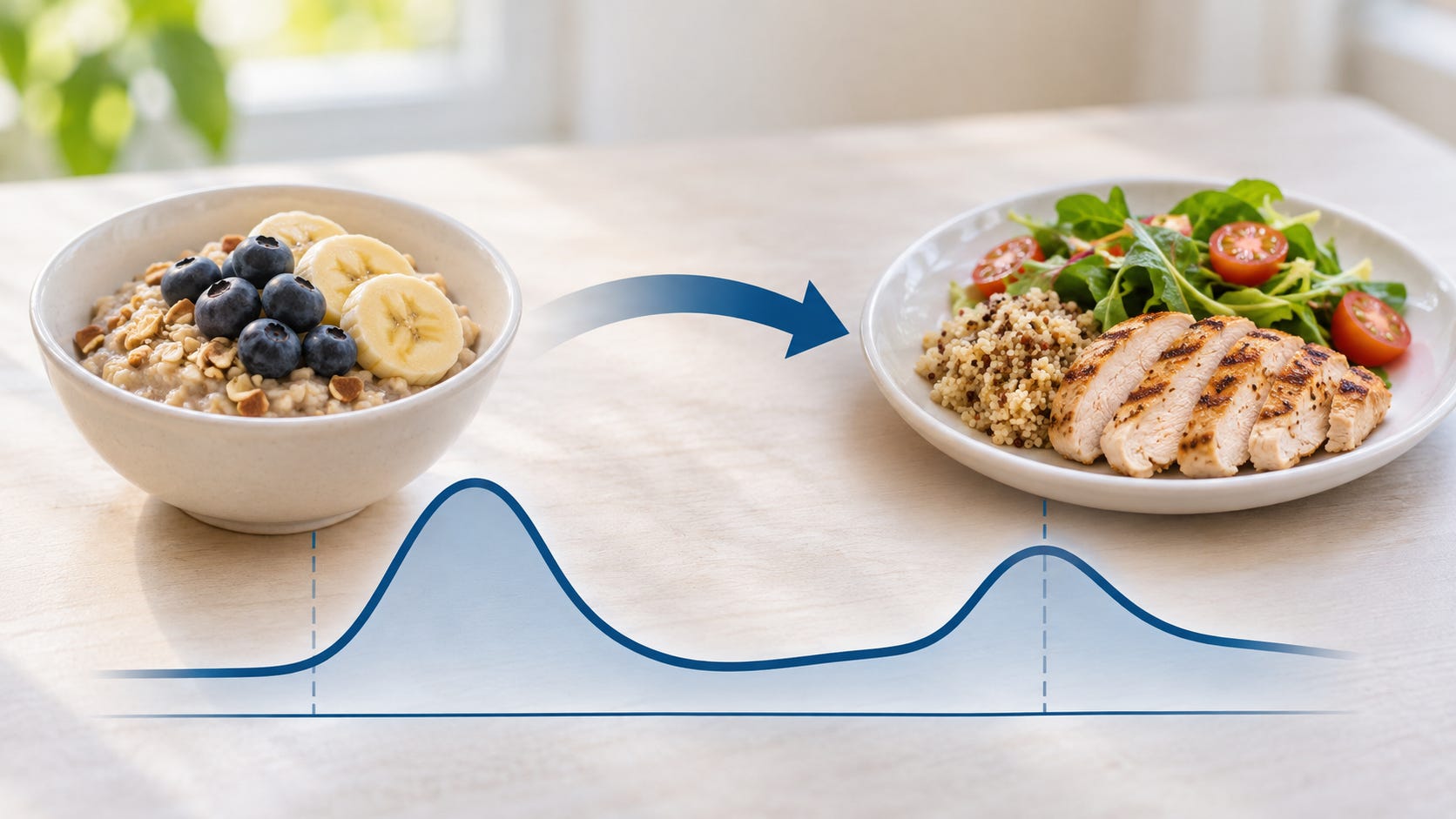
Most people think of meals as isolated events. You eat breakfast, your blood sugar rises and falls, and by lunchtime your body starts over.
But what if your breakfast is still influencing your blood sugar five hours later? Or what if tonight’s dinner affects how your body handles breakfast tomorrow morning?
This phenomenon is called the second-meal effect, and it reveals something important about metabolism: Your body remembers what you ate, even after the meal has been digested.
The question is how long that effect lasts, what causes it, and whether you can use it to improve your blood sugar control.
The evidence
In a 2006 study, ten healthy adults ate one of three different breakfasts. Five hours later, each ate the same lunch, containing 93 grams of carbohydrate.
The researchers wanted to know whether the composition of breakfast would affect how the body handled an identical lunch several hours later. It did. Despite eating exactly the same lunch, participants had different blood glucose responses depending on what they had eaten for breakfast.
The phenomenon was first described about a century ago and was later investigated by David Jenkins, who developed the glycemic index, in the early 1980s.
Repeated spikes in blood sugar after meals are associated with increased cardiometabolic risk, meaning a greater likelihood of developing conditions such as type 2 diabetes, heart disease, and stroke. If changing breakfast can improve the body’s response to lunch, it offers another way to manage blood sugar without necessarily changing lunch itself.
But why would a meal eaten five hours earlier still matter?
The mechanisms
Several biological mechanisms help explain the second-meal effect.
Free fatty acids. Between meals, adipose tissue (body fat) releases free fatty acids (FFAs) into the blood to fuel the body. Insulin suppresses that release after you eat. Elevated FFAs impair glucose uptake in skeletal muscle. A breakfast that keeps FFAs lower for several hours may therefore help your muscles process glucose more efficiently when lunch arrives.
Fermentable carbohydrates. In the 2006 study, one breakfast consisted of a rapidly digested, high-glycemic cake supplemented with lactulose, a fermentable carbohydrate. Lactulose works much like certain fermentable fibers found in beans, oats, onions, and bananas. Many of these fibers are also known as prebiotics because they feed beneficial gut bacteria.
Instead of being digested in the small intestine, lactulose travels to the colon, where gut bacteria break it down. This process, called fermentation, produces compounds that can help regulate blood sugar.
Despite the breakfast’s high glycemic index, participants had a better blood sugar response to lunch five hours later. Researchers linked this improvement to bacterial fermentation in the colon and lower levels of free fatty acids (FFAs) in the blood. High levels of FFAs can make it harder for the body’s cells to absorb glucose, so lowering them helps the body control blood sugar more effectively.
In other words, fermentable fibers eaten at breakfast may still be influencing how your body handles blood sugar hours later.
Hormonal priming. The first meal can also influence how the pancreas and digestive system respond to the next one. In adults with type 2 diabetes, breakfast appeared to prime the hormonal response to lunch: insulin and GIP, a gut hormone that helps stimulate insulin secretion, rose higher after lunch than after breakfast.
These mechanisms show why blood sugar regulation depends on more than just the content of your next meal. What you ate earlier can also influence the result.
Does protein have the same effect?
Trending: WAYNE ROOT: Las Vegas Oddsmaker with Best Record in Modern Media History Makes Final Midterm Predictions.
Protein is an important part of breakfast, but its benefits need to be distinguished from the second-meal effect.
When eaten with carbohydrates, protein can help moderate the glucose response to that meal, depending on the amount and composition of the food. But those benefits don’t necessarily carry over to the next meal.
In one trial of twelve adults with type 2 diabetes, a high-protein breakfast lowered post-breakfast glucose. It did not change lunchtime glucose compared with a high-carbohydrate breakfast.
Protein still belongs at meals. It increases satiety, supports lean mass, and improves the immediate glucose response. But the evidence for a second-meal benefit is weaker than the evidence for certain fermentable fibers and slowly digested carbohydrates, like lentils, chickpeas, beans, barley, and steel-cut oats.
Fat also affects how the body processes carbohydrates. It slows the rate at which food leaves the stomach, delaying carbohydrate absorption and often reducing the initial glucose spike. However, it can also prolong the glucose response, sometimes causing blood sugar to rise several hours later, particularly in people with diabetes.
Like protein, fat’s effects on the current meal don’t necessarily translate into better glucose control at the next one.
Can the effect last overnight?
Five hours is one thing. But can what you eat tonight influence your blood sugar tomorrow morning? Research suggests that it can.
Studies have found that certain low-glycemic evening meals, particularly those containing slowly digested or fermentable carbohydrates, can improve glucose tolerance at breakfast the following morning.
The mechanisms overlap with those seen during the day. Slowly digested carbohydrates and fermentation in the large intestine may influence free fatty acid levels and glucose metabolism long after dinner is over.
That suggests that the metabolic effects of a meal can persist for up to 16 hours, and sometimes longer, depending on the food and the interval between meals.
However, that does not mean every meal has a predictable 16-hour effect. The duration depends on the type of carbohydrate, the amount consumed, individual metabolism, and other factors.
The important takeaway is that your metabolism doesn’t necessarily reset when you go to sleep.
Should you skip breakfast?
The second-meal effect describes how one meal influences the body’s response to the next. It isn’t limited to breakfast and lunch. After all, it’s called the “second-meal effect,” not the “breakfast-lunch effect.”
The lesson isn’t that breakfast is mandatory; it’s that meals are metabolically linked.
If you practice intermittent fasting, which is eating within a compressed timeframe such as 11 am-7 pm, these findings are completely consistent. What you eat at one meal influences your glucose response not just for that meal, but for the next meal.
The bottom line
Most people already know the importance of limiting excess sugar, choosing carbohydrates carefully, and paying attention to blood glucose levels.
The second-meal effect adds another useful tool: understanding that what you eat at one meal can influence how your body processes the next.
Research has demonstrated this effect five hours after breakfast and even across an overnight fast. How much longer it can last, and under what conditions, is still being investigated.
Have a question for the GoldCare HealthDesk? Let us know here.
Richard Amerling, MD is Academic Director at GoldCare Health & Wellness. A longtime academic nephrologist at Beth Israel Medical Center and Associate Professor at Mount Sinai, he taught clinical skills at St. George’s University until 2021, when he was placed on leave for declining an experimental treatment. He then served as Associate Medical Director for America’s Frontline Doctors. He has written and lectured extensively against evidence-based medicine and rigid clinical guidelines, advocating independent clinical judgment.
Ad block users: Some site features may not work correctly while an ad blocker is enabled, because they break scripts and content this website depends on. If you can’t see comments below, for example, please disable your ad blocker.